








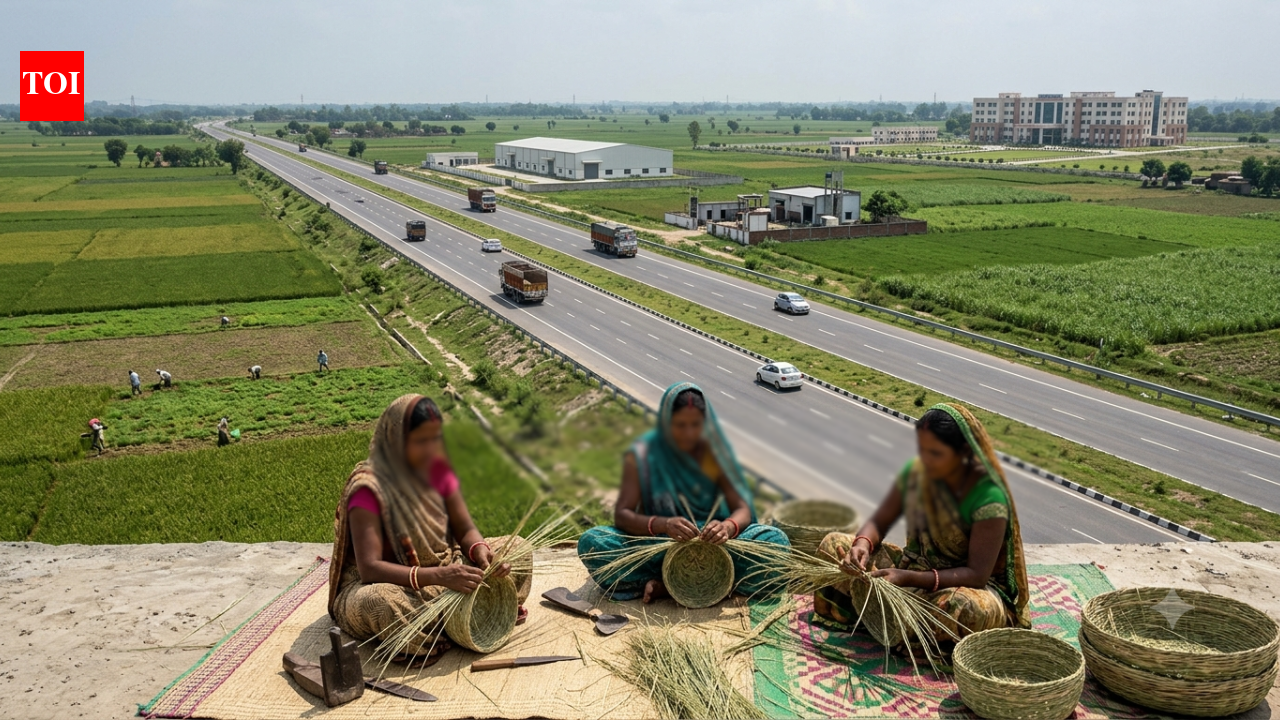
Sultanpur, a politically talked-about eastern-central district of Uttar Pradesh, has emerged as an important example of how infrastructure-led development can reshape the economic and social profile of a traditionally agrarian district. Sultanpur has historically depended heavily on agriculture, small trade and traditional occupations. However, the period since 2017 under Yogi regime has brought a visible shift in its development trajectory. Major expressway connectivity, new industrial possibilities, the promotion of traditional crafts, expansion of healthcare and medical education, and a fresh round of public investment have together begun integrating Sultanpur more closely with the wider economy of Uttar Pradesh.The transformation is significant because it is not based on a single project. Rather, Sultanpur’s development story reflects the convergence of roads, industry, rural enterprise, healthcare, education and public infrastructure. The district is increasingly being positioned not merely as a transit point between Lucknow and eastern Uttar Pradesh, but as a potential centre for investment, employment and services.Purvanchal Expressway: The new economic lifelineThe most visible symbol of Sultanpur’s transformation is the Purvanchal Expressway. Inaugurated in 2021, the expressway has fundamentally changed the district’s connectivity profile. Passing through Sultanpur, it has brought the region into a high-speed transport network connecting Lucknow with eastern Uttar Pradesh.For a district with a predominantly agricultural economy, improved connectivity has implications far beyond passenger travel. Farmers, traders and small businesses can now access larger markets with greater speed and predictability. Reduced travel time can help in the movement of agricultural produce and other time-sensitive goods, while improved logistics also makes the district more attractive for warehousing, food processing and other economic activities.The expressway has also changed perceptions about Sultanpur’s geographical location. Areas that were once considered relatively distant from major commercial centres are now connected through a modern corridor. The improved accessibility has generated greater interest in land and real estate near important interchanges and connecting roads.A particularly notable feature associated with the expressway in Sultanpur is the 3.2-kilometre airstrip near Akhalkiri Karwat village. Designed for emergency aircraft operations, it reflects the strategic importance of the corridor and adds another dimension to the district’s infrastructure profile.More importantly, the expressway has created the foundation for future economic activity. Roads by themselves do not automatically create industrialisation, but they reduce one of the biggest barriers to investment—high logistics costs. Sultanpur is now better positioned to convert its connectivity advantage into employment and enterprise.Industrial development along the expresswayThe next stage of Sultanpur’s transformation is expected to come from industrial development along the Purvanchal Expressway corridor. The state government’s efforts to develop industrial clusters and attract investment are particularly important for a district where a large section of the population has traditionally depended on agriculture or migrated in search of employment.Improved road connectivity can support manufacturing units, logistics centres, warehouses, food-processing enterprises and small and medium industries. Sultanpur’s location between the state capital and eastern Uttar Pradesh provides an additional advantage for businesses seeking access to a wider consumer market.The development of industrial infrastructure along the expressway has the potential to create employment opportunities closer to home. This is especially significant for young people who have traditionally had to move to Lucknow, Delhi, Mumbai or other cities in search of work. The larger objective is to create an ecosystem in which infrastructure attracts investment, investment creates jobs, and jobs increase local purchasing power. Over time, such a cycle can stimulate the growth of housing, retail, transport, education and other service sectors.ODOP gives traditional Moonj craft a new identityWhile expressways and industrial clusters represent the modern face of development, Sultanpur’s transformation has also involved strengthening its traditional economic base. Under the One District One Product programme, the district’s Moonj craft has received greater recognition and commercial support.Moonj is a locally available wild grass traditionally used to create a variety of handmade products. Rural artisans have long used it for making baskets, mats, decorative articles and other utility products. However, traditional crafts often remained confined to local markets and offered limited income opportunities.The ODOP initiative has helped bring greater attention to the craft as a potential source of rural entrepreneurship. The growing demand for eco-friendly and sustainable products has created new possibilities for Moonj-based items. With better design, packaging, marketing and market linkages, traditional craft can become a modern livelihood opportunity.This is particularly important for women and rural artisan families. Craft-based enterprises can often be developed with relatively low capital investment and can provide supplementary or independent income within villages. Organisations working with artisans have also contributed to skill development and the expansion of market opportunities.The promotion of Moonj craft demonstrates an important aspect of Sultanpur’s economic transition: development is not limited to attracting large industries. It also involves strengthening local skills and converting traditional knowledge into sustainable micro-enterprises.Healthcare and medical educationAnother major dimension of Sultanpur’s transformation has been the expansion of healthcare infrastructure. The establishment of the Autonomous State Medical College in Sultanpur marked an important step in improving access to advanced medical facilities and medical education.The medical college, with 100 MBBS seats, has created new opportunities for students from Sultanpur and surrounding districts. At the same time, the development of a teaching hospital and associated medical infrastructure is helping strengthen the district’s healthcare ecosystem. For decades, residents of smaller districts often had to travel to Lucknow, Prayagraj or other major cities for specialised treatment. The expansion of medical infrastructure within Sultanpur can gradually reduce this dependence and improve access to healthcare services.The proposed development of nursing education infrastructure is another important step. Healthcare requires not only doctors but also nurses, technicians and a wide range of skilled professionals. The expansion of medical and nursing education can therefore contribute both to better healthcare delivery and to the creation of skilled employment. This investment in human capital has a long-term economic significance. Educational and healthcare institutions generate direct jobs while also supporting hostels, housing, transport, food services and other local businesses.A fresh impetus through major development projectsThe momentum of Sultanpur’s transformation received a further boost in 2026 with a major package of development projects. In July, development works worth more than Rs 819 crore, involving the inauguration and foundation-laying of 99 projects, reinforced the scale of ongoing public investment in the district.Such projects cover the broader ecosystem of development, including infrastructure and public facilities. Their importance lies not merely in the immediate expenditure involved but in the assets they create for future growth. Improved roads, public buildings, educational facilities, healthcare infrastructure and other civic works can raise the overall quality of life while simultaneously supporting economic activity. Construction itself generates employment, while completed infrastructure improves the efficiency of businesses and public services.The latest investment push also reflects a broader strategy of ensuring that development reaches districts beyond the major metropolitan centres of Uttar Pradesh.Towards more diversified economySultanpur will continue to depend significantly on agriculture, but its economy is gradually acquiring new pillars. Better connectivity is expanding market access. Industrial development can create non-farm employment. ODOP is strengthening traditional livelihoods. Medical and educational institutions are building human capital, while public investment is improving the district’s physical and social infrastructure.The real success of this transformation will depend on how effectively these different elements are integrated. The Purvanchal Expressway must lead to industrial investment. Industrial investment must translate into employment for local youth. Traditional artisans must receive sustained market access. Healthcare and educational institutions must continue to strengthen local capacity. If this momentum continues, Sultanpur has the potential to emerge as an important economic and service centre in the Purvanchal region. The transformation of the district over the past nine years illustrates a larger development model in which connectivity, investment, traditional enterprise and human development reinforce one another.From the high-speed corridor of the Purvanchal Expressway to the delicate craft of Moonj artisans, and from new industrial possibilities to expanding medical education, Sultanpur is witnessing a gradual but meaningful transformation. The district’s development journey is increasingly moving beyond its traditional agrarian identity towards a more diversified, connected and opportunity-driven economy—one in which modern infrastructure and local heritage are together shaping the foundations of future growth.


