



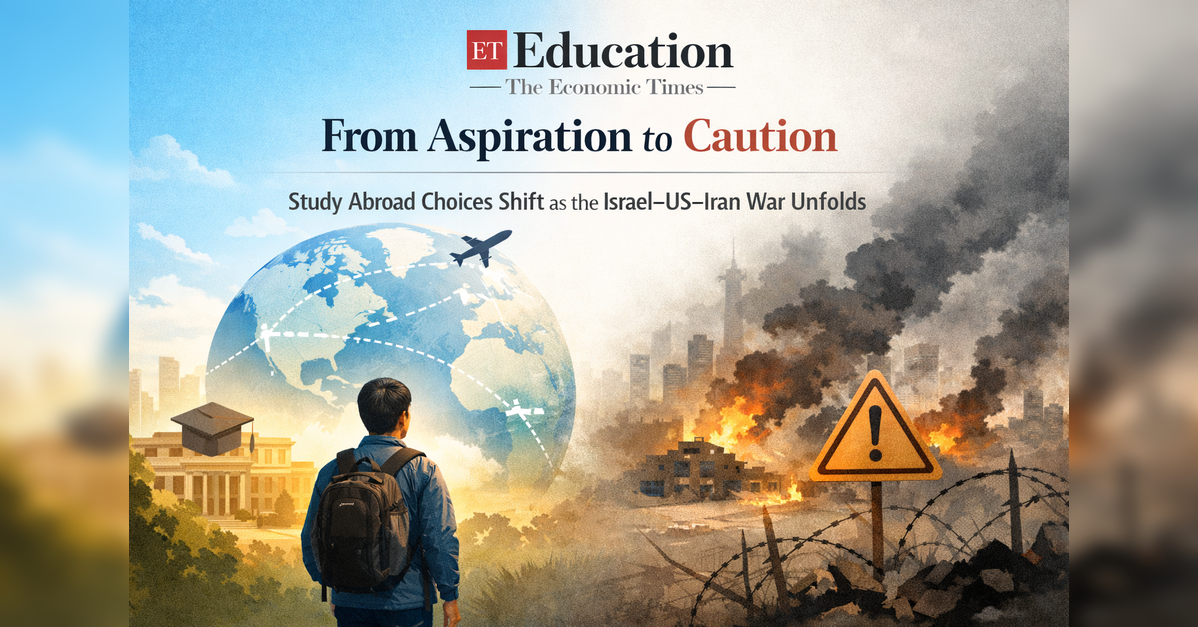
As geopolitical developments continue to unfold across regions, including the evolving situation around the Israel–US–Iran tensions, the global education landscape is witnessing a phase of uncertainty and recalibration. While outcomes remain fluid, the impact on student decision-making is already visible.
For years, studying abroad has represented aspiration, global exposure, and long-term mobility for Indian students. Today, however, that aspiration is being shaped by a more complex and dynamic environment. Safety considerations, geopolitical developments, travel disruptions, rising costs, and visa uncertainties are increasingly influencing how students and families approach global education choices.
Rather than a pause in ambition, this moment reflects a shift in mindset. Students are becoming more deliberate, weighing risks alongside opportunities, and exploring pathways that offer both stability and global exposure. Decision-making is more informed, timelines are more flexible, and preferences are evolving beyond traditional destinations.
In this context of ongoing developments, ETEducation reached out to leading voices across the education ecosystem to understand how these shifts are shaping student behaviour and what opportunities may emerge for India and global education pathways.
How are safety concerns, geopolitical tensions, and visa uncertainties reshaping students’ study abroad choices?
When asked how rising uncertainties are influencing study abroad decisions, education leaders pointed to a clear and consistent shift towards caution, diversification, and long-term planning.
Prof Himanshu Rai, Director, IIM Indore observes, “Rising geopolitical tensions, safety concerns, and visa unpredictability are making Indian students more risk-aware and strategic. We are seeing a shift toward diversified destinations, shorter-term mobility, and hybrid pathways. Decision timelines are lengthening as families prioritise stability, return on investment, and post-study work certainty over traditional prestige-driven choices.”
This evolving caution is further reflected in the perspective shared by Dr Vikram Singh, Chancellor, Noida International University, who notes, “These are challenging times, with uncertainty and unpredictability writ large. Any decision about studying abroad will have to address the basic question of safety, cost-benefit advantages, and maintaining a safe distance from conflict zones. This has to be tempered with a long-term perspective of at least five years, due to fast-moving events caused by geopolitical compulsions. A well-considered decision by all stakeholders was necessary earlier also, but today it is imperative because of long-term ramifications.”
At the same time, this shift is not diminishing aspiration but refining it. Kunwar Shekhar Vijendra, Chancellor, Shobhit University explains, “Geopolitical tensions, safety concerns, and visa uncertainty are not reducing aspiration; they are refining student judgment. Indian students now evaluate destinations through the lens of stability, employability, and institutional credibility rather than legacy preference alone. This creates an important moment for India: under National Education Policy 2020, stronger academic partnerships, trusted accreditation, and clearer global pathways can convert uncertainty abroad into confidence at home.”
Adding a broader global context, Dr Ramakrishnan Raman, Vice Chancellor, Symbiosis International (Deemed) University shares, “Increase in safety worries, more strict visa rules and geopolitical instability of the US, Canada and UK is causing Indian students to rethink the risk associated with their decision making. Therefore, they are relocating towards other relatively stable countries such as Australia, Germany and Ireland where education is also more affordable than in the UK, while also delaying their plans or focusing on employable courses. When making these decisions, they will weigh safety, visa stability and post-study work opportunities much higher than simply prestige alone.”
Bringing in the immediate impact of current geopolitical developments, Piyush Singh Chauhan, Vice Chairman, SR Group Of Institutions adds, “Rising safety concerns from the Israel–US–Iran conflict, coupled with visa uncertainties and escalating costs in traditional destinations like the US, UK, Canada, and Australia, are prompting Indian students to reassess their study abroad plans. Many are deprioritising West Asia entirely due to travel disruptions and regional instability, while stricter visa norms, protest-related scrutiny, and economic pressures in the Big Four are causing delays or shifts in timelines – often pushing intakes or prompting reconsideration of full-degree programs.
Preferred destinations are diversifying towards safer, more affordable, and geopolitically stable options such as Germany, Ireland, the Netherlands, France, Singapore, and New Zealand, which offer better post-study work pathways, lower costs, and proximity advantages. This pragmatic recalibration reflects a stronger emphasis on safety, ROI, and uninterrupted education over prestige alone.”
Taken together, these insights reveal a clear pattern. Students are becoming more deliberate, exploring alternative destinations, adjusting timelines, and placing greater emphasis on safety, affordability, and long-term outcomes.
Do these shifts create new opportunities for India and alternative global pathways?
While the challenges are evident, the same leaders also point to a significant and timely opportunity for India’s higher education ecosystem to evolve and expand its global role.
Prof Himanshu Rai notes, “This shift presents a significant opportunity for Indian higher education to globalise at home. Transnational partnerships, dual degrees, and offshore campuses can offer international exposure with reduced risk. Institutions that embed global curricula, industry integration, and mobility options will be well-positioned to retain talent and reimagine India as a destination, not just a source.”
Building on this perspective, Kunwar Shekhar Vijendra says, “This shift strengthens the case for India as a serious academic destination, not merely a source country. Transnational models, joint degrees, research collaboration, and industry-linked curricula can now mature with greater policy support. Bilateral education partnerships are gaining strategic relevance, and Indian institutions have an opportunity to offer globally aligned education with stronger contextual affordability and institutional continuity.”
Offering a more layered view, Prafulla Agnihotri, Director, Indian Institute of Management Sirmaur, shares:
“Yes and No both.
Let’s understand why most of the Indian students go abroad for their higher studies. Is it for bettering their educational qualification? For higher studies? No. Many Indian schools like IIMs or IITs offer equally good education. Most of them go there to settle down, they are lured by the rich and comfortable lifestyle that some of these developed countries offer.
Will it be affected by war? – No. War is temporary issue.
However, it will be certainly affected by the political policies such no visa or work permit to the foreign nationals.
Will it benefit the Indian Institutes? – Certainly, most of the Indian Institutes offer as good an education as most of the reputed foreign schools do. These students can explore these alternatives like IIMs or IITs for higher studies.”
Adding to this, Sudha Gupta, Chairperson, Presidium Schools reflects, “As an educator for over 30 years, I see this change as a big opportunity to improve education in India. Indian universities need to scale their level to match global standards. Yes, some have already started, however we need to expand and strengthen these efforts across the system. We must move beyond rote learning and focus on problem-solving, where every challenge becomes an opportunity. This will open doors for global collaborations and give students better, more flexible pathways for their future.”
From a systemic growth standpoint, Dr CA Achyut Dani, Director-General and Provost, JG University highlights, “This shift presents a significant opportunity for Indian Institutions as they can step into a more global role and actively retain the country’s brightest talent. It is actually a scenario of AAPADA ME AVSAR (Opportunity in Adversity). Institutions across India can expand trans-national education through international collaborations, dual-degree programs, and offshore academic partnerships that bring global learning closer to home. By offering globally benchmarked curricula, international faculty exposure, and flexible mobility pathways, we can nurture students within India while equipping them with a truly global outlook. This approach not only reduces financial and geopolitical risks for families but also strengthens India’s higher education ecosystem by ensuring that high-potential students contribute to national growth even as they gain international experience.”
Adding further depth to this evolving opportunity landscape, Dr Rajul K Gajjar, Vice Chancellor, Gujarat Technological University shares, “Geopolitical disruptions are accelerating a timely rethinking of global education pathways. For Indian institutions that have consistently demonstrated high standards, this is an opportunity to position India not as a fallback, but as a first-choice destination for quality and internationally relevant education.
Students who were seeking work pathways after completing their studies abroad have the space and time to explore opportunities back home. Emerging technologies and infrastructure industry are opening up avenues which were earlier available on foreign shores.
Universities are already remodelling their programmes, establishing alliances with global universities, indigenous and multinational industry, to increase avenues of exposure during and post the course of study. Industry too has been gearing up for indigenous manufacturing and import substitutes. All they have to do is plug in with Indian universities.”
Further reinforcing this shift, Dr Ramakrishnan Raman adds, “This development offers an opportunity for Indian institutions to provide globally recognised degrees, curriculum tied to the labour market, and joint programs between both local facilities and international partners. There is scope for additional international education options– including branch campuses and hybrid models of mobility (for example, short-term exchanges and combined online and off-campus education)– will add to the options for students who are looking for an affordable, secure, and accredited international education in India, as well as in their respective regional destinations.”
Finally, Piyush Singh Chauhan notes, “Yes, the current geopolitical tensions, safety concerns in regions like West Asia, and visa uncertainties in traditional destinations are prompting Indian students to explore more stable and accessible options closer to home. This shift is creating significant opportunities for Indian institutions to strengthen their global standing through transnational education (TNE) models, joint/dual degree programs, and international branch campuses under NEP 2020.
Many students are now prioritising “glocal” pathways – high-quality global education at lower costs, with reduced travel risks and easier family support – right here in India. This could accelerate investments in domestic infrastructure, faculty collaborations, and research ecosystems, while positioning India as an emerging hub for students from conflict-affected regions as well. Ultimately, it fosters a more resilient, self-reliant higher education landscape that balances aspiration with practicality.”
A more calibrated and resilient path to study abroad
What emerges from the perspectives of education leaders is a clear shift towards more risk-aware and strategic decision-making in response to evolving geopolitical developments. Safety concerns, visa uncertainties, employability, and return on investment are becoming central to how students evaluate study abroad options.
This is reflected in a growing preference for diversified destinations, longer decision timelines, and greater consideration of stability and post-study opportunities, rather than traditional preference-led choices.
At the same time, leaders consistently highlight that these developments are accelerating new opportunities within India, particularly through transnational education models, dual degrees, global collaborations, and industry-aligned programmes that bring international exposure closer to home.


