



What happens when getting every child into school is no longer the biggest challenge, but making sure that school prepares them for the life ahead is?
After decades of expanding access, India’s school education story is entering a more demanding phase. The conversation is moving beyond enrolment and infrastructure towards learning outcomes, foundational skills, employability, technology, wellbeing and aspiration. The question has moved from whether children are reaching classrooms to what they are gaining once they get there.
There are encouraging signs. Foundational learning is improving, teacher capacity and school infrastructure have strengthened, and reforms under the National Education Policy 2020 are attempting to reshape the very architecture of schooling, from the 5+3+3+4 structure to greater emphasis on vocational education, experiential learning and technology. Yet the real test lies in implementation – Can these reforms translate into better learning and wider opportunity for a child sitting in a government school in a remote community?
For Santanu Mishra, Co-Founder, Smile Foundation, the answer lies in returning to the fundamentals while preparing children for a very different future. His experience of working across hundreds of schools and communities brings a ground-level perspective to a national conversation increasingly dominated by AI and digital transformation. From foundational literacy and STEM exposure to career counselling, mental wellbeing and community participation, Mishra argues that future-readiness cannot be built by technology alone.
In this conversation, he reflects on what India’s schools must prioritise next, how government schools can become more aspirational, where grassroots organisations can make the greatest difference, and why the future of education may depend as much on getting the basics right as embracing what comes next.Here is the edited excerpt:
Q. 1. As India completed 79 years of Independence, what should be the key priorities for school education, particularly as the focus shifts from expanding access to improving learning outcomes, employability skills and future-readiness?
There has been measurable progress in strengthening the foundations of India’s school education system. Through Samagra Shiksha, teacher recruitment and a stronger focus on foundational learning, India has crossed one crore teachers, while pupil-teacher ratios are broadly aligned with NEP norms. Under NIPUN Bharat, Class 3 reading levels in government schools have also improved from 16% to 23% over two years.
Some of this progress reflects important structural changes introduced through NEP 2020. The shift to the 5+3+3+4 framework, including the integration of Anganwadi and pre-school years into the Foundational Stage through Balvatika, formally recognises that learning begins well before Class 1. The challenge now is to ensure that this policy architecture translates consistently into classroom quality across states and schools.
The same implementation question applies to employability. NEP 2020’s emphasis on vocational learning, Atal Tinkering Labs, and newer initiatives such as SOAR have created useful building blocks. The next phase should focus on deeper integration linking skills with core subjects, aligning learning with local economic opportunities, and strengthening partnerships with industry and community organisations so that policy intent translates into meaningful employability outcomes.
Q. 2. What are the key elements that can make government schools stronger and more aspirational for students and families?
Foundational literacy and numeracy remain central. A child who can read with understanding and work confidently with numbers in the early years has the base on which every future skill depends. This needs to be supported by basic dignity infrastructure such as functional toilets, drinking water and electricity, which are now available in over 90% of government schools. The next layer is future-readiness. Schools need functional science and mathematics labs, practical exposure to technology, and increasingly, familiarity with AI, so that children are not introduced to important concepts only through textbooks but are able to experiment, problem-solve and learn by doing. Career counselling is equally important. Students need access to credible guidance on where their skills can lead, what education and employment pathways are available, and what options exist beyond their immediate surroundings. That is what makes future-readiness meaningful: not just building capability, but giving children a clearer sense of direction and aspiration.
Q. 3. How can grassroots organisations complement government efforts in education by bringing innovation, implementation support and community participation into school-level interventions?
Government brings scale, with nearly one crore teachers across more than fourteen lakh schools. Grassroots organisations complement this by bringing agility, local understanding and the ability to test and adapt new approaches. Evidence and feedback generated by civil society can also inform government thinking and policy. Their strongest contribution is often at the community level. Mentoring, parental engagement and sustained local support can be particularly important during the middle-to-secondary transition, when the risk of students disengaging from education increases.
Grassroots organisations can also help build a stronger culture of appreciation around government schools. Recognition should go beyond toppers and exceptional achievers to include teachers who improve learning outcomes and schools that show consistent progress. This can motivate those within the system while strengthening families’ confidence in their local schools. Most importantly, the most effective model is one of co-working, where government, schools and grassroots organisations work towards shared outcomes for the child. The aim should be to identify what works, build capacity within the system and gradually transfer ownership so that successful interventions can continue and scale sustainably.
Q. 4. Based on Smile Foundation’s experience of working with government schools, which interventions have shown the greatest potential for sustainable impact, and how can such approaches be strengthened or scaled through partnerships with government and other stakeholders?
In FY 2025-26, our education programme reached more than 3.82 lakh students directly across more than 800 schools in 22 states and UTs, covering 87 districts, including 24 aspirational districts, with a near-equal 52:48 girls-to-boys ratio. Within this work, three interventions have shown particularly strong potential for sustainable impact. Foundational Literacy and Numeracy (FLN) remains central to this approach. A child who learns to read, understand and work confidently with numbers in the early years carries that advantage throughout their education. Our FLN interventions are therefore integrated into the regular classroom, working alongside teachers rather than creating a parallel system. This helps ensure that learning gains remain embedded within the school even after the intervention ends.
As children progress, the focus shifts towards applying these foundational skills through science, experimentation and problem-solving. Our STEM education follows a structured three-year progression, supported by initiatives such as STEM on Wheels and tinkering programmes that bring practical, hands-on learning directly to students.
Alongside academic learning, mental wellbeing is equally important. A child who is struggling emotionally may find it difficult to engage meaningfully with classroom learning, which is why wellbeing is treated as an essential part of sustained participation in school rather than as a separate add-on. We work closely with education departments and align our programmes with national priorities under NEP 2020 and Samagra Shiksha, while staying rooted in communities through Gram Panchayats and School Management Committees. This combination of system-level alignment and community ownership helps ensure that successful interventions can be sustained and scaled over time.
Q. 5. Digital access and exposure to technology remain uneven across Indian schools, particularly for students from underserved communities. How important is it to bridge this gap, and what kind of interventions are needed to ensure that digital learning strengthens, rather than widens, educational opportunity?
Platforms like Vidyanjali play a valuable role in bridging school-level infrastructure gaps. Through the Ministry of Education platform, schools can identify specific requirements, such as smart screens, digital equipment or science labs, and volunteers, development organisations and CSR partners can respond directly. The platform has already expanded significantly, with more than one lakh additional schools joining in the last year. This kind of model works because it connects government, communities and organisations around the specific needs of individual schools, helping ensure that digital learning expands opportunity rather than deepening existing gaps.
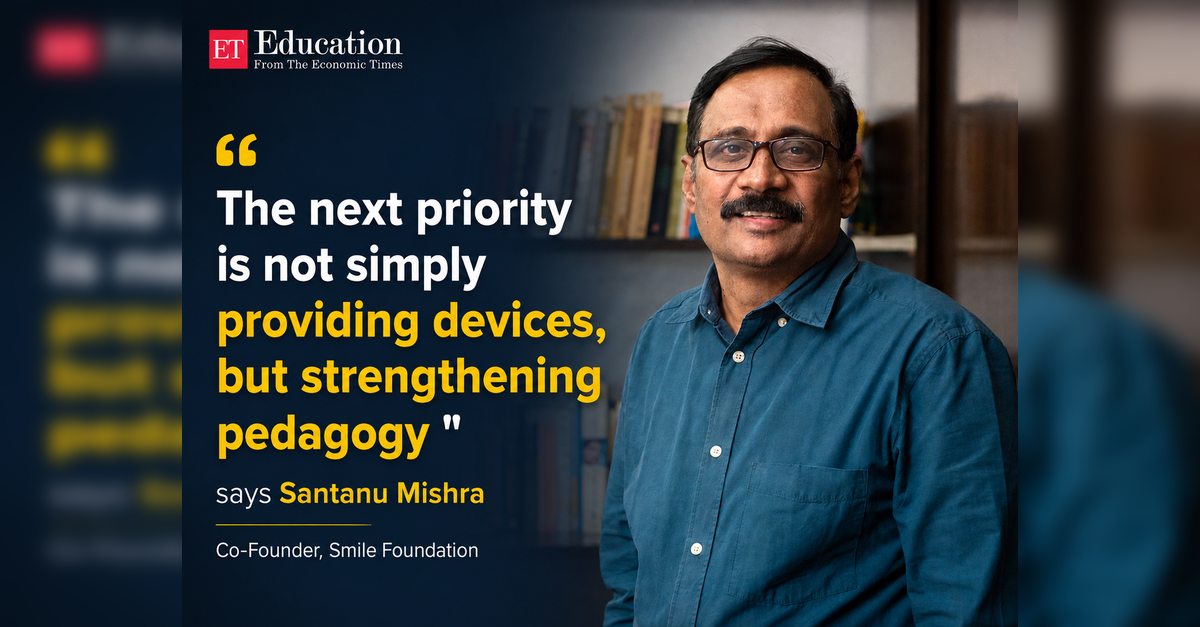
At the same time, the challenge is increasingly shifting from access to effective use. Smartphone ownership in rural India has risen sharply, supported by growing household adoption and improvements in connectivity under Digital India. This means the next priority is not simply providing devices, but strengthening pedagogy. Quality learning still depends on structured teaching, relevant curriculum-aligned content and teachers who are confident using technology in the classroom. A smart classroom delivers its full value only when the teacher is equally well equipped to use it.


