


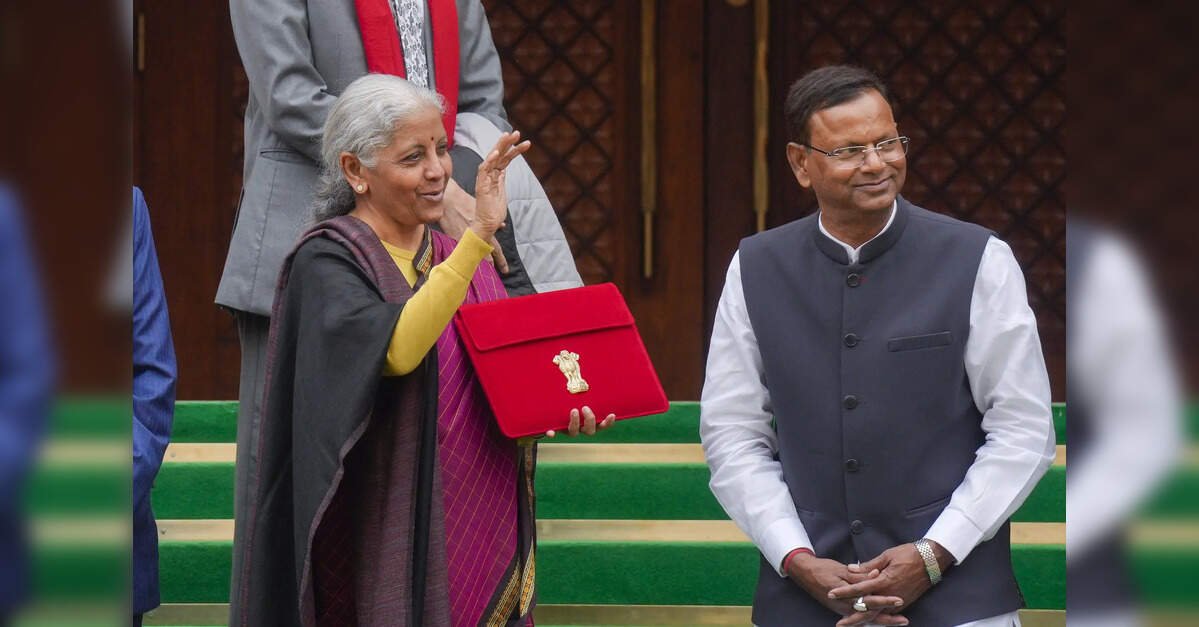
The Union Budget for 2026-27, presented by Finance Minister Nirmala Sitharaman, does not offer headline-grabbing tax cuts. Instead, it advances a quieter but consequential agenda: reducing regulatory friction, improving tax certainty, and signalling long-term sectoral bets aimed at making India a more predictable place to invest and scale.
Notably, the Budget marks a shift from incremental tinkering to structural consolidation, particularly in taxation, trade facilitation, and industrial policy.
“While the Budget doesn’t attempt a ‘big bang’, it sends an important signal of stability and policy continuity at a time of heightened geopolitical uncertainty, reinforcing that India remains open for business. The real growth dividend will come from disciplined implementation of last year’s measures, alongside the steady cadence of legislative and regulatory reform through the year,” said Cyril Shroff, managing partner, at Cyril Amarchand Mangaldas.
A New Income Tax Law, Finally
The centrepiece of the Budget is the confirmation that the Income Tax Act, 2025 will come into force from 1 April 2026, replacing the six-decade-old 1961 law. The government has positioned the new law as a simplification exercise rather than a substantive rewrite, with redesigned rules and forms aimed at easing compliance.
While tax rates and slabs remain unchanged, the significance lies in administrative clarity. The government has sought to draw a line under years of overlapping amendments and interpretational complexity. As tax experts note, this is less a reinvention than a recalibration, intended to reduce ambiguity and litigation over time.
“The FM has clarified that Income Tax, 2025 shall come into effect from April 1, 2026 setting to rest regarding the confusion. In fact, the Finance Bill itself has two parts dealing with income tax provisions i.e. Income Tax Act, 1961 and Income Tax Act, 2025,” said SR Patnaik, partner (head – taxation), Cyril Amarchand Mangaldas.
Lower Litigation, Fewer Procedural Triggers
Several measures target long-standing pain points in tax administration. Assessment and penalty proceedings will now be combined into a single order, reducing duplication. The pre-deposit required to contest a tax demand has been lowered from 20 percent to 10 percent, calculated only on the core tax amount.The prosecution framework has also been rationalised. Minor offences such as non-production of books, certain TDS defaults, and non-disclosure of small foreign assets have been decriminalised, with remaining offences capped at a maximum two-year sentence, convertible to fines at judicial discretion. The intent is clear: to move away from an adversarial enforcement regime towards one focused on compliance and closure.
“Procedural reforms relating to tax return filing, assessment processes, and the decriminalisation of minor offences are targeted to reduce litigation and foster a non-adversarial tax regime,” said Himanshu Sinha, partner- Tax Practice, Trilegal.
Accounting Alignment Ends Dual Burden
In a move welcomed by corporates, the Budget proposes a joint committee of the Ministry of Corporate Affairs and the CBDT to align Income Computation and Disclosure Standards (ICDS) with Indian Accounting Standards (IndAS). From FY 2027-28, separate tax accounting under ICDS will be discontinued.
For businesses, this removes a parallel compliance layer that has long added cost and complexity, particularly for large listed companies and multinationals.
Boost to IT Services and GCCs
Export-oriented technology and services firms are among the clearer beneficiaries. Software development, IT-enabled services, KPO, and contract R&D are being consolidated into a single “Information Technology Services” category under transfer pricing rules, with a 15.5 percent safe harbour margin.
The turnover threshold for safe harbour eligibility has been raised sharply from ₹300 crore to ₹2,000 crore, approvals will be automated, and unilateral advance pricing agreements are to be completed within two years. These changes materially improve predictability for large IT exporters and global capability centres operating out of India.
“The focus is on ease of compliance and reducing the points of friction with the taxpayers. Move towards decriminalising the compliance and imposing fines is welcome. A big change is to provide 15.5% margin for IT and ITES exports upto 3000 crores under safe harbour provisions is likely to give a major boost to the Entrepreneurs wanting to set up IT services and GCCs,” said Kumarmanglam Vijay, partner and head of practice – direct tax, JSA Advocates & Solicitors.
“The expansion of safe-harbour regimes, and clearer treatment for global services, cloud infrastructure and bonded-zone operations signal a move towards predictability and reduced dispute risk. These measures are likely to matter more to investors than short-term tax concessions,” said Haigreve Khaitan, senior partner, Khaitan & Co.
“This materially improves certainty for large Indian IT exporters and GCC-linked service models, reduces TP dispute inventory, and makes India a more competitive jurisdiction for scaling tech delivery with predictable tax outcomes. Though a larger ambit would be of greater assistance, it is a welcome step towards reducing unwarranted litigation, and transaction delays,” said S. Sriram, executive partner, Lakshmikumaran & Sridharan Attorneys.
Signals to Global Capital
The Budget continues to court long-term foreign investment through targeted tax and regulatory measures. Global cloud service providers using Indian data centre infrastructure will be eligible for tax holidays extending to 2047. All non-residents opting for presumptive taxation will be exempt from Minimum Alternate Tax.
Amendments to FEMA’s non-debt instruments rules will allow non-resident individuals to directly invest in listed Indian securities, placing them on par with other portfolio investors. Exemptions for non-resident experts and suppliers to bonded-zone manufacturers further underscore the push to integrate India into global value chains.
“The Budget proposes amendments to the Foreign Exchange Management Non-Debt Instruments Rules, 2019 to further liberalise FDI flows into India. Individuals resident outside India will now be permitted to invest directly in listed securities of Indian companies through the Portfolio Investment Scheme, putting them on the same platform as other FDI routes,” said Komal Dani, Partner- Tax Practice, Trilegal.
MAT Becomes a Final Tax
In a significant structural change, MAT will become a final tax from 1 April 2026, with the rate reduced from 15 percent to 14 percent. Accumulated MAT credits up to March 2026 can still be set off under the new corporate tax regime, but no further credits will accrue.
The move nudges companies decisively towards the new regime, even as it closes off legacy arbitrage opportunities.
Customs, MSMEs, and Export Enablement
On the trade front, the Budget focuses on lowering input costs and easing export constraints. Duties have been rationalised across EV batteries, solar glass, critical minerals, leather, footwear, and seafood processing.
The removal of the ₹10 lakh cap on courier exports is a notable MSME-friendly step, allowing small exporters, artisans, and startups to scale cross-border e-commerce without artificial ceilings. Export timelines have also been extended, easing working capital pressures.
“This customs package is not a routine rate adjustment; it is a structural recalibration of India’s tariff philosophy pruning legacy exemptions, correcting duty inversion, and aligning border taxation with an unapologetically pro-manufacturing industrial policy,” said Patnaik. “The export-linked relaxations for marine, leather, and textile sectors are fiscally modest but strategically sharp; they lower working capital friction while signalling that India intends to compete on speed, scale, and predictability in global value chains.”
Strategic Industrial Bets
Beyond tax and trade, the Budget doubles down on select strategic sectors. India Semiconductor Mission 2.0 expands support beyond fabs to equipment, materials, and domestic IP. The Biopharma SHAKTI initiative commits INR 10,000 crore over five years to build capacity in biologics, biosimilars, clinical trials, and regulatory institutions.
“The launch of Biopharma SHAKTI marks a decisive push to position India as a global hub for biologics and biosimilars, aligning healthcare needs with manufacturing scale, innovation, and global standards. The focus is on building a full-stack biopharma ecosystem from research and education to clinical trials and faster regulatory approvals,” said Sidharrth Shankar, partner, JSA.
Critical minerals corridors and a new SME Growth Fund signal an attempt to marry industrial policy with private capital and risk-sharing mechanisms.
“Union Budget 2026 reframes the regulatory approach to long-term infrastructure investment by prioritising risk architecture over capital intensity. The introduction of an institutional mechanism such as the Infrastructure Risk Guarantee Fund directly addresses construction-phase and early-stage uncertainties that typically deter patient, long-duration capital,” said Prakhar Sharma, GC, NIIF.
“India will continue to take confident steps towards Viksit Bharat, balancing ambition with inclusion. As a growing economy with expanding trade and capital needs, India must also remain deeply integrated with global markets, exporting more and attracting stable long-term investment,” said Sitharaman in her budget speech.


