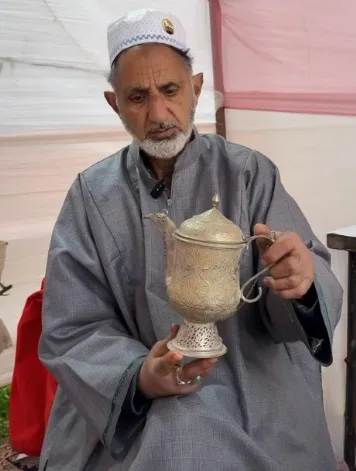
Srinagar, Mar 18: In the narrow lanes of Rainawari, where tradition still echoes through the rhythmic sound of hammer and chisel, silversmith Mohammad Yousuf Zargar continues to keep a fading legacy alive. Though the craft itself is centuries old, Yousuf has devoted the last 55 years of his life to mastering and preserving it.
“I started this work in my childhood,” Yousuf recalls. “We would return from school, leave our bags at home, and head straight to the workshop to learn and practice.” What began as a daily routine soon turned into a lifelong dedication.
Displaying his finely crafted silverware, Yousuf highlights the immense effort behind each piece. “These items carry the labour of my entire life. Some take weeks, others months. But once completed, they are strong and built to last,” he says. A traditional Kashmiri silver samovar (teapot) took him nearly a month to complete, while crafting a charkha (yendir) required about a week.
Despite its rich history, the craft is now struggling to survive. “Earlier, this work was profitable. We earned both respect and a fair income. Today, people mostly avoid handmade items and buy them only on special occasions like weddings,” he explains. Items such as silver Quran boxes, dry fruit bowls, and purses are now largely limited to ceremonial gifting.
Yousuf blames the rise of cheaper, machine-made products flooding markets from outside states. “People often don’t check quality—they go for what’s cheaper. That has affected us deeply,” he adds.
Officials from the Handicrafts and Handloom Department have acknowledged the decline. Director Mussarat-ul-Islam described silverware as a “languishing craft” and said efforts are underway to revive it. “We have included this craft in our third-phase plan and prepared a dossier for its Geographical Indication (GI) registration. This will help establish authenticity based on origin,” he said.
Plans are also in place to introduce hologram tagging for handmade silver items, ensuring buyers can identify genuine products.
“We urge customers to insist on GI-tagged items when purchasing traditional crafts. This will support artisans and preserve authenticity,” the director added.
As time and technology reshape consumer habits, artisans like Mohammad Yousuf Zargar remain among the few custodians of a centuries-old tradition, keeping it alive one handcrafted piece at a time.