



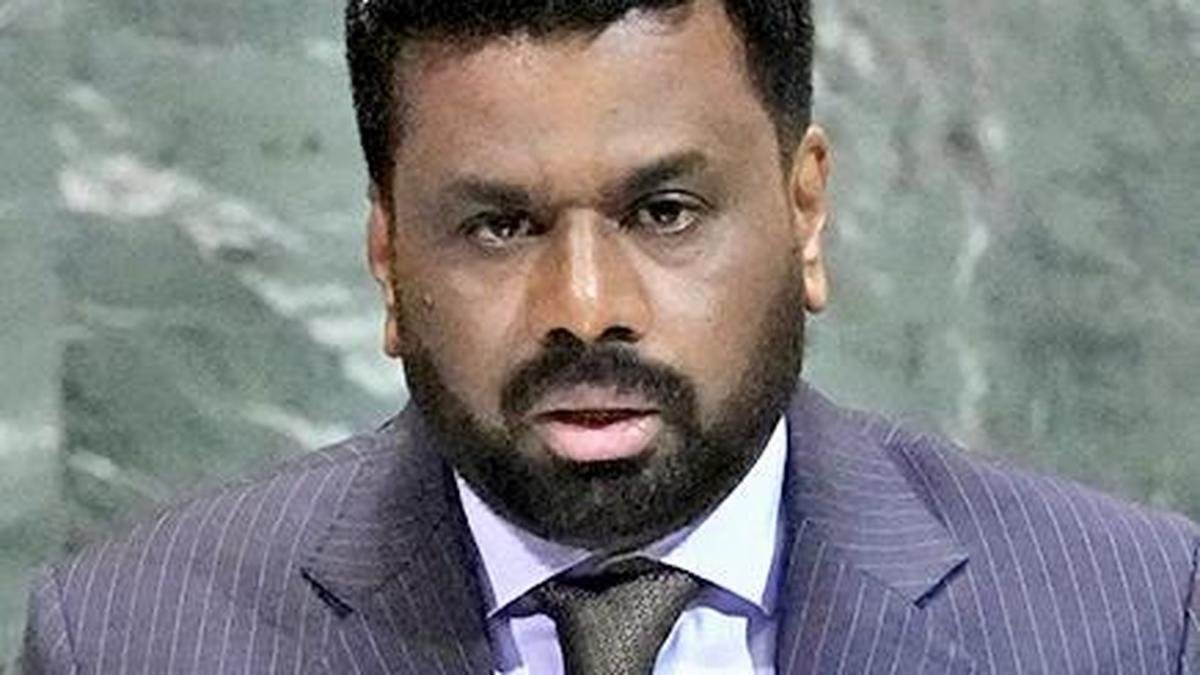
Sri Lankan President Anura Kumara Dissanayake. File
Colombo
The Sri Lankan government will table a contentious Bill in Parliament this week seeking to raise the mandatory retirement age of judges of the country’s Supreme Court and Court of Appeal, a move critics say could undermine the independence of the judiciary.
According to a media statement issued by Minister of Justice Harshana Nanayakkara, the government will table the proposed constitutional amendment Bill — the 22nd Amendment — on Tuesday (August 18, 2026). It seeks to amend Article 107(5) of the Constitution to raise the retirement age of Supreme Court judges from 65 to 67 years and that of Court of Appeal judges from 63 to 65 years.
“To help address backlog of cases”
The Anura Kumara Dissanayake administration has sought to justify the move by saying it would help address the massive backlog of cases, expedite court proceedings, and ensure continuity by retaining experienced and senior judges. The amendment would help address a backlog of approximately 1.1 million pending cases, Mr. Nanayakkara, an Attorney-at-law, told the media.
However, the political Opposition, members of the legal fraternity and sections of civil society are fiercely opposing the move, arguing that it would impact the independence of the judiciary.
In a social media post, leader of the Opposition Sajith Premadasa questioned why the extension [of the retirement age] must apply to sitting judges.
Amid the ongoing debate largely confined to Sri Lanka’s legal fraternity and sections of civil society, a 20-member delegation of the Bar Association of Sri Lanka (BASL), a professional body of lawyers, met President Dissanayake on August 12.
“The BASL emphasised that the proposed amendment would have a serious impact on the independence of the Judiciary and that, in the circumstances, the proposed amendment should not be proceeded with. The BASL further pointed out that there are several other urgent matters requiring the attention of the Government which must be given priority,” the association said in a statement following the meeting.
The President’s office said Mr. Dissanayake “stressed that the decision to extend the retirement age of judges was not taken with any individual or group in mind, but in the broader public interest.” He further emphasised that this amendment represents only one component of a broader reform programme aimed at addressing issues across the entire judicial system, the Presidential Media Division said in a statement following the meeting.
Responding to the developments, Margaret Satterthwaite, U.N. Special Rapporteur on the independence of judges and lawyers, recently wrote to the government and noted that the amendment, in the form reportedly proposed and in its implications, “may not be in line with international human rights standards related to the independence of the judiciary and the right to a fair trial, including: the separation of powers, the ability of judges to perform their functions free from undue influence, pressure or interference, and the public’s confidence in the judiciary’s independence”.
Published – August 16, 2026 05:52 pm IST


