



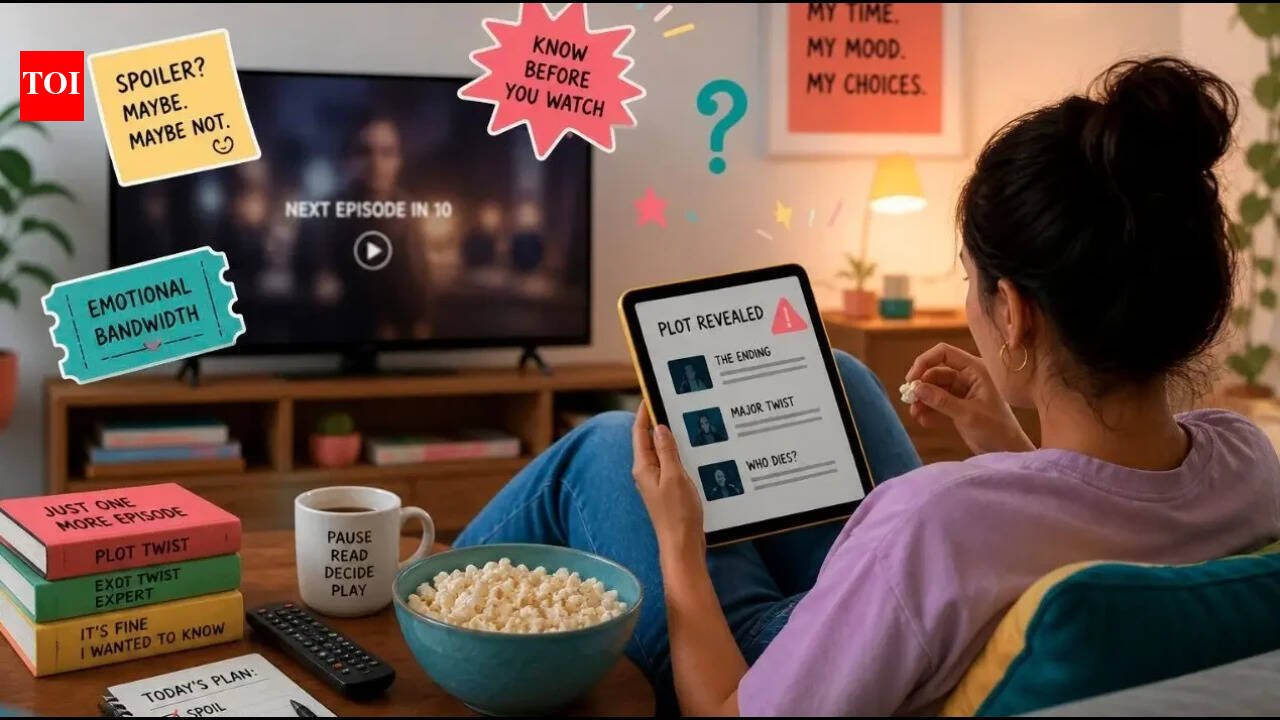
Remember when people actively avoided spoilers? That instinct is quietly changing. Thanks to content overload and emotional exhaustion, they are now seeking spoilers out. Viewers are choosing to consume key plot points before watching a film or a series to handle impact, save time and take control of how they experience entertainment.“When 777 Charlie released, I didn’t watch it. Having lost pets before, I knew it would affect me deeply,” says Anjana, 28. For someone like her, watching films is not just passive viewing. It is about emotional boundaries.“I usually wait until the episodes drop and then read about major plot points before committing to a show. It helps me decide whether the emotional tone of the story matches my mood, and if it’s worth investing time in,” says Vanshika, 26.The reasons are varied. A few like Anjana do a blanket risk assessment, while others like Vanshika are thinking from a more practical point of view — there is too much content and too little time.Spoilers: A decision-making toolOnline discussions show a similar pattern, with users saying they prefer their spoilers in broad strokes.“Spoilers actually make me either want to see a movie more, or to see it less. I also see it as a way of saving money. Almost like a third-party movie review,” comments one Reddit user.Another user wonders the lengths some people go to to avoid spoilers. “If the movie’s going to be good, it’s going to be good. Spoilers don’t really have an effect on the outcome for me,” they wrote.This is less about individual preferences, and more reflective of a broader shift in how people are approaching content. In a high-stress, high-content and high-speed reality when people turn to entertainment, most of them want to know how much emotional weight they can bear. Vanshika echoes these feelings as she adds, “Knowing certain developments beforehand actually helps me mentally prepare for heavy storylines and visuals. I think a lot of people in our generation are doing this now.”Sometimes the emotional bandwidth and the ability to sit with discomfort changes with the medium. Nishita, 26, shares, “With long-running series, investment builds over days or even weeks, and I’d rather know beforehand if it’s going to leave me drained. But for movies? Not really. I can deal with the impact for 3-4 hours — it feels contained, almost cathartic.”Managing the emotional overloadIt is not just about plain old curiosity anymore. Psychology experts suggest that an increased need for uncertainty management has actively fed into the spoiler-seeking behaviour.“There’s enough cliffhangers in real-life existence that you want to sit down and enjoy a movie that should be relaxing,” Christina Scott, a professor of social psychology, California, tells The Times.For some, it is about making an informed decision and not wasting time.“Earlier, it was all about trial and error,” says Parmita, 41. “Now you get to decide whether something is worth your time or not. There is no dearth of content on the Internet, but that doesn’t automatically mean that they are all great.”Spoilers as enhancersInterestingly, some filmmakers and researchers argue that spoilers don’t flatten the experience, but reframe it.Glass Onion director Rian Johnson engaged with the spoiler culture by giving spoiler-heavy interviews only a couple of days after his film was released. Meanwhile, acclaimed filmmaker Steven Soderbergh had similarly implied in an earlier interview with Indiewire that knowing what is going to happen switches the brain’s attention from the plot to the acknowledgement of the craft.Some research supports this claim. Jonathan Leavitt, a data scientist, tells The Times this shift can also be linked to how stories are being written. Films by Christopher Nolan, Ari Aster and Martin Scorsese are good examples of how complex stories create confusion in first viewing, which is then resolved during its postmortem.“When you know the outcome, you get to feel a lot smarter and make better inferences. And you ultimately understand the story better in the end,” Leavitt adds.Control over consumptionThe control over consumption has gone a notch higher, with some audiences reading up about shows they never intend to watch. Take 31-year-old Pallavi’s case. After she came to know about the HBO show Euphoria via social media, Pallavi became increasingly sure that she would not like the series if she were ever to watch it. But there is also a fear of missing out on the discussions and the hype, and the desire to just know what happens.Yet there are a few who still swear by the no-spoilers rule — “I avoid them. In fact, I sometimes buy paid preview tickets and watch films a day before they release,” says Kuhu, 22.In an unpredictable world, spoilers are no longer feared or avoided. They are becoming a significant tool in how viewers experience the story.— Anvita Singh


