


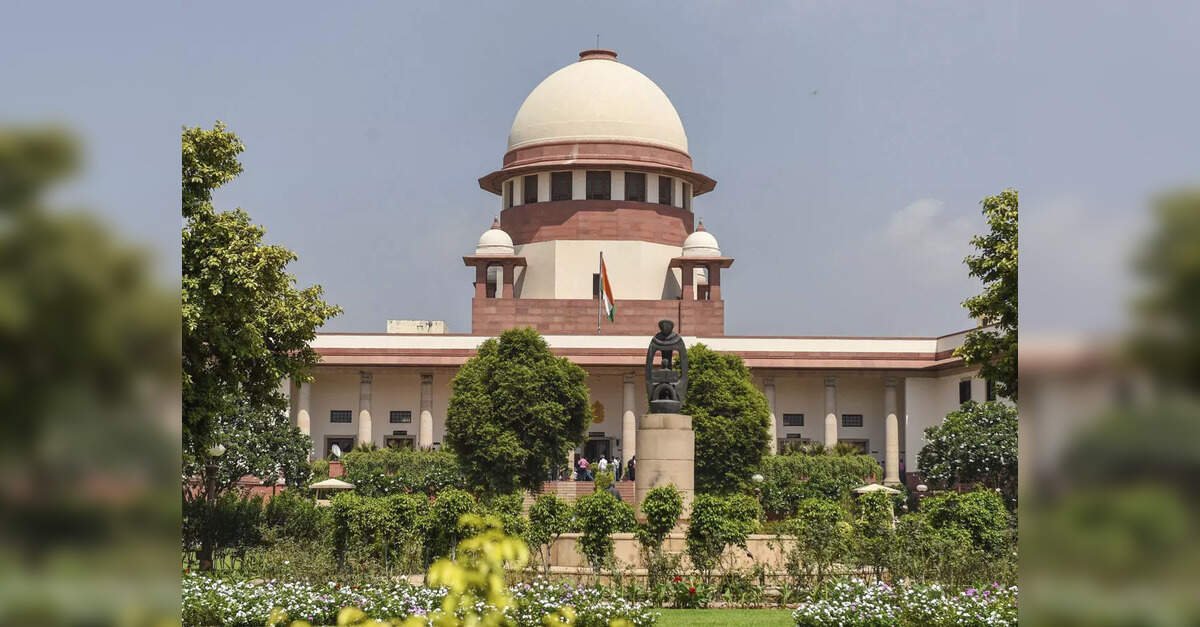
New Delhi: In a landmark decision, the Supreme Court on Friday held that the spectrum allocated to telecom service providers is not an asset to be subjected to proceedings under the Insolvency and Bankruptcy Code.
The decision will have ramifications in the telecommunication sector where telecom firms such as Aircel Group of Companies have invoked moratorium on the basis of voluntary corporate insolvency resolution process under the Insolvency and Bankruptcy Code (IBC) for restructuring of their assets.
A bench of Justices P S Narasimha and A S Chandurkar ruled that the Union government is the owner and trustee of spectrum on the one hand, and the Telecom Regulatory Authority of India (TRAI) is the regulator on the other, and taken together, they occupy the “entire province of telecommunications”.
It said while a licence and allocation of spectrum may, in abstract terms, constitute an intangible asset, it is always subject to the telecommunication laws of the nation like the Telegraph Act, 1885, Wireless Telegraphy Act, 1993, and the TRAI Act, 1997, followed by rules and regulations.
“We hold that spectrum allocated to telecom service providers (TSPs) and shown in their books of account as an ‘asset’ cannot be subjected to proceedings under the Insolvency and Bankruptcy Code, 2016,” the top court ruled.
The bench said the regulatory jurisdiction for the telecommunication sector through TRAI extends to making recommendations to the Union government and discharging the functions under the TRAI Act.
“The statutory regime under the IBC cannot be permitted to make inroads into the telecom sector and re-write and restructure the rights and liabilities arising out of administration, usage, and transfers of spectrum which operate under the exclusive legal regime concerning telecommunications.
“The disharmony caused by applying IBC to the telecom sector, which operates under a different legal regime, was never intended by Parliament,” the bench said.
It added that the statutory interpretation adopted by the corporate debtors like Aircel Group entities for applying IBC to the material resource of the nation, the spectrum by referring to it as an “asset” in its books of account, the licence agreement, tripartite agreement (between DoT, banks and TSPs), or the spectrum trading guidelines of 2015, is like the “tail wagging the dog”.
“Statutory interpretation cannot be based on a myopic approach of reading the definition clauses out of their context. Merely because spectrum can be treated as an ‘asset’ on the basis of certain attributes, such as possession and usage, lease and assignment, claim and liability or credit and debt, the entirety of the telecom sector cannot be brought under the sweep of IBC,” the top court said, as it overruled the view taken by the National Company Law Appellate Tribunal (NCLAT) holding that spectrum can be subjected to IBC process.
The top court said the scope and ambit of IBC is to speed up the process providing for insolvency, and achieving maximisation of the value of the asset of the entity undergoing corporate insolvency resolution process (CIRP) and the focus is on the company.
It said on the other hand, the Telegraph Act, the Wireless Telegraphy Act and the TRAI Act form a complete and exhaustive code for all matters relating to the telecom sector.
The bench said the framework of IBC includes only those tangible or intangible assets within the insolvency framework over which the corporate debtor has ownership rights, including all rights and interests therein as recorded in the balance sheet.
“Mere recognition of spectrum licensing rights as an intangible asset by TSPs in the financial statements is not conclusive of their ownership, as it only represents control over future economic benefits.
“Even assuming that licensing of spectrum rights is one among the bundle of rights, in the absence of transfer of title over the spectrum, no ownership rights are created in TSPs either in the spectrum or in its right to use as governed by the licensing conditions. Hence, under the IBC framework, spectrum licensing rights is not a part of the pool of assets for insolvency or liquidation,” it said.
Referring to its 2020 verdict in embassy property, the bench said this court has emphasised that IBC cannot be invoked to usurp or neutralise powers vested in the state under special statutes, nor can insolvency proceedings be used to compel the state to act contrary to its statutory obligations.
It added that the jurisdiction of the NCLT and NCLAT is confined to matters that arise purely within the insolvency framework and does not extend to adjudicating the legality of sovereign actions.
The top court allowed the appeal filed by the Centre through the Department of Telecom and dismissed the pleas of the State Bank of India and other telecom service providers who were aggrieved by certain aspects of the NCLAT judgement.
The Aircel Group entities – Aircel Limited, Aircel Cellular Limited and Dishnet Wireless Limited – were granted telecom licences by the DoT under the Unified Access Service Licences (UASL) pursuant to licence agreements dated December 5, 2006, for a term of 20 years.
The firms failed to pay licence fee and when the DoT attempted to recover these amounts, they invoked IBC by filing an application for the voluntary corporate insolvency resolution process.
The application was admitted by the NCLT’s Mumbai bench in 2018 and an interim resolution professional was appointed. PTI


