






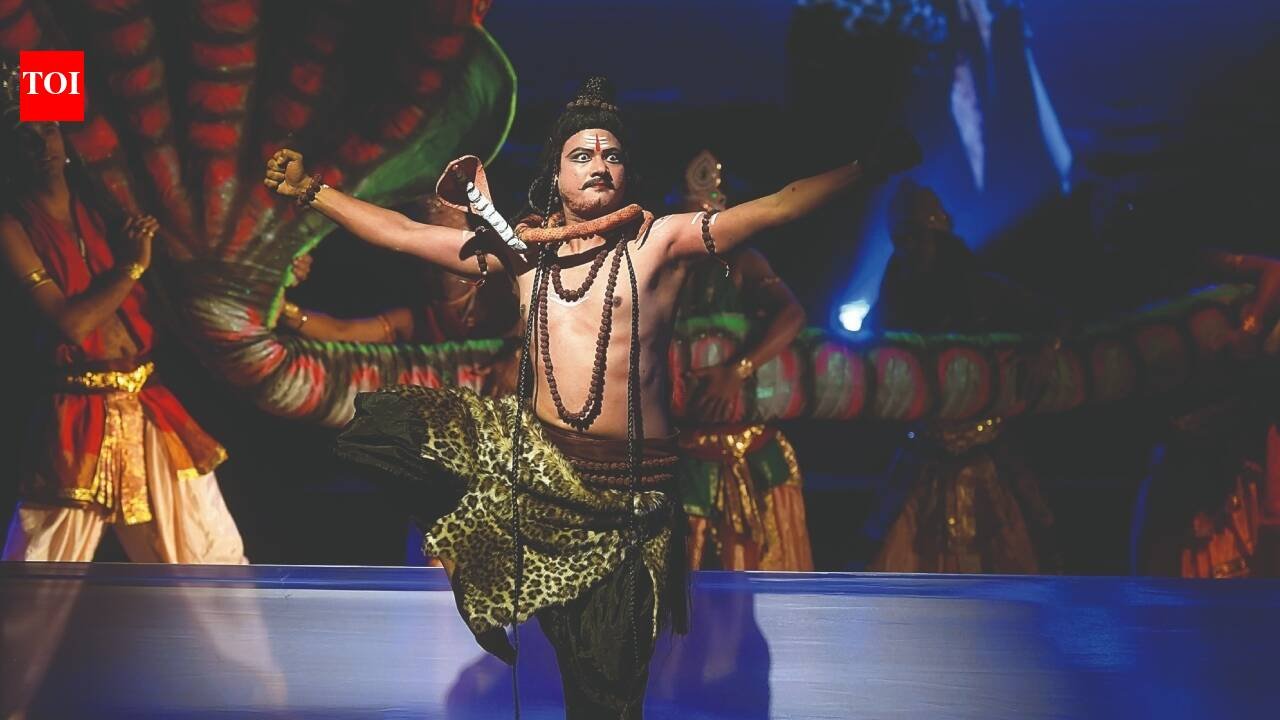
The Natyashastra author Bharat Muni takes the stage with his 100 children to seek Brahma’s permission to create theatre. Vedic chants fill the venue as a large 3D image of Shiva appears in the background. Dancers perform, and hymns are sung. Suddenly, the celebration comes to a standstill. The fourth wall breaks as a group of young people enter the stage, expressing their reluctance to participate in the drama.The opening is followed by a battle scene between Indra and the demons. Indra’s elaborate costume, his weapon vajra and his majestic white elephant, Airavat, establish his power and grandeur. The intricately crafted costumes, with Indra brandishing his vajra, make for an arresting visual.Samudra Manthan is visually stunning, with the stagecraft complementing its costumes. However, the somewhat chaotic setting and abrupt transitions come at the cost of narrative clarity.The battle sequences, props and the demons are among the production’s highlights. Indra’s entrance on Airavat, flanked by apsaras and dancers, steals the show. The attention to detail is remarkable, especially with regard to the characters of Airavat and Vasuki. Vasuki’s length as it coils around the mountain is impressive to behold. Depicting the churning of the ocean on a stage is a difficult feat to pull off, but the NSD repertory rises to the challenge.However, the play-within-a-play, a narrative technique used in works from Shakespeare to the Mahabharata, could have been more effective. The narrative framing of Bharat Muni’s story and its link to the mythological story feel uneven in parts, preventing the two from coming together seamlessly to tell a larger tale.However, what Samudra Manthan lacked in storytelling, it made up for in the costume, music and acting departments. The choreography of the demons, their entry from beneath the stage, followed by their introduction through rhythmic movements and chants, was almost hypnotic. Yet the drama would have felt more complete had it been accompanied by more coherent storytelling.The production’s idea of using a Puranic tale to underscore the modern crises that plague our world fails to land convincingly.-Anvita Singh
Want us to review your play? Mail us at tims.delhitimes@timesofindia.com


