



Key events
Spain to respond to Trump’s threats as senior EU commissioner criticises ‘deeply disruptive’ comments
Sam Jones
in Madrid
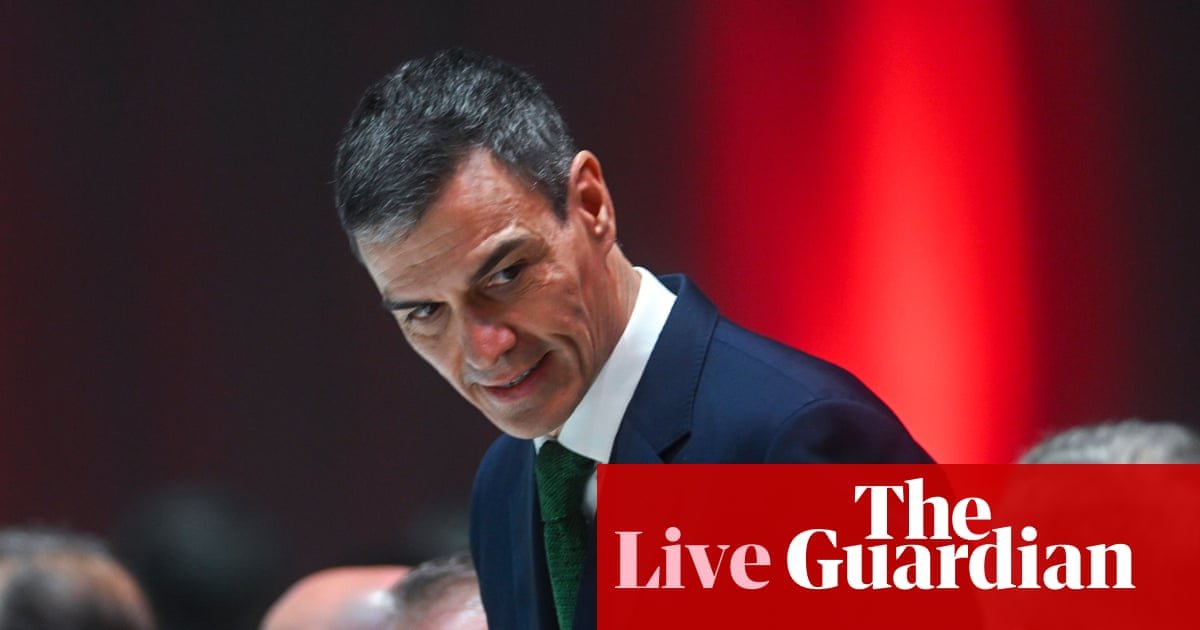
Spain’s prime minister, Pedro Sánchez, is due to make a statement at 9am local time to respond to Donald Trump’s extraordinary threat to cut of all trade with Spain over its refusal to allow two jointly operated bases in its territory to be used in the US’s ongoing strikes against Iran.
Last night, a European Commission spokesperson said: “The Commission will always ensure that the interests of the European Union are fully protected.”
Teresa Ribera, a former Spanish deputy prime minister who now serves as the EU’s green transition chief, has also pointed out that the EU’s external trade is negotiated as a bloc and that the European Commission is the relevant authority on the issue.
Speaking to Spain’s Cadena Ser radio just after 8am, Ribera said:
“At this moment, it isn’t possible to establish trade reprisals or separate trade relations … I think the most surprising thing about this fact is that the American federal government is unaware of this, and therefore it is necessary to insist, as the spokesperson for the European Commission did last night, that the trade negotiations of each and every one of the 27 member states of the EU are the responsibility of the Commission, and it is not possible to create a division or fragmentation among the member states.”
Ribera also said Trump’s threat to cease trading with Spain was reminiscent of his recent threat to seize control of Greenland.
“What we’re seeing is very similar to what happened just a month ago with those threats – also in a boastful tone – regarding Greenland. And the truth is, there was an immediate reaction from our EU partners, from the European Commission, and from the markets. I think that the instability; the tension generated by this way of relating to, or speaking about third parties – whether it’s about Starmer, Macron, or Pedro Sánchez – is deeply disruptive, not only for societies, for peace, for cooperation, but also for the economy. And it has immediate consequences for the overall economic activity of everyone.”
Other Spanish politicians have been more forthright. In a social media post last night, Yolanda Díaz, a deputy prime minister and Spain’s labour minister, wrote:
“Spain doesn’t take to being blackmailed or lectured by an aggressor country. We’re a country of peace. If the US wants an ally, let them begin by respecting our sovereignty and international law.”
But the Spanish government’s stance on the Iran strikes has been criticised by its opponents, who have accused Sánchez of posturing.
“Different opinions are welcome,” said Alberti Núñez Feijóo, the leader of Spain’s conservative People’s party. “What is no longer open to debate is that the government’s foreign policy is consistently irresponsible and that frivolity has consequences … We cannot jeopardise our security, our stability, and our position in the world in an attempt to win a few votes domestically.”
Morning opening: Spain faces Trump’s criticism and threats over Nato spending, use of bases
Jakub Krupa
Spain’s prime minister Pedro Sánchez is about to respond to harsh criticism from Donald Trump this morning after the US president said last night that “Spain has been terrible” on Iran and claimed to instruct his officials to “cut off all dealings with Spain.”
His comments were sparked by Spain’s insistence the US should not use their joint military bases in southern Spain for its operations in Iran, and Madrid’s reluctance to ramp up defence spending, as agreed within Nato.
Speaking alongside German chancellor Friedrich Merz, Trump said:
“First of all, it started when every European nation, at my request paid 5 percent, which they should be doing. And everybody was enthusiastic about it. Germany, everybody, and Spain didn’t do it, and now Spain actually said that we can’t use their bases. …
We could use their bases if we want, we could just fly in and use it. Nobody’s going to tell us not to use it, but we don’t have to, but they were unfriendly. And so, I told him we don’t want – Spain has absolutely nothing that we need other than great people, they have great people, but they don’t have great leadership.”
Curiously, Merz not only didn’t come to the rescue to an EU ally, but joined in as he said:
“The answer on that is quite simple. We are trying to convince Spain to catch up with the 3 percent or 3.5 percent, which we agreed on in Nato, and as the president said, it’s correct. Spain is the only one who is not willing to accept that, and we are trying to convince them that this is a part of our common security that we all have to comply with these numbers. … So, Spain has to comply with that.”
After leaving the White House, he sounded a bit differently, telling reporters:
“I said that Spain is a member of the European Union and we negotiate about tariffs with the United States only together or not at all. There is no way to treat Spain particularly badly.”
These comments sparked a big reaction over in Spain, and Sánchez is about to respond publicly in an “institutional statement.”
I will bring you all the key lines here.
Later, we will keep an eye on the latest on Cyprus and security situation in the region, about European evacuation flights from the Middle East, the EU’s Industrial Accelerator Act, and other key news from across the continent.
It’s Wednesday, 4 March 2026, it’s Jakub Krupa here, and this is Europe Live.
Good morning.


