



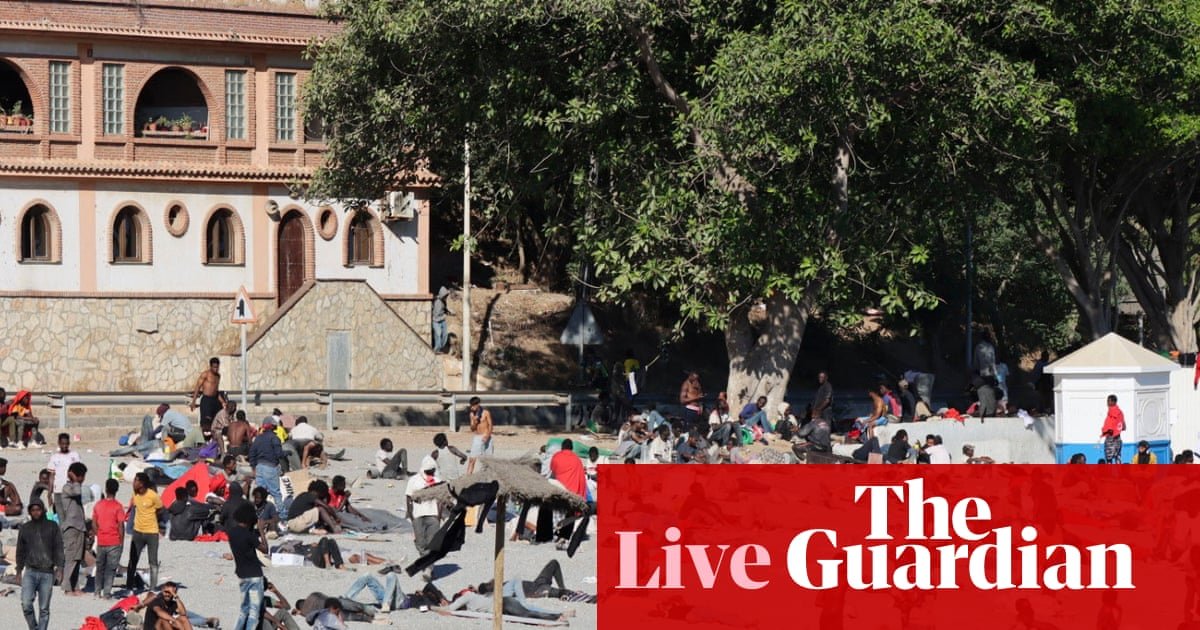
70,000 out of 72,000 migrants in Ceuta returned to Morocco, Spanish minister says
Spain’s interior minister Fernando Grande-Marlaska is also briefing the press right now.
He says all countries were “constructive” and acknowledged Spain’s immediate response.
He tells reporters that 70,000 of the estimated 72,000 that crossed in Cueta have now returned to Morocco.
Spain is “in the process of resolving” the status of the remaining individuals, and those who do not have the right to remain in the country will be returned to Morocco, he says.
But he goes out of his way to make it very clear that the EU’s Schengen area “was in no way compromised” by the crisis, with “no secondary movement, nor even the possibility of any.”
As we explained on Europe Live on Friday, Ceuta has a special status under the Schengen rules, meaning that all entries and exits to mainland Spain or the EU still require full border and document checks.
He says today’s meeting was “satisfactory” in recognising Spain’s work on irregular migration.
Key events
Brunner also gets pushed on whether Italy was right to reintroduce border controls with Spain in the aftermath of this crisis.
He isn’t that keen to be drawn on this either, and says it’s a decision for individual member states.
But he delicately pushed back, saying that it’s now clearer that there will be no onward migration to the EU or Schengen, which he says was not clear when Italy made its decision on Friday.
He says he understands the images made EU citizens concerned, and that’s why some countries wanted to react strongly.
The Guardian’s Brussels correspondent Jennifer Rankin follows up on the question of whether the EU would be prepared to back some further work on the so-called return hubs and put some money into these projects.
But Brunner is evasive in his answer: he says it’s a matter for separate financial negotiations, and goes back to his broader point about the EU’s push to reform its asylum and returns policies.
Brunner also says it was clear there was some “interference from smugglers and human traffickers,” with “misinformation” spread on social media.
But he distances himself from any attempt to put the blame on Morocco too.
He says the Spanish minister actually acknowledged the role Morocco played in bringing the situation under control.
He also says he cannot comment on this further as there is a formal investigation into the crisis that will look at these things.
Brunner gets asked about Italy’s push for return hubs (13:26).
He says the idea was mentioned by some countries, as he references not just Italy’s plans with Albania but also separate proposals by five or six other countries.
He says it is one of the options, but also points to the need to focus on reforming the agreed asylum procedures.
EU’s Brunner opens by acknowledging the Ceuta incident was a “test” of the EU’s resilience and the security of its external border, which he says the bloc “passed.”
He says ministers expressed “full solidarity with Spain.”
He says the Spanish government had a chance to “clarify” the situation and confirm that the situation has been contained and no onwards movement towards the EU or the Schengen area was recorded.
He sides with Spain on their interpretation that the border crisis was fueled by criminal smuggling networks and disinformation on social media, as he promised the bloc’s support to Ceuta and Spain to strengthen the border further.
EU’s migration commissioner briefing press on Ceuta border crisis
EU’s migration commissioner Brunner is also speaking now.
You can follow along live here:
No advance warning about possible migrant surge, Spanish minister says
Spain’s Grande-Marlaska also rejected suggestions that Spain was specifically warned about a potential surge at the Ceuta border, as sort of implied by a senior Moroccan official earlier today (11:31).
He says that if there had been any warning or signal of a similar surge, there would have been a much closer communication at the highest levels of the Spanish government.
He also says the plans to extend the maritime border infrastructure were already in place before last week’s crisis.
Grande-Marlaska also insisted that Spain will respect all fundamental rights of minors in Ceuta, but insisted there were no reason to suggest otherwise.
Ireland’s home affairs minister Jim O’Callaghan also offered his take on today’s meeting.
Ireland hosts the EU’s rotating presidency of the Council of the European Union, meaning it chairs the key meetings during this period.
In a diplomatically worded statement, O’Callaghan said:
“The EU is united and stands ready to support Spain and protect our external borders from illegal migration.
We commend Spain for their swift response to the situation in Ceuta and extend our deepest condolences for the tragic loss of life.
The EU’s external borders are our shared responsibility, and migration requires a united European response.
Today’s meeting which I convened provided an important opportunity for member states to assess the tools already at our disposal, identify where further cooperation is needed, and advance our collective preparations ahead of the next ministerial meeting and the European Council in October.”
The EU’s readout also added that there was “a common understanding on the need to continue relentlessly fighting migrant smuggling networks” and to “improve situational awareness” to prevent similar crises.
70,000 out of 72,000 migrants in Ceuta returned to Morocco, Spanish minister says
Spain’s interior minister Fernando Grande-Marlaska is also briefing the press right now.
He says all countries were “constructive” and acknowledged Spain’s immediate response.
He tells reporters that 70,000 of the estimated 72,000 that crossed in Cueta have now returned to Morocco.
Spain is “in the process of resolving” the status of the remaining individuals, and those who do not have the right to remain in the country will be returned to Morocco, he says.
But he goes out of his way to make it very clear that the EU’s Schengen area “was in no way compromised” by the crisis, with “no secondary movement, nor even the possibility of any.”
As we explained on Europe Live on Friday, Ceuta has a special status under the Schengen rules, meaning that all entries and exits to mainland Spain or the EU still require full border and document checks.
He says today’s meeting was “satisfactory” in recognising Spain’s work on irregular migration.
At least 75 people died in Ceuta border crisis, EU ministers told by Spain
Meanwhile, French interior minister Laurent Nuñez is currently on French TV, speaking after today’s meeting of the bloc’s ministers to discuss the latest on Ceuta.
He says that during the three-hour meeting, the ministers expressed their “solidarity” with Spain and praised how Madrid handled the crisis last week. (Erm, did not sound like it last week!)
He says the Spanish minister, Fernando Grande-Marlaska, told colleagues that some 70,000 crossed the border and were returned to Morocco.
75 dead bodies have been recovered so far, Grande-Malaska told ministers, stressing that this figure was “preliminary” and could rise further.
The ministers also discussed the measures taken by Spain to strengthen its border, including a new floating barrier.
(This may not sound like a lot, but it’s a legally critical point as it will clearly classify any attempt to cross the border as falling under one of the exceptions to the recent Supreme Court restrictive ruling on pushbacks, allowing authorities for speedier processing of repatriation.)
Nuñez also said the ministers were concerned by attempts to sow disinformation about the crisis and “interference” by foreign states in a bid to criticise the bloc and “sow division” among the member states.
He says France remains available to help Spain in whatever way possible. In this context, he mentions France’s decision to strengthen its checks on borders with Spain to prevent “secondary movements,” including towards France and the UK.
The minister also stresses the need to fight against human smuggling gangs, including the work “upstream” in the countries of origin.
He also says all countries strongly backed the EU’s Asylum and Migration Pact, which he called “indispensable” in fight against irregular migration.
Jakub Krupa
We will no doubt hear more about this proposal – and the EU’s initial response – from the bloc’s migration commissioner Brunner during his press conference in the next hour.
I will bring you the key lines here when it happens.
Italy pushes for EU-funded overseas migrant processing centres modelled on controversial Albania deal
Well, turns out you don’t quite need to be a fly on the wall to know what the EU ministers are talking about in the context of last week’s events in Ceuta, as some of them are actually quite keen to make their remarks public.
Italy is understood to have called for EU-funded migrant processing centres and return hubs in third countries, with interior minister Matteo Piantedosi telling ministers that they “must act as a united, cohesive bloc to stop departures at their source and return those who have no right to remain on EU territory,” a copy of his speech released by his office showed.
“Now the time has come to put into practice new hub models for the external processing of asylum procedures and for returns in safe third countries,” he was quoted by Reuters as saying.
But as we extensively covered in the Guardian, the apparent model for this solution – Italy’s controversial deal with Albania – has faced numerous legal challenges.
The Council of Europe’s commissioner for human rights Michael O’Flaherty wrote for us last month saying that “without iron-clad legal safeguards, offshore migration centres can only repeat the worst mistakes of the recent past.”
Czechia, Slovakia report record-breaking nighttime temperatures
Other countries in central and eastern Europe are also reporting disruptions caused by the extreme weather conditions.
The Czech Republic has recorded the highest nighttime temperature since records began, with 27.9 C in Bystřice pod Hostýnem, ČT24 reported.
Similar record was broken across the border, in Slovakia, with 27.5 C overnight in Plavecký Peter, surpassing the previous record from 2013, Pravda reported.
Temperatures are expected to rise up to 39C later today.
Jakub Krupa
Oh, interesting: the EU migration commissioner Brunner’s press conference has just been pushed back by about an hour as the meeting is still ongoing.
It’s now expected not before 2pm local time (1pm UK).
Oh, to be a fly on the wall on that call.


