






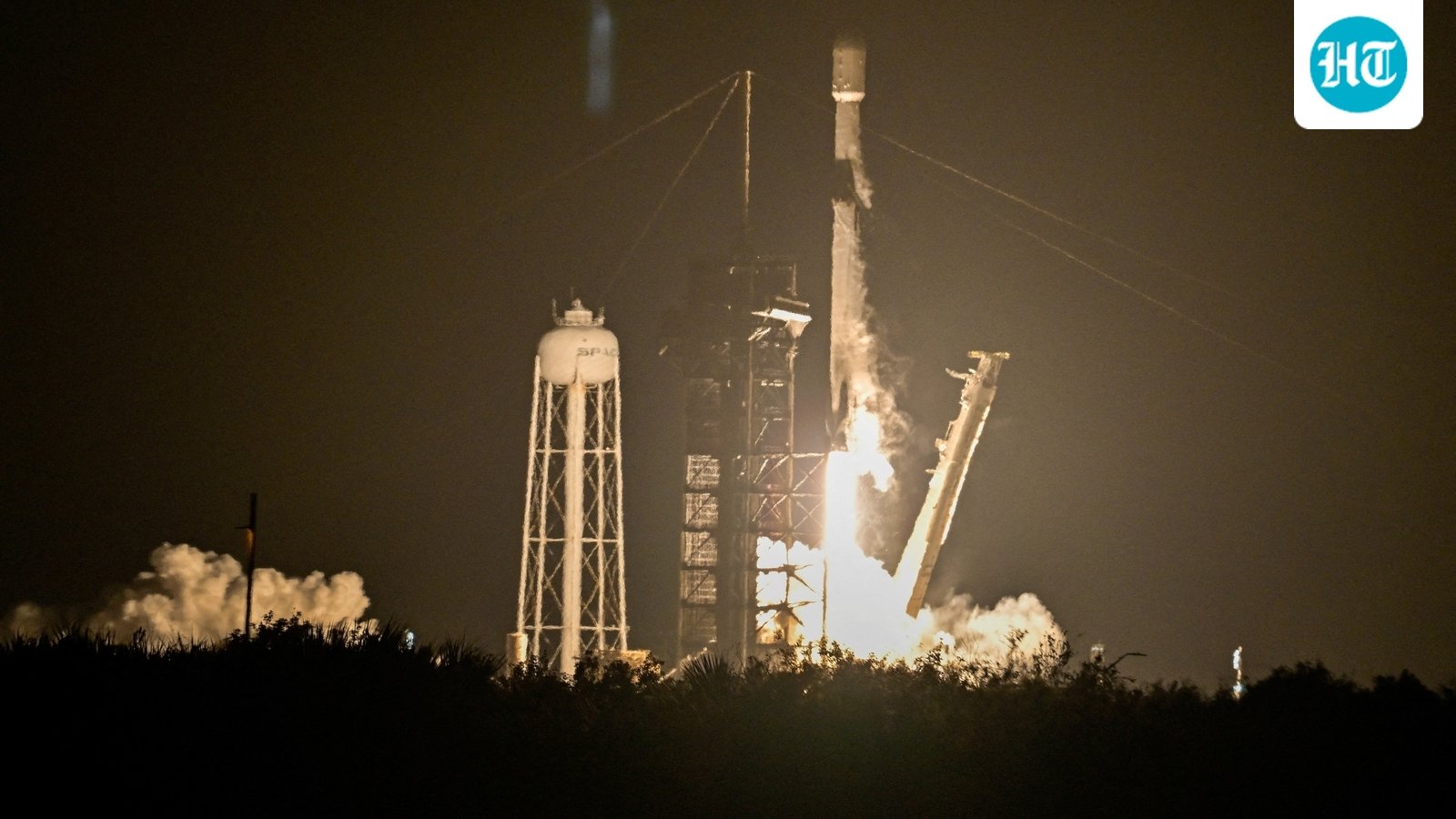
A discarded SpaceX Falcon 9 rocket stage is set to crash into the Moon today in a rare human-made impact that scientists say could offer valuable insights into how craters form. According to Space.com, the Falcon 9 upper stage, left over from the January 2025 launch of Firefly Aerospace’s Blue Ghost and ispace’s Hakuto-R lunar missions, is expected to strike the Moon at 2:35 am EDT (0635 UTC) on August 5.

The 45-foot-long (13.8-meter) rocket stage, weighing about 9,000 pounds (around 4,000 kilograms), is expected to hit near Einstein Crater on the Moon’s Earth-facing side at a speed of roughly 5,400 mph (8,700 km/h).
Will the SpaceX rocket impact be visible from Earth?
According to Space.com, the impact flash itself will probably not be visible because the rocket is expected to strike a sunlit section of the Moon near its western limb. The brightness of the lunar surface is likely to wash out any flash created by the collision.
However, astronomers say there is a chance observers could see an ejecta plume, a cloud of dust and debris thrown high above the Moon’s surface.
Astronomer Bill Gray, who first identified the rocket stage’s eventual lunar collision, wrote on the Project Pluto website: “Maybe we’ll see the flash. Maybe we’ll see rocks ejected from the crater. Maybe we’ll even see both.”
Recent simulations cited by Space.com suggest the central ejecta plume could rise as high as 60 miles (100 kilometers) above the lunar surface, though it remains uncertain whether it will be bright enough to detect from Earth.
Who will have the best chance of seeing it?
Viewing conditions are expected to vary by location.
According to Project Pluto, the Moon will be relatively low above the southeastern horizon for observers along the US East Coast at the time of impact, making viewing conditions less than ideal.
Observers in parts of South America are expected to have a better view because the Moon will be positioned higher in the sky. Scientists say advanced amateur astronomers using large telescopes and sensitive cameras will have the best chance of spotting any debris plume.
Why are scientists interested in the crash?
Even if the impact cannot be seen from Earth, several spacecraft will observe it from much closer.
According to Space.com, South Korea’s Danuri lunar orbiter is expected to monitor the collision in real time, while NASA’s Lunar Reconnaissance Orbiter (LRO) will photograph the impact site before and after the crash to measure the newly formed crater.
Researchers say the event presents a rare scientific opportunity because, unlike a natural meteoroid, the Falcon 9 rocket stage has a known size, mass and velocity. That will allow scientists to test impact models and improve understanding of how craters form on the Moon.
The observations could also help researchers better assess the hazards posed by space debris as both crewed and robotic lunar missions become increasingly common.


