



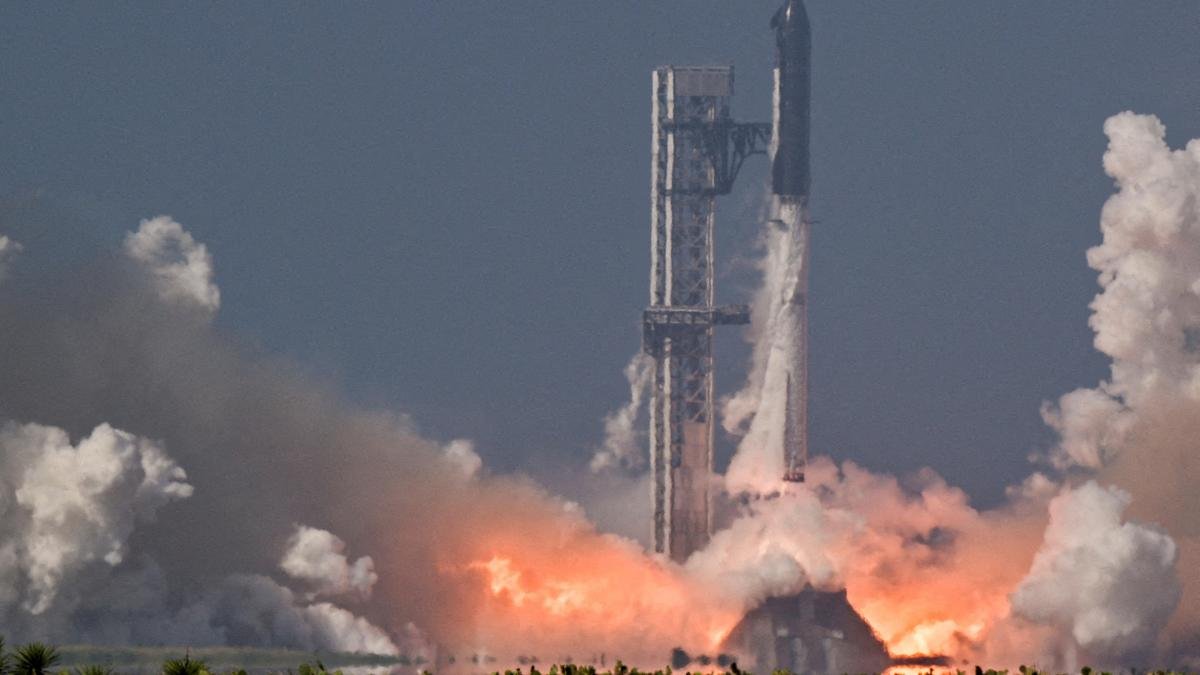
The SpaceX initial public offering (IPO), set for June 12, on Nasdaq (SPCX) is expected to be the largest single listing in history. The company is targeting a $75 billion raise at a valuation of $1.75-2 trillion.
SpaceX is seeking a large liquidity influx to fund its Orbital Data Centre (ODC) initiative and terrestrial expansion of its artificial intelligence (AI) unit. The prospectus also reveals a mandatory “deleveraging” requirement whereby SpaceX must use its IPO proceeds to repay a $20 billion bridge loan within six months.
Early headwinds
Investors are already scrutinising the “Frankenco” structure of the company, where profits from the space-based Internet service Starlink are being used to offset xAI’s heavy losses, nearly $6.4 billion in 2025 alone.
Starlink is facing headwinds of its own. In May, in a bid to protect competitors like Eutelsat and OneWeb, the European Commission proposed new regulations to limit third-country, including U.S., satellite operators to only one-third of Europe’s bandwidth. This significantly shrinks Starlink’s market in a high-wealth region. Second, as more direct-to-cell services launch, the amount of noise in protected radio bands increases. Regulators are thus becoming more conservative with spectrum grants, thus imposing a ceiling on Starlink’s data throughput.
While pre-IPO deals with Google and Anthropic provide revenue bridge capacity, investor scepticism has stayed high. Analysts at Morningstar have already warned of a valuation bubble, pegging the company’s fair value at just $780 billion, which is less than half of SpaceX’s target.
Sceptics are also motivated by independent experts calling into question the viability of Musk’s ODC plans.
Financial complexity
In March, SpaceX secured a $20 billion bridge loan led by Goldman Sachs. A bridge loan is a short-term loan, usually for 6-18 months, for immediate liquidity until a larger and more permanent funding event, like an IPO, happens. This loan was used to retire $17.5 billion of high-interest junk debt sitting on the balance sheets of X and xAI. SpaceX’s S-1 filing clearly states that the company is required to use a portion of its IPO proceeds to repay this loan within six months.
Normally, an IPO generates capital for growth; in this case, that would be money to build more rockets. However, here, a significant portion of the $75 billion raised will be non-productive capital as it won’t go into R&D but to pay off a loan.
Likewise, in February 2026, SpaceX officially merged with xAI, folding the social network X (a subsidiary of xAI) and the Grok AI model into the SpaceX corporate structure. Morningstar analysts had flagged this as a “related-party transaction” (RPTs). That is, because Musk controlled all the involved entities, the price of the merger — $250 billion for xAI — was determined not by the open market but by internal deliberations. Investors generally dislike RPTs for this reason.
Morningstar’s scepticism was further bolstered by the fact that xAI was burning cash, and by merging it into SpaceX, its losses were being hidden inside the considerable revenue from Starlink. As a result, investors could have a harder time calculating the real burn rate of SpaceX’s core rocket business.
SpaceX’s AI push
The new valuation of $1.75-2 trillion also rests on the assumption that SpaceX will own the ‘rails’ of the AI economy. As part of this, SpaceX has proposed a new semiconductors fabricating facility dubbed Terafab in Grimes County, Texas, at a cost of $55-119 billion. The goal is to manufacture 1 terawatt of internal computing capacity per year. This will be in the form of custom GPUs for xAI models and SpaceX satellites.
In an IPO, however, this asks investors to buy shares based on what money SpaceX is making now from its existing businesses as well as the performance of a chip-making factory it has yet to build. Critics have already argued that SpaceX is trying to solve a supply-chain bottleneck by becoming its own supplier for the world’s most complex product — custom GPUs — which could lead to long delays.
The proposed ODC is tied to this. According to the filing with the U.S. Federal Communications Commission, the constellation will have 1 million satellites with computing accelerators. The pitch seems to be that AI models running in orbit will be able to harvest 24/7 solar energy and bypass terrestrial land-use regulations. But it is no coincidence that to justify a $2 trillion valuation, SpaceX needs a total addressable market (TAM) larger than just launch services — and this is the ODC, an attempt to claim the AI cloud computing TAM.
However, thanks to risks like orbital debris, the insurance premiums and regulatory fines on the ODC alone could make all of SpaceX uninvestable.
Finally, to bolster the IPO, SpaceX signed a $30 billion agreement with Google through 2029 as part of which Google will pay around $920 million every month before the IPO to access SpaceX’s AI chip clusters, as bridge capacity for Google’s Gemini AI models. While this is SpaceX’s attempt to show that its AI-in-orbit business can be profitable, the catch is that Google is renting SpaceX’s terrestrial resources.
Concerns about the ODC
Independent experts have already raised serious questions about how a server in earth orbit will shed heat fast enough to keep operating — a considerable engineering challenge on the ground even with convection (the natural movement of air from warmer to cooler areas) to help. There is no air in space, however, so there is no convective cooling.
Another option is radiation, but here the Stefan-Boltzmann law. Effectively, to shed 1 MW of waste heat — corresponding to a small terrestrial datacenter — at 20° C, a satellite will need around 1,200 sq. m of radiator area, larger than the wingspan of a Boeing 747. Engineering sceptics have already estimated that the mass of the radiators required to cool a gigawatt-scale computational facility in orbit would make the satellites too heavy to be cost-effective, even with Starship’s reduced launch costs.
Second, high-performance AI chips, like the NVIDIA H100s or SpaceX’s custom silicon, are very sensitive to single-event upsets (SEUs) from cosmic rays. In an SEU, a single charged particle striking a sensitive part of a microelectronic device can change its state. So these chips will have to be ‘hardened’ to radiation, which will reduce their performance by orders of magnitude. An alternative plan to launch consumer-grade chips and replace them every 2-3 years would heighten the space debris risk and inflate costs beyond profitability.
Gambler’s scheme
By using SpaceX IPO proceeds to pay off the bridge loan, Musk is effectively shifting debt from a private, struggling entity to a public and successful one. Second, if the $1.75 trillion valuation is the “bubble” Morningstar suggests it is, new investors will essentially provide the exit liquidity for the banks. Third, even if SpaceX captures 100% of the global launch market, that is only a roughly $20 billion/year industry. And if the ODC is physically impossible or economically unviable due to the cooling constraints, the $2 trillion valuation will effectively be based on a phantom product. Finally, by announcing a capital-intensive project in the form of Terafab, SpaceX is trying to force the market to keep funding it.
Taken together, it has many signs of a Ponzi scheme — but it isn’t one. Instead, it is a gamble. Musk is betting that he can build Terafab and the ODC fast enough for the revenue they generate to dwarf the $20 billion debt he dumped into the company. But this is also why the S&P 500, perhaps the gold standard for stability and retirement funds, has refused to waive its strict inclusion rules for SpaceX, essentially calling Musk’s bluff on the company’s financial health.
Ultimately, if the ODC also fails, SpaceX will be left a successful rocket company with an unsustainable debt load and a stock price that could drop 70-80% once the AI hype has been stripped off.
mukunth.v@thehindu.co.in


