



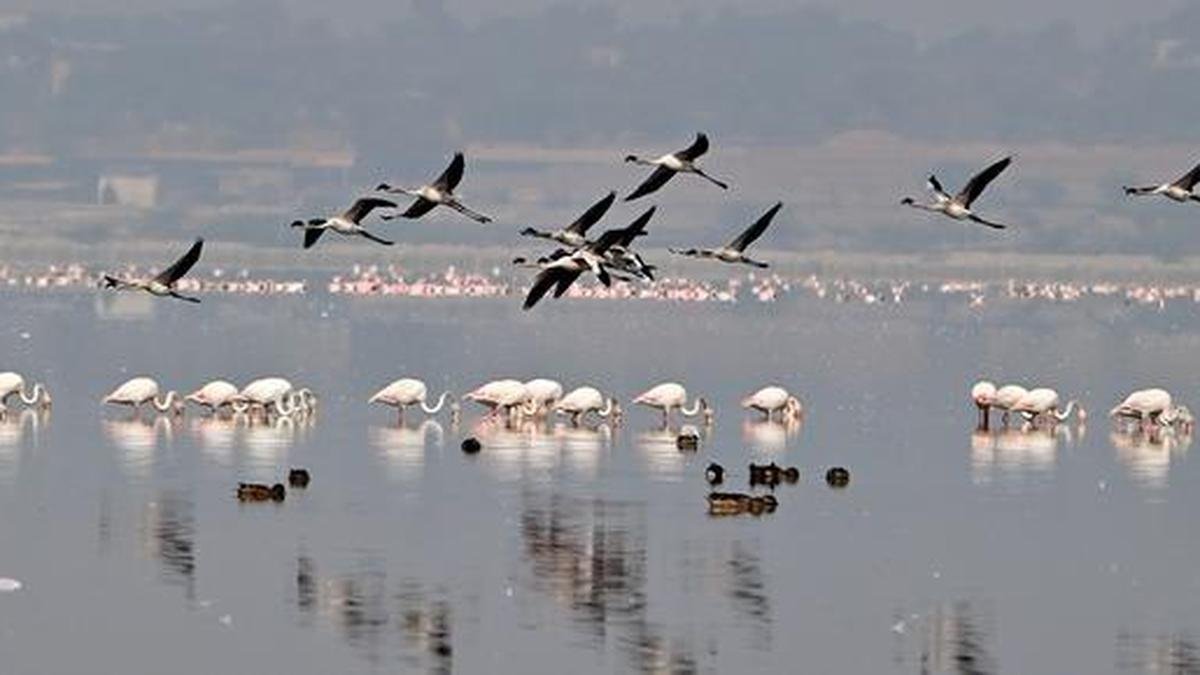
Flamingos at Sambhar Lake near Jaipur, Rajasthan.
| Photo Credit: MOORTHY R.V./The Hindu
Industrial salt pans threaten Sambhar Lake’s survival
Sambhar Lake is India’s largest inland saltwater wetland. When they analysed satellite data from 1984 to 2023, scientists found the lake depends heavily on seasonal rain, with water levels peaking in late summer and shrinking significantly in the dry season. Between 2022 and 2023, the lake’s surface also shrank while salt pans nearby expanded. The authors said efforts to conserve the lake must separate industrial salt pans and the wetland environment, including natural saline land.
AI models fail simple distraction test that humans pass
Humans use an ability called executive control to focus their attention on tasks and ignore distractions. Researchers used the Stroop task, asking AI models to name the ink colour of words while ignoring the text, like ‘BLUE’ written in red. While the models did well on short word lists, the models’ executive controls nosedived as the lists got longer, unlike humans. The results suggest current AI models will need additional controls to achieve general intelligence.
When eating insects, Europeans start on the back foot
Insect shells have a tough material called chitin. Humans have to digest chitin if they eat insects. When researchers analysed two genes that produce chitin-digesting enzymes in the stomach, they found people in the tropics had the variants that improve digestibility. However, Europeans had the gene variants that significantly reduced these enzymes’ levels. The team also confirmed these genetic differences existed around 9,000 years ago. In a world with insect foods, Europeans could be disadvantaged.
Published – June 07, 2026 08:00 am IST


