



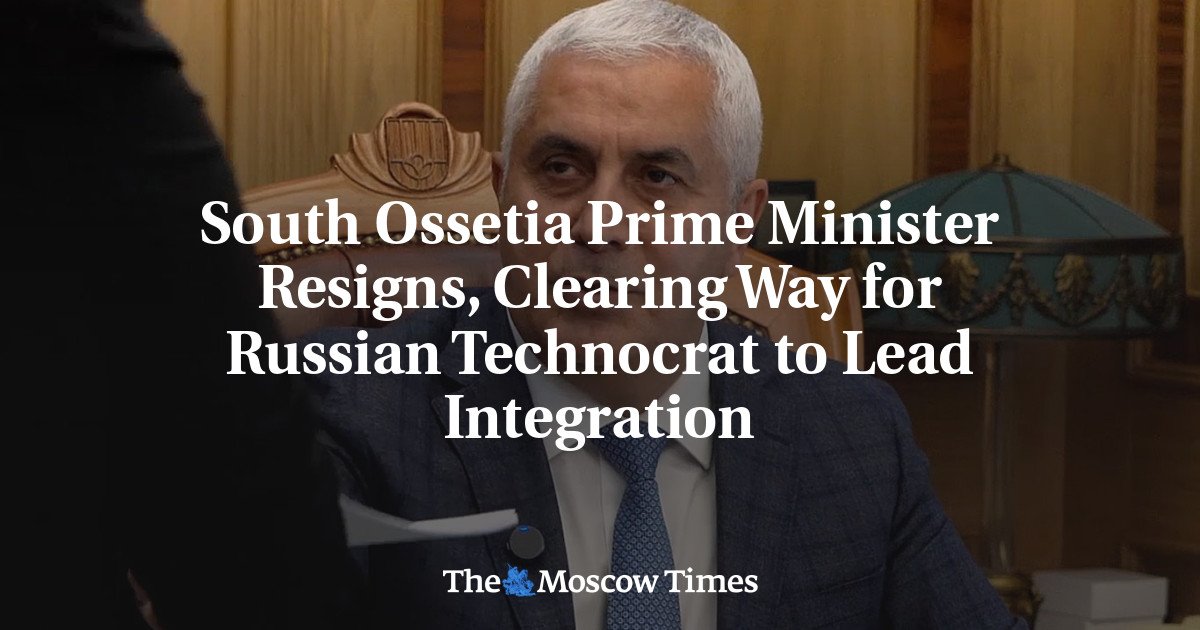
The prime minister of the Georgian breakaway region of South Ossetia stepped down on Monday, paving the way for a Russian technocrat to take up the post following the recent ratification of a major integration agreement with Moscow.
South Ossetia’s Moscow-backed president, Alan Gagloyev, accepted the resignation of Prime Minister Dzambolat Tadtoyev during a cabinet meeting.
While Gagloyev temporarily appointed one of Tadtoyev’s deputies as interim prime minister, he announced plans to submit the candidacy of Marat Kambolov to local lawmakers for a confirmation vote.
The leadership shuffle comes on the heels of an agreement ratified last month by Russian President Vladimir Putin, which seeks to align South Ossetia’s laws closer to Russia’s.
Under the deal, Moscow commits to providing social support benefits to the local population and boosting living standards. Putin emphasized the trade, economic and social cooperation of the arrangement, while Gagloyev hailed it as “the beginning of the reunification of the Ossetian people.”
According to the newspaper Kommersant, Kambolov is a native of the Republic of North Ossetia in Russia’s North Caucasus. He served as Russia’s deputy education minister between 2010 and 2014 before holding senior positions at the Kurchatov Institute — a major nuclear research center — where he served as director between 2021 and 2025.
As prime minister, Kambolov would be tasked with overseeing the implementation of the integration deal between South Ossetia and Russia, according to an official statement.
South Ossetia, along with the Black Sea region of Abkhazia, is recognized internationally as part of Georgia but has been under de facto Russian control since the two countries fought a brief war in August 2008. Russia maintains military bases in both breakaway territories.
A Message from The Moscow Times:
Dear readers,
We are facing unprecedented challenges. Russia’s Prosecutor General’s Office has designated The Moscow Times as an “undesirable” organization, criminalizing our work and putting our staff at risk of prosecution. This follows our earlier unjust labeling as a “foreign agent.”
These actions are direct attempts to silence independent journalism in Russia. The authorities claim our work “discredits the decisions of the Russian leadership.” We see things differently: we strive to provide accurate, unbiased reporting on Russia.
We, the journalists of The Moscow Times, refuse to be silenced. But to continue our work, we need your help.
Your support, no matter how small, makes a world of difference. If you can, please support us monthly starting from just $2. It’s quick to set up, and every contribution makes a significant impact.
By supporting The Moscow Times, you’re defending open, independent journalism in the face of repression. Thank you for standing with us.
Continue
Not ready to support today?
Remind me later.
×
Remind me next month
Thank you! Your reminder is set.


