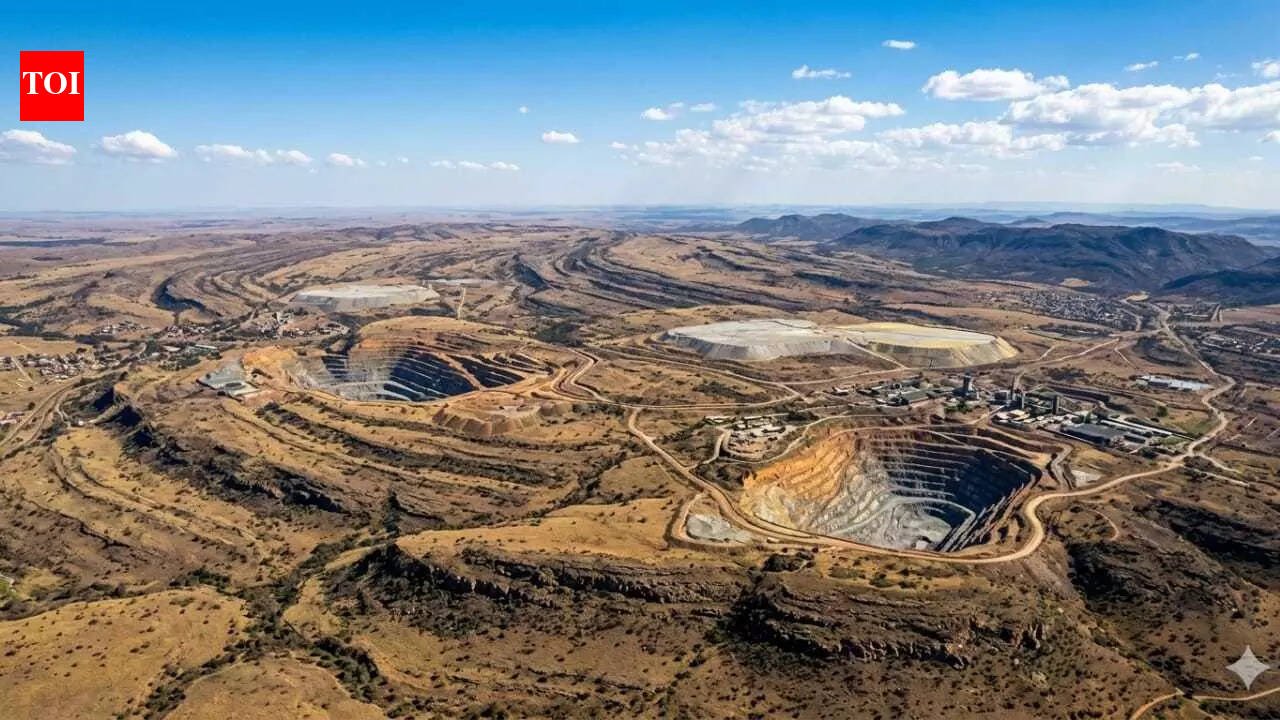
Witwatersrand Basin in South Africa, since the Archean Eon which is roughly 2.7 billion years old. This isn’t just an ordinary heap of debris sitting on metals; it’s one of the main contributing factors in the geology as well as the economy of the whole continent. The landscape across Johannesburg looks barren and scarred due to mining towers and highways under construction, but this guise veils what sits underneath.Geological studies and mining records show that roughly 40 percent of all the gold ever extracted on the entire planet came from this single basin. Witwatersrand Basin remains the only region on Earth to have sustained that level of production for more than a century of continuous mining.
How 3-billion-year-old rivers concentrated gold in South Africa
The Witwatersrand Basin isn’t just a towering mountain of metal. Rather, it’s a vast sedimentary basin composed of layered rocks that once shaped ancient river systems, floodplains, and shallow inland seas. Nearly three billion years ago, rivers coursed over volcanic landscapes called greenstone belts, eroding mineral-laden rocks and sweeping fragments downstream.Gold, being so dense, sinks rapidly in flowing water. Over time, it built up in gravel bars and riverbeds. As sediments stacked higher, these deposits got buried and squeezed tight. Heat and pressure transformed them into tough conglomerates, fossilising the original river gravels in stone. Geologists call this a palaeoplacer, an ancient placer deposit turned to rock.Many gold grains in those conglomerates still show rounded edges, just like bits tumbled by water. That clue fuelled fierce scientific rows over how the deposits formed. Instead of crystallising deep underground in later hydrothermal veins, much of the gold seems to have gathered on Earth’s surface during the Archaean era, then sealed away as continents collided and bulked up.
What researchers confirmed about the basin
For much of the twentieth century, scientists argued whether the gold in South Africa’s Witwatersrand Basin came solely from ancient river action or if later hydrothermal fluids were the main driver. Modern geochemical studies have finally shed light on the matter.Researchers from the University of Arizona examined isotopic signatures in the basin’s minerals, uncovering evidence that points to erosion from nearby greenstone belts in the Archaean era. Their results back the palaeoplacer model. The data bolsters the view that rivers concentrated the gold initially, with subsequent burial and tectonic forces preserving and reshaping the deposits.The surrounding rocks date back between about 2.7 and 3 billion years, a period when microbial life ruled Earth and complex plants or animals were yet to appear. Thus, the basin doesn’t just hold immense gold reserves; it also archives the story of early continental growth.
How Johannesburg came into existence: the 1886 era
President Paul Kruger proclaimed the area open for public diggings on 20 September 1886, transforming a makeshift tented camp into a thriving settlement. Officials surveyed Randjeslaagte, a strategic wedge of government land between farms and auctioned the first 600 stands on 8 December. They named it Johannesburg after surveyors Christiaan Johannes Joubert and Johann Rissik, fusing their names with “burg” for town.By early 1887, Ferreira’s Camp (soon renamed Ferreira’s Township) was home to 3,000 people. A health committee was established in November, managing a three-mile radius around the market square. Within a decade, the population surged past 100,000, establishing Joburg as a mining powerhouse tied to the Witwatersrand Basin’s ancient gold reefs.
Ongoing research and mining at the basin
As near-surface ore bodies ran dry, mining operations delved ever deeper into the Earth’s crust. The Witwatersrand Basin earned a reputation for pioneering some of the world’s most sophisticated deep-level mining. Several shafts plunge over four kilometres underground, where rock temperatures often top 50°C and intense pressures heighten the danger of seismic rock bursts.To keep things running, companies fitted massive refrigeration systems to chill the work zones and installed robust, reinforced supports to shore up the tunnels. These formidable challenges never stopped production. For over a century, the basin kept churning out staggering amounts of gold, even as yearly yields slowly dropped from their heyday.Formed in the Archaean era and first tapped in 1886, the Witwatersrand Basin continues to account for roughly 40 percent of all gold mined in modern history, based on industry records and geological surveys.