






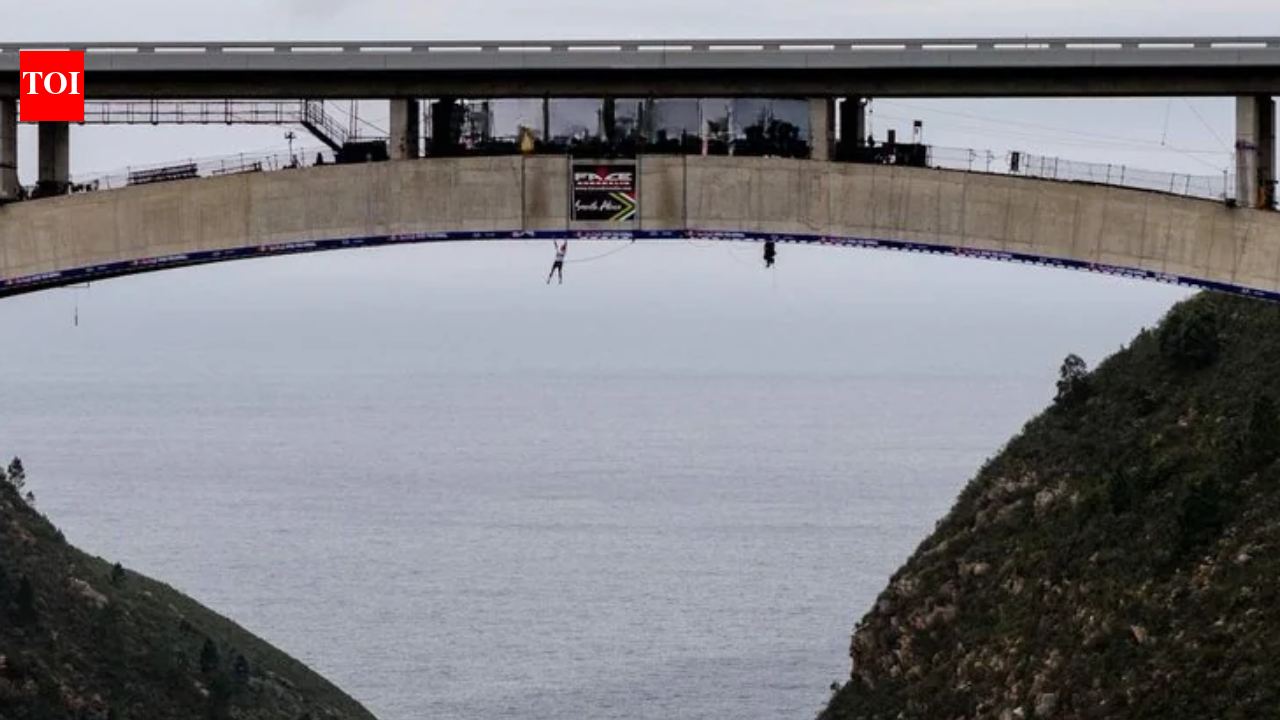
A South African obstacle course racing champion has completed a daring crossing beneath one of the country’s most famous bridges, gripping 600 suspended monkey bars 216 metres above the river below and traversing more than 280 metres in 47 minutes and 37 seconds. Thomas van Tonder completed the Red Bull Bridge Bars challenge beneath Bloukrans Bridge on October 26, 2026, in what organisers described as a world-first feat. According to Red Bull’s official report, the specially constructed course followed the bridge’s arch, forcing the athlete to climb an incline, cross the highest section and descend on the other side using only his hands.The crossing tested Van Tonder’s grip strength, endurance and mental resilience, even after months of preparation. The athlete, an obstacle course racing world champion, said the challenge pushed him beyond what he had expected and that the continuous strain on his hands and arms was considerably more demanding than his training simulations.“I have finished what I started. I set the big, crazy goal, and we actually got it done,” Van Tonder said after reaching the other side, according to Red Bull.
A 45-degree climb at the start
The course was designed to follow the shape of Bloukrans Bridge’s arch rather than take a straight route across its upper section. It began with a steep, approximately 45-degree ascent, continued over a shorter, flatter section near the crown and ended with a controlled descent. Van Tonder had to pull himself from bar to bar throughout the crossing, with no opportunity to walk or rest normally. The opening climb proved particularly demanding because it forced him to work against gravity while maintaining a secure grip on the suspended bars.The athlete began the crossing at 10.21 am with a heart rate of 150 beats per minute. By the time he reached the middle of the structure, fatigue had set in more heavily than he had anticipated. Van Tonder had expected his training simulations to prepare him for the duration of the attempt. However, the continuous load on the same muscle groups made the real crossing substantially harder.He said he had initially expected to finish in about 30 minutes, allowing up to 35 minutes if conditions proved difficult. When he checked his watch near the middle and realised he had already spent around 30 minutes on the course, he began to question whether his hands would hold up until the end. “I underestimated how tired my body would be by the time I made it to the middle,” he said, according to IOL.
Grip strength tested on the descent
Reaching the crown of the bridge brought little relief. Van Tonder still had to navigate the descent, where gravity increased his speed between bars and made controlling his momentum essential. As the crossing continued, the tape protecting his fingers began to wear through. His grip weakened under the sustained strain, forcing him to concentrate on individual bars and smaller sections of the remaining distance rather than the entire course.In comments reported by The Citizen, Van Tonder said the incline had humbled him despite his confidence going into the attempt. The athlete had trained extensively for the challenge, but the physical demands of the suspended route proved difficult to replicate on the ground. He also had to manage his position carefully when fatigue set in. The combination of exhaustion, changing gradients and the need to maintain control made the crossing as much a test of concentration as of upper-body strength. The attempt was completed in one continuous crossing, with Van Tonder reaching the opposite side after negotiating all 600 bars.
Months of preparation for a world-first attempt
The crossing was the culmination of a goal Van Tonder had been pursuing for approximately two years. Before the attempt, he trained for six months on a purpose-built rig featuring almost 50 metres of uphill monkey bars at home. The training structure helped him prepare for the steep ascent, but the actual bridge presented a different challenge because of the length of the course and the sustained effort required to complete it.Van Tonder could have attempted a simpler, straighter route across the bridge’s upper section. Instead, he chose the arch, which required him to climb upwards before descending the other side. “This is by no means something I know I can do, which means it’s the right challenge,” he said before the attempt, according to South African tourism agency South African Tourism.The athlete was not new to extreme physical challenges. He became an obstacle course racing world champion over 100 metres in 2019 and set a Guinness World Record for a 50-metre rope climb in 2020, according to Red Bull. He also won the inaugural Red Bull Rancher Strong competition in 2025.
Safety system built without drilling into bridge
The course required a specialised rigging and safety system. Richard Lievaart, head of rigging and safety director at Vertical Safety Systems, and his team constructed the setup with two independent safety points. According to Red Bull, no permanent fixtures were installed in the bridge, and nothing was bolted or drilled into the structure. The arrangement allowed the suspended bars to follow the arch while maintaining independent safety connections.Bloukrans Bridge carries the N2 highway between South Africa’s Western Cape and Eastern Cape provinces. Standing 216 metres above the river, it is known for its bungee-jumping attraction and has become a prominent destination for adventure tourism.The Red Bull Bridge Bars crossing added a different kind of challenge to the landmark, replacing a conventional walk across a bridge with a test of sustained grip and endurance beneath its arch.For Van Tonder, the successful crossing turned a long-standing ambition into reality. What began as an ambitious personal goal became a world-first achievement that required months of preparation, careful safety planning and nearly 48 minutes of continuous effort suspended high above the river.


