



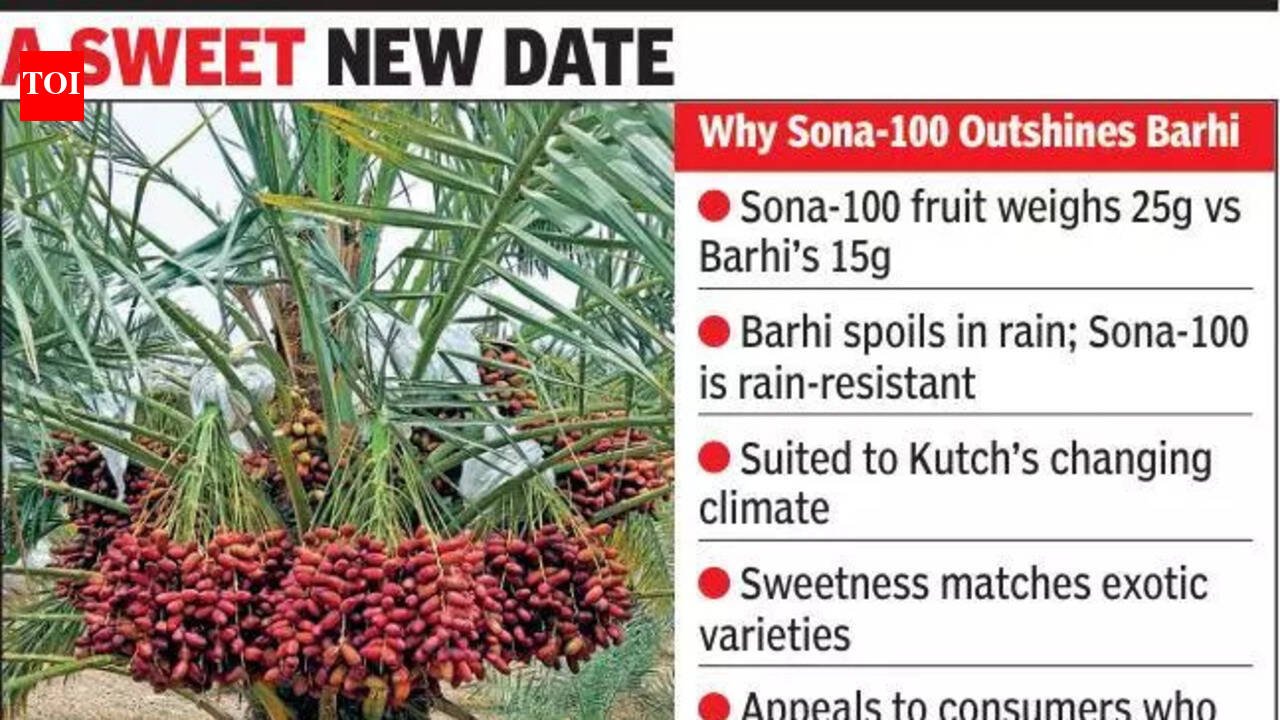
Rajkot: For years, date farmers in Kutch have endured losses they never imagined. Dates typically ripen in June, and until recently, the monsoon arrived only by mid-July. That buffer once gave growers enough time to harvest and sell a quality crop. But shifting climate patterns have disrupted that rhythm. Early monsoon showers in June have repeatedly spoiled fruit still hanging on trees.Many farmers, fearing total loss, were forced to sell half-ripe dates. Those with later-maturing crops had even fewer choices, often offloading rain-damaged fruit at throwaway prices. The buzz that once surrounded the Barhi variety faded as farmers struggled to cope with unpredictable weather. Now, a resilient indigenous variety is rewriting that script. A homegrown date palm cultivar developed in Kutch has reached a milestone: registration from the Protection of Plant Varieties & Farmers’ Rights Authority (PPVFRA). The achievement came under the guidance of the Date Palm Research Centre in Mundra, which operates under Sardarkrushinagar Dantiwada Agricultural University. In an inspiring gesture, the farmer who first grew the variety voluntarily surrendered his exclusive rights, opening it to growers everywhere. Named ‘Sona-100′, the variety has won attention for its sweetness, flavour, and most importantly, its ability to withstand early monsoon rain. The variety was first spotted in 2010 on the farm of Meghraj Barot in Zarpara village of Mundra taluka. It emerged naturally from seeds he had sown. While the popular Barhi — often called “Israeli dates” — is prized for its quality, Sona-100 surpasses it in sweetness and fruit size. Crucially, it has shown remarkable resilience in changing weather patterns. “Dates usually come in June and the monsoon begins in Kutch in mid-July, but for the last few years, the monsoon has started hitting by June, which spoils the date crop,” said Devsi Ahir, associate research scientist and unit head at the Date Palm Research Centre in Mundra. Ahir and his team played a key role in identifying and registering the variety. “We tested these dates during the rain. It could tolerate up to 20 inches (500mm) of rain. That means the fruit will not spoil due to an early monsoon,” Ahir said. Beyond rain tolerance, Sona-100 boasts a total soluble solids (TSS) level of about 30 — slightly higher than other varieties — and a fruit size of 25g compared with Barhi’s 15g. The research centre spent years validating and propagating the variety. Offshoots were sent to a Hyderabad lab for tissue culture in 2010, and by 2018, 100 plants grown at the centre had fruited, confirming its unique traits. Today, an estimated 10,000 Sona-100 plants have been planted across Kutch, offering farmers renewed optimism. The registration has proved a boon for growers. “There is huge demand for this variety among farmers; they are replacing exotic varieties like Barhi with it because the farmer decided to let the variety be available to the public,” Ahir said. “After this registration, farmers will get govt attention, and this variety will get recognition and be known in other parts of the country and outside India,” he added. The variety is registered under the name of Meghraj Barot, the farmer who first grew it. Barot spoke fondly of how the name was chosen: “The scientists came to my farm and wanted to give this variety a name. I proposed it be named after my daughter, Sona, and they agreed.” The Date Palm Research Centre — with former director C M Murlidharan, scientist Kapil Sharma, and Ahir playing key roles — has ensured that this indigenous gem finally receives recognition. Kutch today has an estimated 20 lakh date trees spread over 19,000 hectares, with an annual production of about 1.8 lakh metric tonnes. With Sona-100, farmers hope the future will taste sweeter again.


