



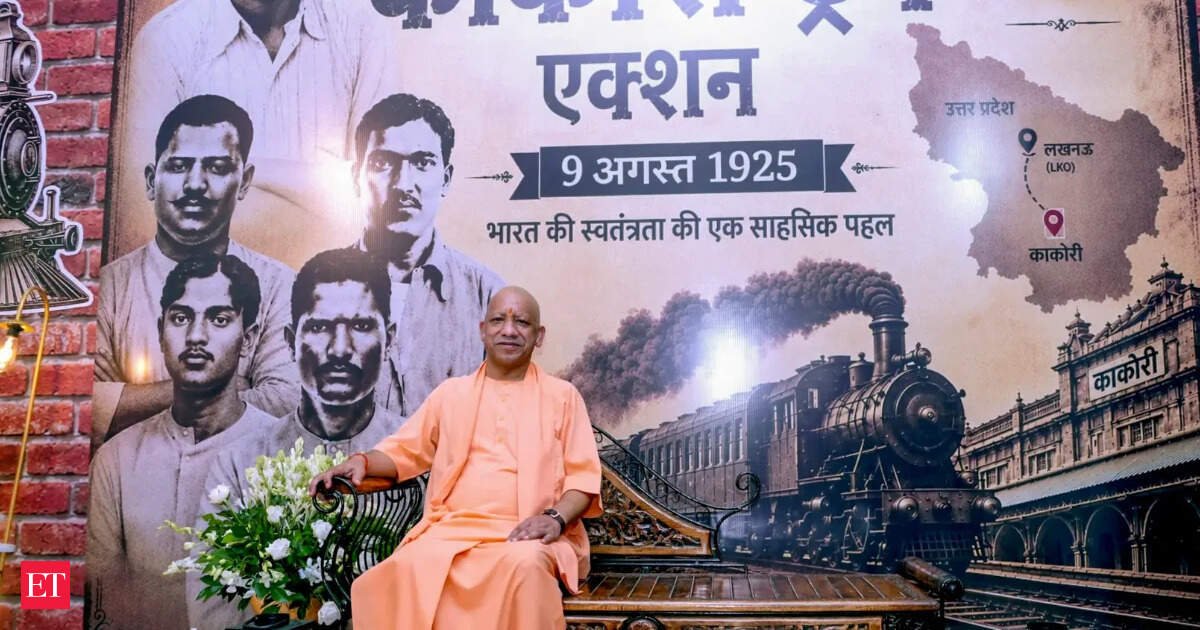
Addressing the inaugural programme of the ‘Kakori Train Action Centenary Celebrations’ at Kakori, Adityanath alleged there has been a conspiracy to keep the present generation of people from taking pride in many of the country’s revolutionaries.
He said after Independence, institutions were named after members of “one khandaan”, a veiled reference to the Nehru-Gandhi family, but after Narendra Modi became prime minister in 2014, many freedom fighters are getting their due.
The chief minister also appealed to people to hoist the national flag at every home on Independence Day and ensure that “Vande Mataram” is sung at institutions.
“India did not become enslaved without reason. India’s slavery was due to our internal divisions and conspiracies against us. Even today, certain forces are working to weaken India in the name of caste, region and language are continuing such conspiracies,” he said on the 101st anniversary of the historic Kakori train action that happened on August 9, 1925.
“These conspiracies now have a third medium — the social media platform. All anti-India forces are misusing this platform to create rumours against India, misuse it and make a malicious attempt to mislead society through such conspiracies,” he said.
The chief minister said those who kept the younger generation away from the country’s revolutionaries and heroes had committed a great injustice to them.”Not giving a young person an opportunity to take pride in his heroes is like distancing him from his ideals. It is like cutting off his sources of inspiration,” he said.
Adityanath alleged that after Independence, revolutionaries such as Ram Prasad Bismil, Roshan Singh, Ashfaqulla Khan, Chandrashekhar Azad, Veer Savarkar, Bhagat Singh, Rajguru and Sukhdev were deliberately kept out of public memory.
“There was a continuous conspiracy to ensure that the names of these revolutionaries did not reach the present generation,” he said.
Adityanath said that in 1922, when the Chauri Chaura incident took place in Gorakhpur, the Congress suspended the movement and distanced itself from the episode and Pandit Madan Mohan Malaviya fought the case on behalf of the revolutionaries.
“Many of the revolutionaries were sentenced to life imprisonment, and, unfortunately, two Congress leaders from Lucknow who were lawyers argued against them in court,” Adityanath said.
He also alleged that efforts were made to prevent grand memorials being built in honour of Rani Lakshmibai, Uda Devi Pasi, Avantibai Lodhi and Jhalkari Bai Kori.
The chief minister credited Prime Minister Narendra Modi’s government with beginning efforts after 2014 to honour the “real heroes” of India’s freedom struggle.
He said memorials associated with B R Ambedkar, Veer Savarkar, Ram Prasad Bismil, Roshan Singh and Ashfaqulla Khan were being developed, while the historic incident was referred to as the “Kakori Train Action” instead of “Kakori dacoity” to give due respect to the revolutionaries.
“The British called it a dacoity. Unfortunately, even in independent India, those who came to power continued to insult the revolutionaries by calling it the Kakori dacoity kand,” Adityanath said.
He said similar attempts were made to belittle the Chauri Chaura incident and the contribution of revolutionaries.
Adityanath paid tribute to revolutionaries who were part of the Kakori Train Action, which included Bismil, Thakur Roshan Singh, Ashfaqulla Khan, Chandrashekhar Azad and Rajendra Lahiri.
On August 9, 1925, revolutionaries of the Hindustan Republican Association (HRA), including Bismil, Ashfaqullah, Thakur Roshan Singh and Rajendranath Lahiri, stopped the No. 8 down train near the Kakori railway station in Lucknow district and looted money from the guard’s cabin belonging to the British Treasury.
All four were hanged by the British government on December 19, 1927, for their involvement in the train “conspiracy”.
“Today, institutions are being named after these revolutionaries. Otherwise, after Independence, the naming of institutions was largely confined to one ‘khandaan” (family), and the names of others did not find a place,” Adityanath said.
The chief minister said the government had organised several programmes over the past year to commemorate the revolutionaries and honour their descendants.
He also called upon people to identify forgotten freedom fighters from their villages, districts and regions and preserve material related to their contribution.
“We should collect whatever material related to India’s revolutionaries and freedom fighters is scattered here and there, beautify and repair their memorials, and express our respect by preparing them for floral tributes,” he said.
The chief minister also honoured descendants of families associated with the Kakori Train Action and families of soldiers who sacrificed their lives in the service of independent India.
Adityanath urged people to promote the use of Indian languages, mother tongues and indigenous products as part of the vision of a developed and self-reliant India.


