



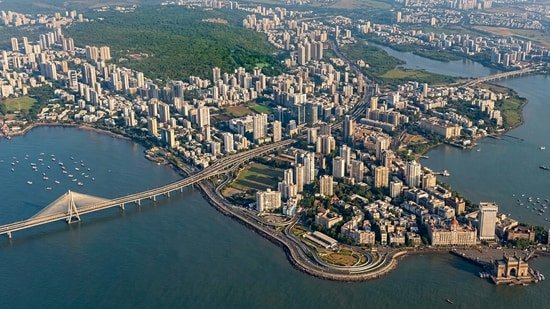
Mumbai real estate market’s western suburbs, such as Borivali, Goregaon and Andheri, are increasingly approaching benchmarks traditionally associated with South Mumbai and premium locations like Worli, Bandra and Juhu, prompting a debate over whether suburban markets are beginning to rival established luxury hubs.


According to real estate experts, the recent transactions in projects of branded developers signify a fundamental structural shift rather than isolated outliers. Experts noted that while the average per sq ft price in the suburbs remains significantly lower than in South Mumbai and prime areas like Worli, Bandra, and Juhu. However, the gap has narrowed.
Recent noteworthy transactions
In 2024, a 4 BHK luxury apartment in the₹14 crore”> Aquaria Grande building by Wadhwa was sold for ₹14 crore, at a per sq ft rate of ₹56,000.
In 2025, Bollywood actor Akshay Kumar sold his apartment in the Oberoi Sky City building in Borivali for over ₹50,000 per sq ft.
In the same year, DLF sold over 2,000 sq ft of apartments in The West Park project in Andheri for over ₹70,000 per sq ft. Going further, in February 2026, Oberoi Realty sold an over 8,500 sq ft penthouse in its Oberoi Garden City project in Goregaon for over ₹64,000 per sq ft.
The highest per sq ft rate ever recorded in Mumbai to date is around ₹2.80 lakh per sq ft for a building named Naman Xana in Worli.
Experts take on price race
According to real estate experts, the average price in these areas remains between ₹35,000 and ₹50,000 per sq ft. However, projects by tier-1 developers have set a benchmark for pricing.
“The recent benchmark pricing of ₹50,000– ₹70,000 per sq. ft. for premium projects in Mumbai’s western suburbs signifies a fundamental structural shift rather than isolated outliers. While average rates in these suburbs typically range from ₹28,000 to ₹38,000 per sq. ft., high-end “branded” residences by tier-1 developers have successfully breached prime market price points,” said Ritesh Mehta, Senior Director and Head (North and West), Residential Services and Developer Initiatives, JLL India.
According to Vivek Rathi, National Director-Research at Knight Frank India, the gap in per sq ft prices between Suburbs, South Mumbai, and prime areas is narrowing but has not closed.
“At a market-wide level, structural parity hasn’t arrived yet. What Borivali, Goregaon, and Andheri are seeing is top-end price convergence, as select Grade A projects from developers reach benchmarks previously exclusive to Bandra or Juhu. The broader micro-market averages remain lower. The gap is narrowing, but it hasn’t closed,” Rathi said.
“Prime locations like Bandra, Juhu, Dadar, and South Mumbai still command a consistent premium. The price points being discussed (for suburbs) are concentrated in branded Grade A developments, large-format amenity-heavy projects. These are project-led benchmarks, not a uniform repricing of entire micro-markets. That said, repeated transactions at these levels are starting to reset homebuyer expectations, and that’s typically how micro-market repricing begins,” said Rathi.
Rathi said there are a few structural factors driving this catch-up. “This includes the project quality, which has materially improved, larger gated developments, better design efficiency, and full-service amenities mean western suburb projects can now compete on the product experience, even if location premiums remain different,” he said.
“Finally, as Bandra, Juhu, and South Mumbai move further out of reach (in terms of pricing), demand is redirecting westward, but buyers still expect a premium experience, and developers are delivering it. This is a top-down repricing led by high-quality supply, supported by infrastructure and a maturing buyer base. If transaction depth at these levels sustains over the next few years, it becomes a genuine micro-market shift. Right now, it’s the early stages of that process,” Rathi added.


