


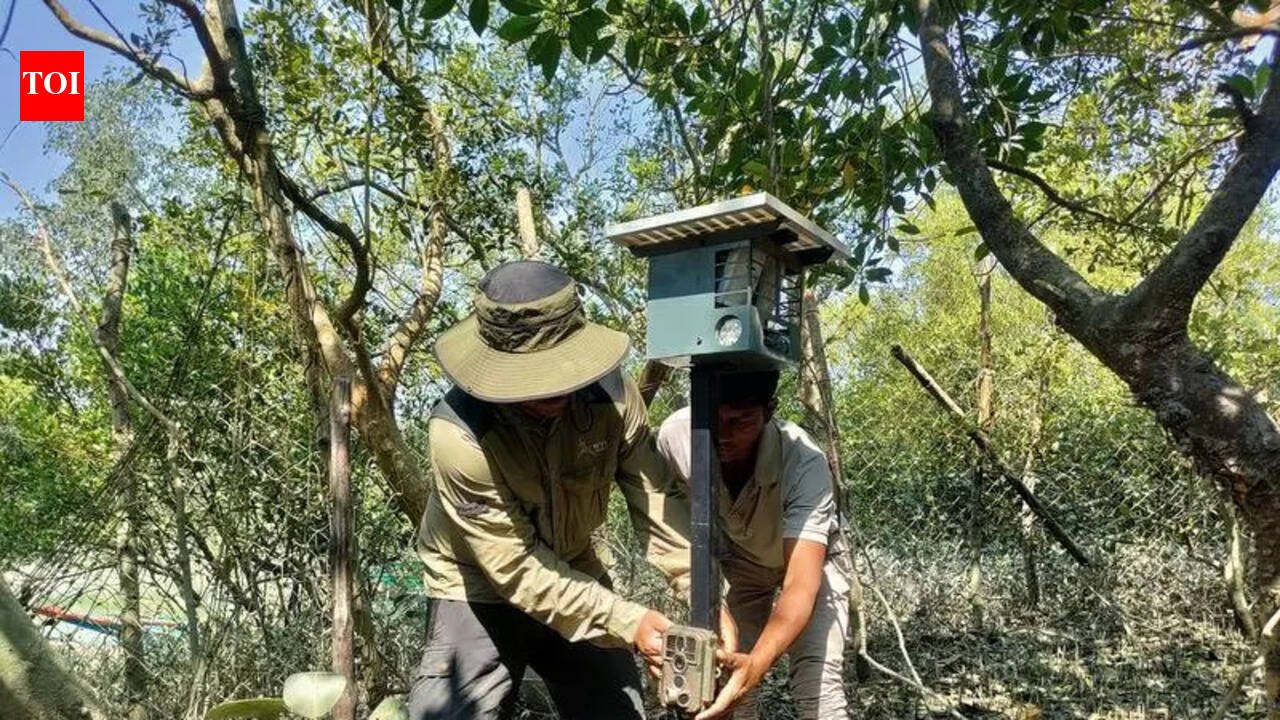
Kolkata: After nylon nets, solar lights and AI cameras, ‘smart scarecrows’ have come to the Sundarbans to keep straying tigers at bay and check human-animal conflict.In 2024, there were at least 15 cases of tigers straying from the South 24 Parganas forest division of the Sundarbans into fringe villages. Last year, at least two such cases were reported. This year, an incident was reported a few days ago from Jharkhali’s Tridibnagar, in the same division.Smart scarecrows, often known as ANIDERS (Animal Intrusion Detection and Repellent System), are innovative solar-powered devices designed to deter tigers, leopards, and other big cats from entering villages and agricultural fields, particularly in buffer zones around tiger reserves, said a senior official at Wildlife Trust of India (WTI), which has provided four devices to the forest department.The devices, according to Abhishek Ghoshal of WTI, are currently deployed in UP’s Pilibhit and Katarniaghat, among other places. They use sensors to trigger light and sound alarms to scare away animals without harming them.In the Sundarbans, the four devices were deployed on Tuesday at strategic locations near the forest-village interface in the Herobhanga compartment, part of the Raidighi range in Kultali block, where incidents of human-tiger conflict are often reported. Four more will be installed soon.Ghosal said the cameras have been installed at strategic locations where tigers cross canals to enter villages. AI cameras will be placed at the locations so the combined system generates both alerts and pictures.“The ‘scarecrows’ use a combination of loud buzzes of sound and intense light to startle the animal and push back its movement. The Pilibhit forest division in UP, which faces the unique problem of ‘sugarcane tigers’, is one the places where ANIDERS have been deployed. Philibit Tiger Rerserve has seen a sharp increase in its tiger population, from 23 in 2014 to 72 in 2022, far exceeding its capacity of 30-35,” said a source.The setups will be monitored by WTI and the forest department. “We are trying to find out how this system works in the mangrove eco-system,” Ghosal said.Samrat Paul, field officer, Sundarbans Tiger Project of WTI, said each device covers a range of at least 25-30 metres in 180° angle from its centre point.Divisional forest officer, South 24 Parganas, Nisha Goswami, said, “In the long run, focus will be more on sustainable, cost-effective and non-lethal approaches towards conflict mitigation.”The South 24 Parganas forest division with ranges such as Matla, Ramganga and Raidighi is home to more than 20 tigers, as per the last all-India tiger estimation report. The report said that though the Indian Sundarbans is now home to about 101 tigers, the figures indicate that big cat numbers may be inching closer to carrying capacity.Carrying capacity is the maximum number of a particular animal that can live in a certain area in a stable manner. Any more than that can result in human-animal conflict.Around 10 months ago, a tiger straying incident was reported from the Deulbari village in the buffer zone after a big cat had reportedly come out of the reserve area to sneak into the village.


