



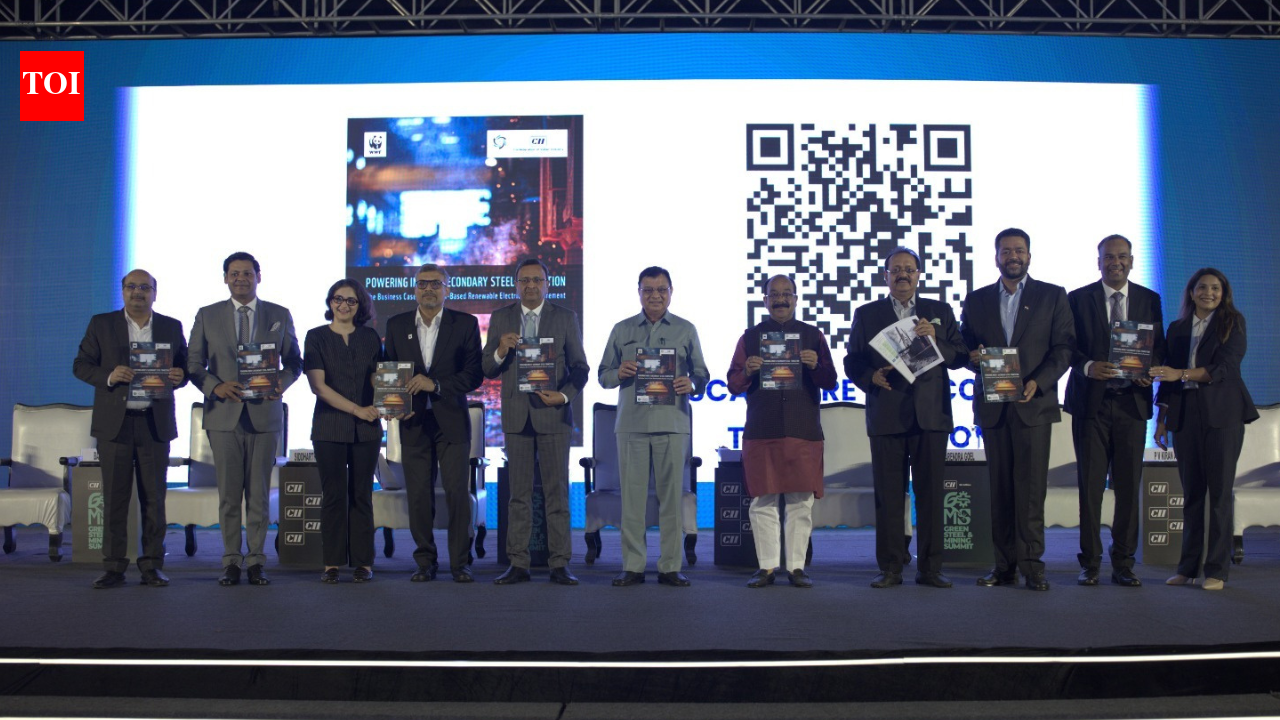
KOLKATA: India’s small and medium steel units can lower their electricity tariffs by as much as 34% by pooling demand and jointly investing in a renewable power plant, according to a report released on Wednesday. For a single unit, that works out to a saving of Rs 2.2 crore to Rs 2.4 crore a year, depending on the cluster and the size of the unit.Electricity accounts for up to 40% of what it costs to run a secondary steel unit, which makes the power bill the first place to look for savings. Renewable electricity is now available at Rs 4.5 to Rs 6 a unit in several states, against grid tariffs of Rs 7 to Rs 8. That gap is what makes the savings possible.Twenty-two clusters were ranked on a Renewable Energy Attractiveness Index, scoring each on state policy, cost-saving potential, electricity consumption, untapped renewable market potential and land availability. Raipur came first, followed by Belgaum, Shimoga, Rajkot and Bhavnagar.The findings are part of a report that was released on Wednesday at the Confederation of Indian Industry (CII) Green Steel and Mining Summit in Raipur. The study was undertaken by JMK Research & Analytics for the India Green Steel Coalition, a joint initiative of WWF-India and the CII-Godrej Green Business Centre, with support from the India Green Steel Network, a platform convened by Climate Catalyst.“For units of this scale, for instance in Raipur, a saving of Rs 2.4 crore a year is significant, particularly in a sector where margins are narrow. The investment is recovered within two years, which makes it a sound commercial decision. The principal uncertainty for our members is regulatory. Greater assurance that open access approvals will remain valid for the full life of a project would encourage many more units in the cluster to proceed,” said Siddharth Agrawal, chairman of the steel subcommittee at CII Eastern Region and managing director of Godawari Power and Ispat Ltd.Secondary steel is made in smaller electric arc and induction furnaces rather than large blast furnaces. The term also covers the re-rolling mills, forging units and foundries that turn that steel into finished products. The segment accounts for about 40% of India’s crude steel production and emits an estimated 50 to 60 million tonnes of carbon dioxide a year across more than 1,000 units, most of them MSMEs.In Raipur, a unit taking a 10 MW share of a group captive solar project would put in about Rs 2.7 crore in equity and cut its tariff by around 34%. In Rajkot, where units are smaller, a foundry taking a 5 MW share would invest about Rs 1.4 crore and cut its tariff by around 20%. In both cases the money is recovered in one to two years.Under a group captive arrangement, several units jointly own a stake in the renewable plant and draw power from it in proportion to that stake. The report examined two other routes and found both wanting at MSME scale. Building a plant outright delivers the largest lifetime savings but demands Rs 17 crore to Rs 35 crore upfront, along with land and in-house maintenance. Buying from a third party requires no capital at all, but surcharges leave almost nothing in savings.“A cluster-based approach can fundamentally change how MSMEs access renewable energy. Aggregating demand through industrial associations makes projects more bankable, enables optimal plant sizing, and spreads equity participation across multiple consumers, reducing the investment risk borne by any single unit,” said Prabhakar Sharma, senior consultant at JMK Research and Analytics.Despite the economics, take-up has been slow. Renewable energy meets around 11% of the sector’s electricity needs, roughly half the 22% share renewables hold in India’s overall generation mix.The report recommends state regulators for time-bound open access concessions for steel clusters, with compensation for distribution companies that lose revenue. It asks SIDBI and IREDA for portfolio-level credit guarantees so that clusters can borrow as a group. And it asks for a common framework for group captive projects, so that units in one state are not negotiating terms from scratch that are settled in another.“MSMEs account for a significant share of India’s secondary steel production, and are central to decarbonising the sector. Renewable energy integration is one of the few levers that lowers production costs and emissions at the same time, allowing units to reduce their carbon footprint while becoming more competitive and CBAM compliant,” said Sakshi Balani, co-acting CEO and director, India, at Climate Catalyst.


