






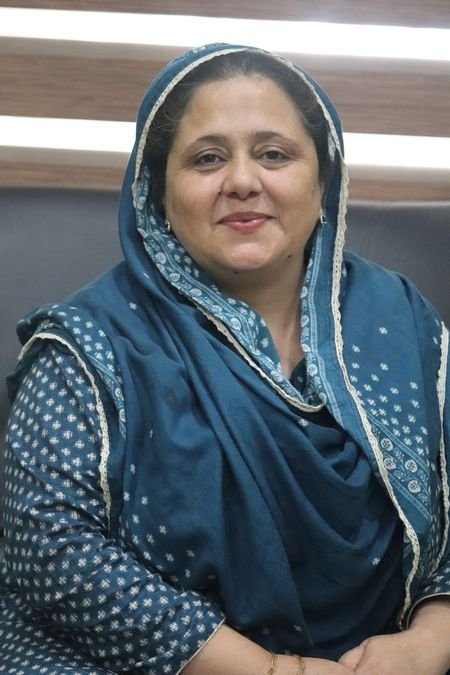
Srinagar, Oct 08: From the traditional Kashmiri apple to an innovative cup of Kehwa, a faculty member at Sher-e-Kashmir University of Agricultural Sciences and Technology of Kashmir (SKUAST-K) is working to give the region’s local produce a new identity through food innovation, value addition and entrepreneurship.
Dr Saima Paul, a professor in the Community Science Division and a Home Scientist, has been working on transforming locally available agricultural resources into convenient, marketable and value-added food products. Her work combines food and nutrition, extension education and human development, with a strong focus on taking research beyond laboratories and into the marketplace.
Her journey towards product innovation began during her tenure at a Krishi Vigyan Kendra (KVK), where she experimented with an unconventional idea—turning the flavours of Kashmiri namkeen chai into a dip-like product.
The innovation initially received encouraging feedback from her family and was subsequently subjected to sensory evaluation among colleagues and staff. The positive response encouraged her to present the product at an exhibition, where it attracted attention and appreciation.
The idea received further encouragement from the university leadership, including the Vice-Chancellor, who suggested that the innovation be scientifically analysed, patented and developed into a potential startup product.
With support from the university’s incubation ecosystem, Dr Saima subsequently worked on refining her products, conducting sensory evaluations and analysing their shelf life and quality before taking them towards commercialisation.
From B-grade apples to “Apple Kehwa”
One of the key innovations emerging from this journey is the development of Apple Kehwa, which aims to create value from apples that generally receive lower market value compared to premium-grade produce.
“Usually, A-grade apples have a ready market, while B-grade apples may not receive the same commercial value. We wanted to see how these apples could also be utilised through value addition,” Dr Saima said.
The apples are processed, dried and incorporated into a Kehwa formulation, creating a finished product that gives Kashmir’s iconic beverage a distinctive apple-based identity.
The initiative reflects a larger objective—to ensure that Kashmir’s agricultural produce does not remain confined to the sale of raw material, but is transformed into finished products with greater shelf life, convenience and market potential.
Nadru gets a new identity
The same approach has been extended to Nadru (lotus stem), a popular ingredient in Kashmiri cuisine.
Instead of limiting Nadru to traditional culinary preparations, Dr Saima and her team experimented with transforming it into Nadru chips.
After repeated trials, the team developed a finished product with a reported shelf life of six months or more. The product has also undergone the required food-safety processes before being taken towards the market.
The innovation seeks to provide consumers with a convenient form of a traditional Kashmiri produce while simultaneously creating an avenue for value addition.
From sea buckthorn to sauce
Another area of ongoing work is sea buckthorn, a nutrient-rich berry found in the Himalayan region, including Ladakh.
While sea buckthorn is already consumed in forms such as juices and supplements, Dr Saima’s team is exploring alternative ways of making the berry more attractive and convenient for consumers.
The team has experimented with sea buckthorn-based sauces and other products, including a Chyawanprash-like preparation.
The products are currently undergoing sensory evaluation and analysis. Commercialisation, Dr Saima said, will follow only after the products meet the necessary quality, shelf-life and food-safety requirements.
Research beyond the laboratory
For Dr Saima, innovation is not limited to developing a product.
She believes research must eventually reach communities and demonstrate practical value.
“As researchers, we cannot remain confined to our books or laboratories. We have to prove that our research is authentic, valuable and capable of reaching people,” she said.
Through training programmes, exhibitions and extension activities, the Community Science team works with people in rural areas and encourages aspiring entrepreneurs to use locally available resources to develop small businesses.
The objective is also to encourage women and young people to explore entrepreneurship, including home-based enterprises and cloud kitchens.
According to Dr Saima, even a small innovation can inspire several others to take the first step towards entrepreneurship.
Turning Kashmir’s resources into Kashmir’s brands
The broader vision behind the initiatives is to create finished products from the resources available across Jammu and Kashmir and the wider Himalayan region.
Whether it is apples from Kashmir, Nadru from local wetlands and agricultural areas, or sea buckthorn from Ladakh, the emphasis is on value addition, product development and commercialisation.
Dr Saima said every product undergoes evaluation before commercialisation, with attention to aspects such as quality, shelf life, food-safety compliance and branding.
The effort, she said, is not only about creating products but also protecting the reputation of the institution and ensuring that consumers receive safe and reliable products.
Mentoring the next generation
A significant part of the initiative is its potential to inspire students.
As a faculty member, Dr Saima sees herself not only as a teacher and researcher but also as a mentor for students who want to transform their research ideas into enterprises.
The message she wants to convey is simple: research can move beyond academic papers and laboratories and become the foundation of a viable business.
“If we can convert our research into a startup or an enterprise, our students can also see that possibility. They can become entrepreneurs and create their own income,” she said.
From apples to Kehwa, Nadru to chips and sea buckthorn to sauces, the work represents an attempt to give Kashmir’s traditional resources a modern identity—while creating opportunities for entrepreneurship, women-led enterprises and student innovation.
The larger vision is to ensure that Kashmir is not known merely as a supplier of raw agricultural produce, but increasingly as a place where local resources are transformed into innovative, branded and market-ready products.


