



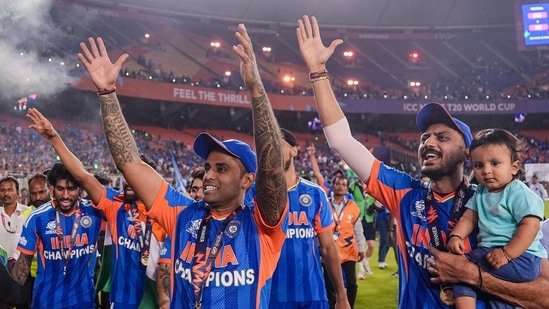
India’s victory in the 2026 Men’s T20 World Cup has strengthened a case that now stretches well beyond one trophy or one team. Over the last couple of years, India have not only won the biggest men’s white-ball titles, but have also collected major ICC silverware in women’s cricket and at age-group level, building a body of success that no other nation can currently match.
That is what makes this moment significant. India are no longer just the financial centre of the sport or its deepest talent reservoir. On results, reach and repeat success across the ICC ladder, they now have the strongest claim to being the real powerhouse of world cricket.
In the space of roughly two years, India have won six ICC trophies. The senior men won the T20 World Cup in 2024, followed it with the Champions Trophy in 2025, and then defended their crown with the 2026 T20 World Cup title. The women’s team added the ODI World Cup in 2025. India’s girls won the Women’s U19 T20 World Cup in 2025, and the boys followed with the Men’s U19 World Cup in 2026.
This is not a case of one champion side covering for everyone else. It is a case of Indian cricket producing title-winning teams across levels, formats and categories. When a nation is lifting global trophies through its senior men, senior women and youth sides within the same cycle, it stops being a good run and starts looking like system-wide supremacy.
India are not dominating one bracket, but the entire ICC ladder
The senior men’s team will naturally grab the biggest share of attention, because their tournaments sit at the loudest end of the sport. Their sequence alone is imposing. The 2024 T20 World Cup ended a long wait for another men’s title in the format. The Champions Trophy in 2025 showed that the success was not isolated. The 2026 T20 World Cup then elevated the run into something historically weightier, making India the first men’s team to win the tournament three times and the first to defend the title.
Yet even that does not fully explain why India’s current position feels so commanding.
The women’s World Cup triumph matters enormously in this conversation because it broadens the evidence. For years, India’s power in cricket could be argued through audience, money and the men’s game. A women’s world title changes that tone. It turns India’s rise from a team story into a fuller national cricket story. It says the system’s strength is no longer concentrated in a single corridor.
Then there is the age-group proof. India’s U19 girls and U19 boys both winning world titles in this period is not just a pleasing add-on for the trophy count. It is the clearest possible sign that the pipeline beneath the senior teams is functioning at an elite level. Youth tournaments do not guarantee future greatness, but they do reveal the health of the structure that feeds the future. India are not only winning now. They are also continually replenishing the next wave.
This is what a true cricket powerhouse looks like
The phrase gets thrown around loosely in sport, often as a synonym for wealth, popularity or historical prestige. But a true powerhouse is measured differently. It must have a range. It must have continuity. It must show that its success is structural rather than accidental.
India tick all three boxes. They have a range because they are winning across men’s, women’s and youth cricket. They have continuity because these titles are arriving in sequence rather than as isolated spikes. And they increasingly look structural because the victories are emerging from multiple teams, not one golden generation carrying the entire burden of reputation.
That last point is crucial. For a long time, India could be described as cricket’s biggest force in commercial and cultural terms. What they did not always have was the cleanest claim to being its most complete competitive force at the same moment. They do now.
None of this means India will win every major tournament from here or that the rest of the world has stopped mattering. Cricket does not work that way. Australia remain formidable. England remain dangerous. Other sides will rise, adapt and strike back. But based on what has unfolded across this cycle, India are not merely one of the sport’s most powerful nations.
They are the benchmark.
And that is the clearest way to read the last two years. India have not just assembled another strong men’s side. They have built a period in which the sport’s biggest events, across categories, keep ending with the same conclusion: when the trophies were on the line, Indian cricket was the one left standing.


