



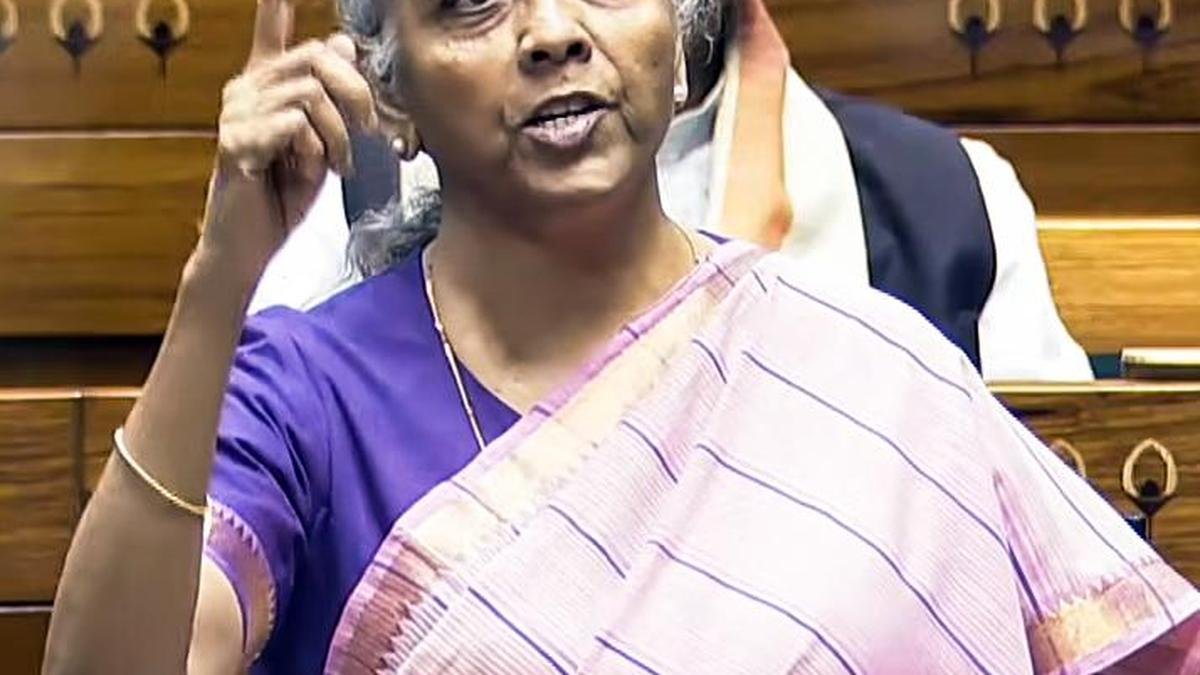
Finance Minister Nirmala Sitharaman speaking in Lok Sabha during the Budget Session of Parliament, in New Delhi on Monday.
| Photo Credit: ANI
Finance Minister Nirmala Sitharaman on Monday (March 30, 2026) defended the Insolvency and Bankruptcy Code (IBC) in Parliament, citing the high level of realisations from the distressed assets, recovery for creditors, and turnaround of companies that have emerged from the resolution process.
Replying to the debate on the Insolvency and Bankruptcy (Amendment) Bill 2026, the Finance Minister said that the point of the IBC was not debt recovery, but instead the rescue of viable businesses and addressing their financial stress.
“The IBC is a framework for rescuing viable businesses and resolving financial stress while preserving the enterprise value,” Ms. Sitharaman explained. “It was never intended to be a debt-recovery tool. Recovery values are a byproduct. The main intention is to rescue viable businesses and make sure that we resolve the financial issues that they face.”
Market-driven process
Therefore, she said, the IBC process is market-driven and recoveries reflect the underlying asset quality and commercial viability of the distressed enterprise.
“The IBC actually realises 94.95% of the fair value of the company at the time of admission,” Ms. Sitharaman said. “Realisation also is exceeding 171.54% of the liquidation value, which indicates the recovery levels, reflects the enterprise’s distressed state upon entry, and is not a failure of the resolution framework.”
She added that, as of December 2025, IBC has facilitated the resolution of 1,376 companies, enabling creditors to recover ₹4.11 lakh crore. Financial creditors have also seen recovery exceeding 34% of their claims. The IBC was originally enacted in 2016.
Improved credit ratings
Ms. Sitharaman also said that the IBC has led to the improved credit rating of companies that have emerged from the process, adding that the proportion of companies that are resolved rather than liquidated has improved over the years.
“In financial year (FY) 2017-18, for every one company resolved, five companies went into liquidation,” she said. “However, in FY 2024-25, this ratio has now substantially improved and has come close to one.”
Another success of the process, the Minister said, was that the “credible threat” of losing ownership through the IBC process has pushed debtors to settle 32,179 cases even before they enter the formal process, addressing underlying defaults worth ₹14.62 lakh crore.
The Lok Sabha passed the Bill to amend the insolvency law to provide for strict timelines, an out-of-court settlement option and enable the framework for cross-border insolvency processes. IBC has been amended seven times since its inception in 2016.
Published – March 30, 2026 05:40 pm IST


