



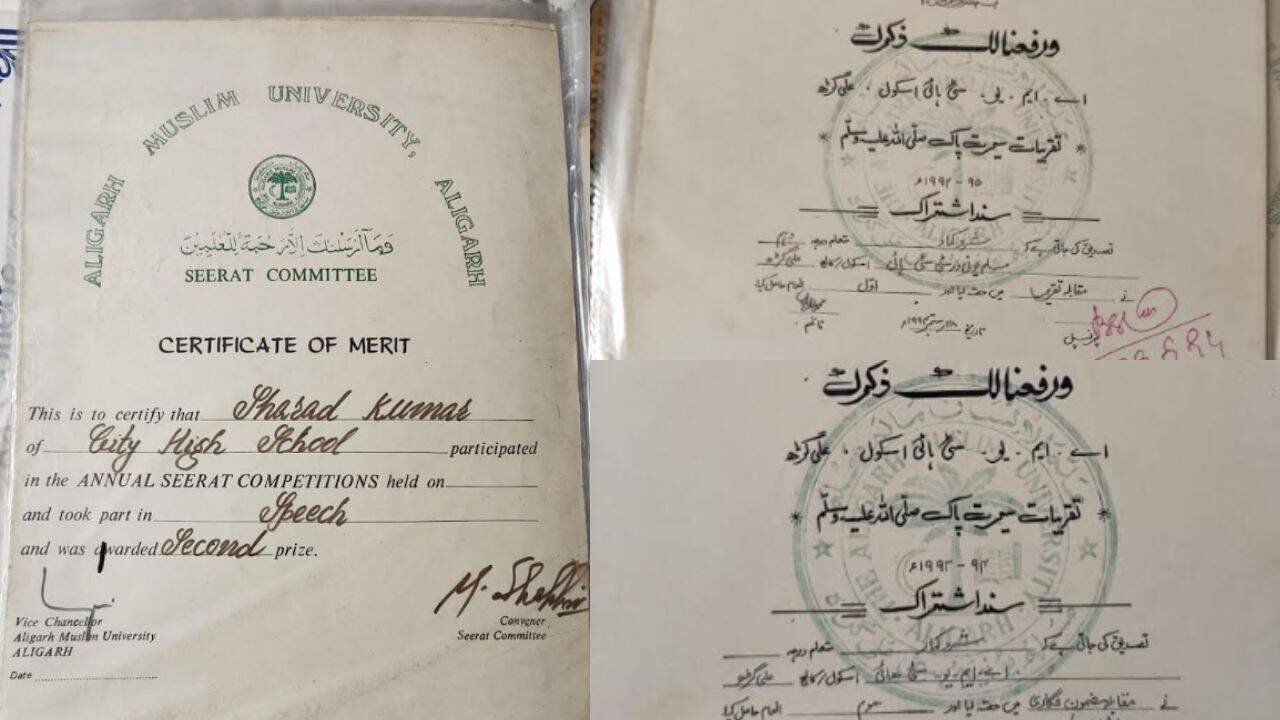
NEW DELHI: Across Delhi, steel almirahs are being opened, dusty trunks dragged out and cardboard boxes emptied as families search for birth certificates, school records and electoral slips amid the Election Commission’s Special Intensive Revision (SIR) of electoral rolls.For 46-year-old Sharad Kumar Sharma, a senior manager at a Gurugram-based private company, the search unearthed something no official had asked for—a yellowing 1995 certificate from AMU City High School recognising him, a Hindu student, for representing his school in Seerat competitions on the life of Prophet Muhammad.Sharma had begun searching after failing to trace his parents’ names on electoral rolls from the period when his family moved from Aligarh to Delhi in 2002-03. The certificate, browned with age, bears the AMU seal, the blue-ink signature of then principal Badrul Islam, and a line that caught his attention after three decades: “Being a non-Muslim student he has represented this school through his participation in Seerat competitions (Character of Mohammad Prophet)...”“I had completely forgotten about it,” Sharma said. “I wasn’t looking for this. I was looking for documents.”The discovery prompted him to reconnect with former classmates, including a journalist and an anaesthetist, who had studied Urdu and participated in similar competitions alongside him. Their conversations soon turned nostalgic, recalling a period when Hindu parents routinely hired Urdu tutors to prepare their children for admission to AMU, where elementary Urdu formed part of the entrance process and school curriculum.“Back then, if you wanted to study at AMU, you learnt Urdu,” Sharma said. “Hindu families, including mine, hired tutors because admission mattered more than anything else. Nobody found that unusual.”One of those classmates, now a journalist with a national daily, remembers the experience similarly. “I scored better in compulsory Urdu than in advanced Hindi,” he said, adding that elementary Urdu remains common among many non-Muslim students in Aligarh because the city’s education system continues to revolve around AMU. “It starts as a necessity for good education and then some develop an interest.”Sharma’s memories are echoed by Parveen Jahan, now in her late 60s, who taught Urdu to dozens of children from her home in Aligarh’s Upper Kot neighbourhood for years.“Hindu parents came because their children wanted admission to AMU,” she said. “Advanced Hindi students still had to study elementary Urdu.”She recalls one of her brightest pupils, Surbhi, a Hindu Class X student. “We started with alif, be—the Urdu alphabet,” Jahan said. “In her first test, she scored 35 out of 100. Within six months, she was reading Iqbal and Ghalib. When she passed, she came home to show me her result.”According to Jahan, Hindu students still come to learn Urdu, though fewer than before. “The interest is still there because of the university,” she said. “Sikhs came too. Parents wanted their children to learn.” However, she said she no longer sees Hindu students taking part in Seerat competitions as they once did.For Sharma, Urdu and Seerat competitions were simply part of growing up in Aligarh. He remembers volunteering for public-speaking contests, including one at AMU’s Kennedy Hall where he was the only non-Muslim participant among the finalists.Outside campus, however, there were occasional questions.“Some people would ask, ‘Are you planning to become Muslim?’ because I was participating in Seerat competitions,” Sharma recalled. “But inside school, none of this felt unusual.”The certificate took on new meaning only after he showed it to his children.“Their first question was, ‘Papa, what is Seerat?'”“That’s when I realised they were growing up in a very different world from the one I did,” Sharma said.The family is still searching for documents that may help establish their electoral records from the early 2000s. The AMU certificate has gone back into the same cardboard file where it lay unnoticed for nearly three decades.It may not help prove identity or residency.But amid a city-wide search for official records, it reopened memories of an educational culture in which Hindu children learnt Urdu, participated in Seerat competitions and carried home certificates that, at the time, seemed ordinary enough to be forgotten.


