



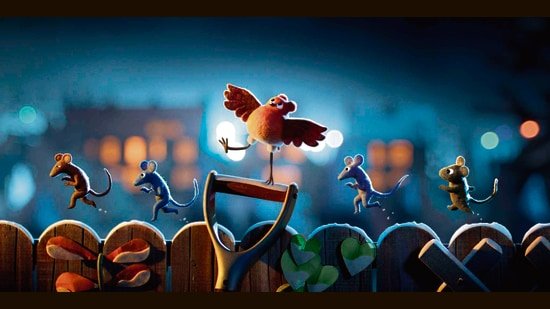
There is a word that recurs in conversations about Aardman Animations: tangibility. The idea that it is, in some way, more real. The sense that the thing one is watching was made by human hands, and that somewhere in the surface of Wallace’s grin or Gromit’s resigned eyebrow, you can see the fingerprints.
That is not an accident. It’s a philosophy.
Fifty years ago, the television landscape was dominated by a very different kind of magic. It was the golden age of Saturday morning cartoons, an era ruled by the industrial efficiency of studios such as Hanna-Barbera and Disney. It was a simpler era, on a tight budget.
Characters such as Scooby-Doo, The Flintstones and Yogi Bear moved against repeating backgrounds, their bodies often stiff, with only mouths and eyes shifting to convey emotion.
Disney was taking a different direction, leaning into the Xerox process to bypass the painstaking hand-inking. Theirs was a world of flat cels (or celluloid sheets), bright colours, simple stories and high-volume production.
It was in this era that Aardman was born.
It began with two schoolboys, teenagers in the town of Woking, England, named Peter Lord and David Sproxton, who began to experiment with a camera that belonged to Sproxton’s father. Their earliest animation efforts were filmed at a kitchen table. “When we started out, on that kitchen table, there was no market for what we were doing at all. Nobody wanted to see clay animation,” Lord would later say.
The name of their company came about in the way that the best names do: accidentally, absurdly. BBC offered the pair an opportunity to create material for a show called Vision On, aimed at children with impaired hearing. Lord and Sproxton were playing with drawn animation at the time and needed a character. They hit upon the word aardvark, liked the absurdity of it, and named their idiotic, powerless superhero “Aard Man”. When the first cheque was being written by BBC, in 1972, they realised they needed to register as a company, and became Aardman Animations.
The schoolboy games were now a going concern. Sproxton was still just 18; Lord, 19.
The inspiration for clay had come from television. The two boys had watched the American animator Eli Noyes’s 1967 film, Clay or the Origin of Species, and the idea took hold that clay could be animated. Moving drawings felt like a blind alley. Plasticine did not.
So, in 1977 at BBC, the two created Morph, a small, orange, inarticulate figure who served as a mischievous sidekick for presenter Tony Hart on another children’s show, Take Hart. Morph could melt through tables and change shape. He could convey more emotion with a shrug than some actors manage in a career. He was a huge hit, and served as Aardman’s blueprint for everything that followed.
The previous year, the company set up its studio in Bristol. (That’s the anniversary being celebrated this year.)
In Bristol, the studio grew. Nick Park arrived, quietly, in 1985. He’d been working on a short film since art college, about a man and his dog going to the moon for cheese. In his very early sketches, Gromit was a cat, but Park changed him into a dog: more loyal, more expressive, and easier to animate.
These things matter. The difference between a cat and a dog is the difference between indifference and devotion; and it is Gromit’s devotion, wordless and endlessly put-upon, that makes the movies work.
The search for cheese would come to life as Wallace & Gromit: A Grand Day Out (1989). The 23-minute film would be nominated for an Oscar for Best Animated Short, and would lose to another Aardman production. But more on that in a bit.
Before all this, in 1986, Peter Gabriel released his hit single, Sledgehammer, with its mind-bending stop-motion, claymation music video. “All you do is call me, I’ll be anything you need,” he sang, as fruits rearranged themselves into faces, and plucked chickens danced on two legs. The song and video won multiple awards and received heavy airplay. Aardman and the American animators Brothers Quay worked on it. Lord and Sproxton, now in their early 30s, grew famous because of it.
SHEAR GENIUS
By 1990, Park’s short Creature Comforts had won an Oscar, beating Aardman’s other nominee in the same category, Wallace & Gromit: A Grand Day Out.
The five-minute stop-motion gem featured real-life conversations recorded on streets and in care homes, animated onto clay animals. It was the first time Aardman had won an Oscar, but it would not be the last. A British studio operating out of Bristol, making films with clay, frame by frame, was starting to win the highest prize in American cinema.
The Wrong Trousers (1993; 30 mins) followed, in which Wallace rents a spare room to a penguin wanted by the law. Then A Close Shave (1995; 30 mins), in which Gromit is mistakenly arrested for killing sheep. Both won Oscars too. (A fourth would follow in 2006, for Wallace & Gromit: The Curse of the Were-Rabbit.)
The same year as A Close Shave, in 1995, a freak idea: a full-length stop-motion feature. One that would revisit the 1963 World War 2 John Sturges classic The Great Escape, but retell it with chickens.
This was the era of Pixar and Toy Story, and the idea of a stop-motion feature seemed outlandish. Chicken Run (2000) was directed by Park and Lord, funded by Steven Spielberg’s DreamWorks, and remains the highest-grossing stop-motion film ever made. It is also, quietly, one of the more subversive mainstream comedies of its era: a film about female solidarity, collective action, and escaping the systems designed to consume you, all packed into a story for children.
CLAY IT AGAIN
Despite Hollywood, the Oscars and a fan following that included animation giants such as Matt Groening of The Simpsons and Brad Bird of Ratatouille, the studio stayed in Bristol. In 2018, Lord and Sproxton transferred majority ownership to its employees. There are studios that talk about a collaborative culture. Aardman structured it into its ownership.
“I’m occasionally asked to define what it is that’s distinctive about the way we animate, or more generally the way we make films,” Lord has said. “I think the very fact that it’s British is defining. Almost all of the animation you see in films or TV is not British.”
There is something to that. The particular flavour of Aardman’s comedy — the warmth without sentimentality, absurdism without cruelty, and deep and genuine affection for its characters, even (or perhaps, particularly) when they are being ridiculous — is closer to the world of the 1950s Ealing comedies, a kind of Britain preserved in memory. It is Bristol and Wigan, Wensleydale cheese, and a dog who reads Dostoevsky and says nothing but communicates everything.
Fifty years in, over 150 objects from the Aardman archives, including models, sets and storyboards; the accumulated evidence of five decades of patient, fingerprint-leaving work, are on display at the Young V&A museum in London (until November). Wallace and Gromit. Shaun the Sheep. Morph, who started it all.
Stop-motion animation did not begin with Aardman; it dates in fact to the 1980s. But the idea that it could be mainstream, fill cinemas, and delight both children and critics, that began with Aardman.
The principle, as Lord once pointed out, is the same one that animated King Kong in 1933. One frame at a time.
No shortcuts.
The craft is tangible. That is the point.


