



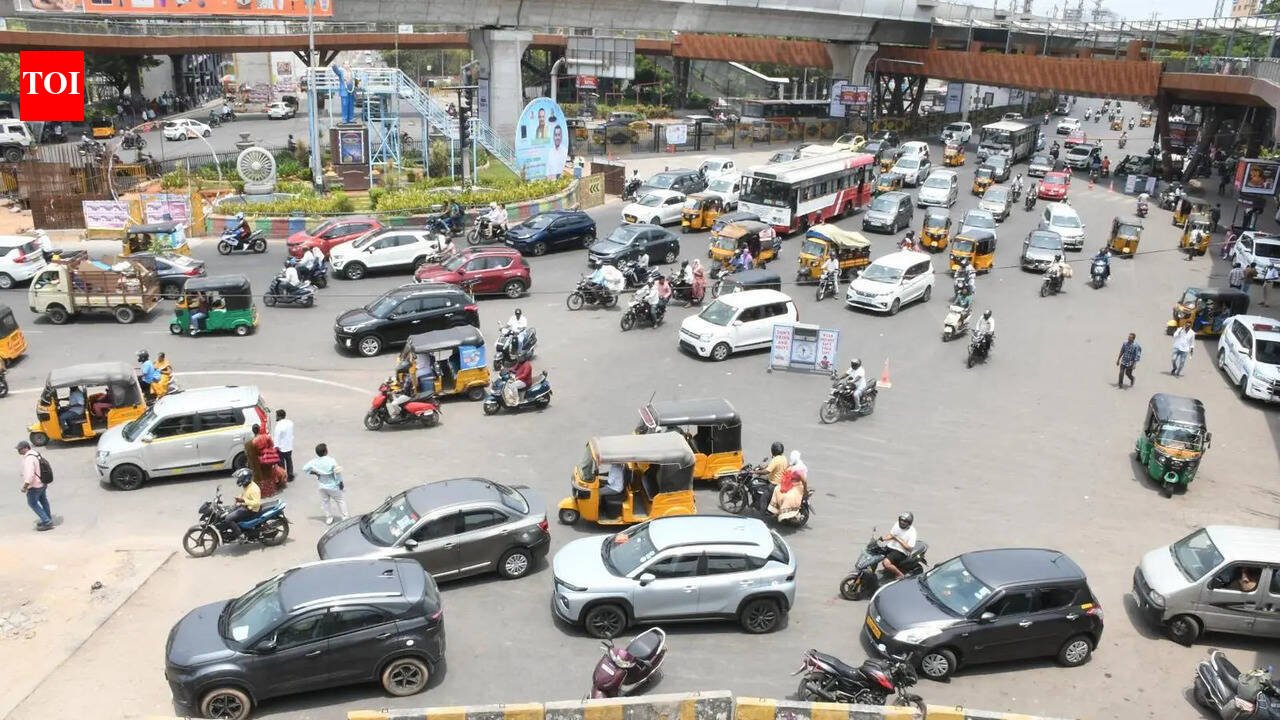
Hyderabad: The city’s ambition to become a signal-free city may sound futuristic, but with over 80 lakh vehicles operating on an estimated 800-km road network — nearly 10,000 vehicles per km — experts say the state govt’s vision faces major practical and financial hurdles.Despite rapid infrastructure expansion over the past decade through flyovers, underpasses and elevated corridors, urban planners and traffic experts argue that building a completely signal-free network across the city remains an enormous infrastructure challenge.Under the Strategic Road Development Programme (SRDP), the govt has constructed multi-level flyovers, grade separators and link roads to ease congestion and reduce travel time. Yet, traffic bottleneck continue to worsen in several parts of the city as vehicle registrations surge and urban expansion outpaces road capacity.“Some signal-free stretches have already been created in areas like Uppal, Begumpet and Tarnaka, but they have not produced significant positive results. Implementing such a system across the entire city is not possible. In fact, none of the major global cities have implemented a completely signal-free system because it is not practically feasible,” said Vinod Kanumala of the Indian Federation of Road Safety.He added that several major projects aimed at easing congestion, including the Uppal-Narapally and Suchitra-Kompally elevated corridors, have remained pending for years.Space constraintsUrban planners point out that many of Hyderabad’s busiest corridors pass through densely populated commercial and residential areas, making road widening and interchange construction extremely difficult without large-scale demolition of shops, apartments and private properties.Areas such as Ameerpet, Panjagutta, Khairatabad, Secunderabad, LB Nagar, HI-Tec City and Mehdipatnam already face severe space constraints and heavy traffic pressure.Officials, however, clarified that the govt’s immediate focus is not on making the entire city signal-free, but on eliminating chronic bottlenecks at critical junctions.“Our objective is to decongest critical junctions and help commuters save fuel consumption. We have engaged the Hyderabad Unified Metropolitan Transport Authority (HUMTA) to identify severe congestion points and bottlenecks. The study report is expected within three months,” said Jayesh Ranjan, special chief secretary.AI-powered signals?Experts say Hyderabad’s decades-old urban growth makes citywide implementation extremely difficult. “Unlike planned cities, Hyderabad evolved over time and you cannot simply erase junctions in older neighbourhoods without major social and economic disruption,” said T Satyanarayana Reddy, retired engineer and former scientist at the Central Road Research Institute.“Creating seamless traffic movement across all major corridors would require elevated systems, service roads and massive investment. Every new corridor intended to reduce congestion eventually attracts more private vehicles,” he said.Experts instead believe technology-driven traffic management offers a more realistic solution. AI-powered adaptive traffic signals, which adjust timings based on real-time vehicle flow using cameras and sensors, could significantly reduce waiting times and improve traffic movement without massive physical expansion.


