



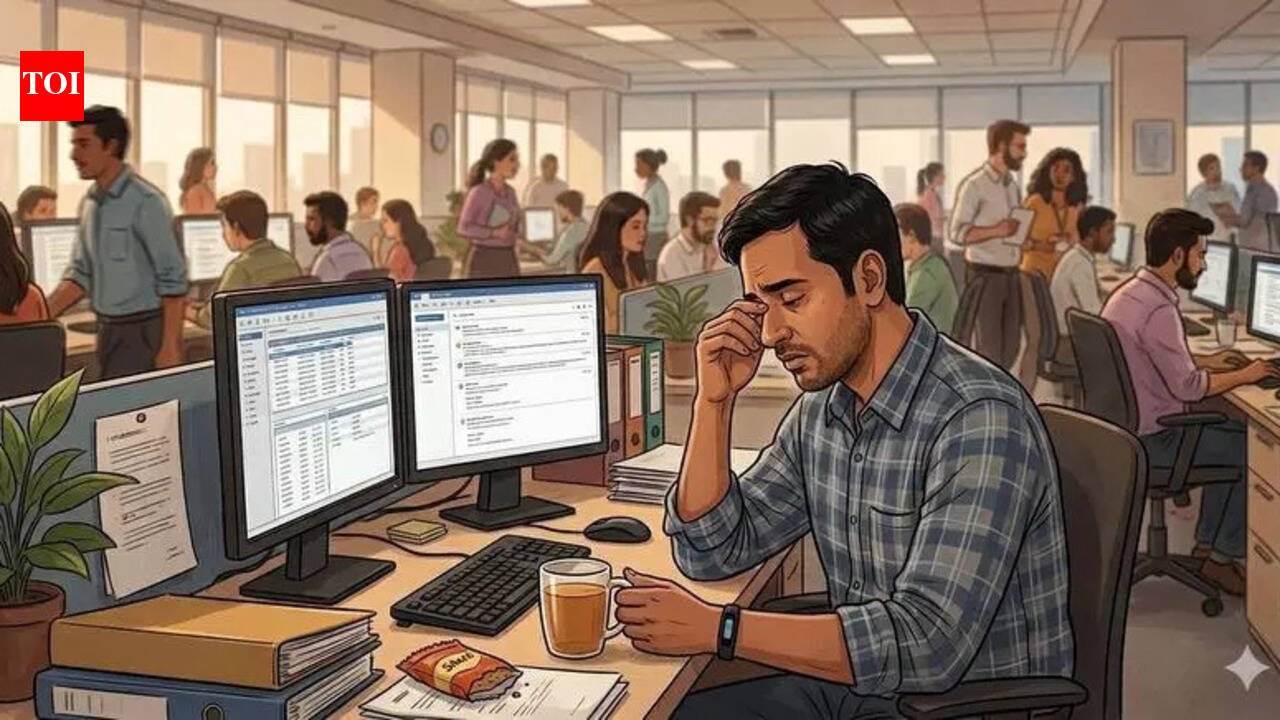
Bengaluru: Seized by fears of Artificial Intelligence-triggered job losses and a rough job market, working professionals are embracing presenteeism. They’re showing up at work every single day despite challenges like exhaustion, anxiety, and depression. After a grind of daily stand-ups and odd-hour client calls for months and years, employees become a case study for mental health professionals.These silent struggles drag on. Until burnout explodes or sickness manifests physically.“There has been a rise in presenteeism as many employees continue to function outwardly while struggling internally, often masking their symptoms to meet certain expectations. This pattern is common in high-pressure, performance-driven environments where productivity is valued more than well-being, leading individuals to push through distress instead of pausing and seeking help,” said Dr Darshan Yallapa Jotibannad, consultant psychiatrist, Sparsh Hospital, Infantry Road.How does mental exhaustion affect productivity? Neha Cadabam, senior psychologist and executive director at Cadabams Hospitals, broke it down: “The presentation depends on the job. For roles needing creative thinking or strategy, mental health issues definitely take a toll. If it is a monotonous task, it gets done mindlessly. Quality might drop, coffee breaks might increase, or a person might sit in front of a computer without truly investing hours.”Dr Girishchandra BG, medical director and senior psychiatrist, Maarga Mind Care, said: “Since there is no visible physical abnormality, mentally ill persons come across as ‘okay’ and others assume they are functioning normally. But their overall functioning deteriorates — their communication skills, concentration, ability to interact, and judgment get influenced by their state of mind. A person with depression, anxiety or other illnesses has a reduced capacity.“Presenteeism is not new, but workplaces have evolved — sensitive managers, company-sponsored counselling, and even dedicated mental health leave in some organisations. Yet, according to clinicians, employees still baulk at claiming it.“If an employee takes a mental health day off and returns the next day, a manager might ask, ‘You took a mental day off — what happened?’ Those kinds of questions can feel intrusive or stigmatising. Employees worry about what people may think of them,” Neha explained. Experts favoured greater normalisation of mental health issues. Dr Darshan said, “This includes formal mental health leave, flexible working hours, realistic load of work, and visible load of leadership. Training managers to recognise burnout, encouraging regular breaks, and providing access to counselling services can create psychological safety, allowing employees to rest and recover before exhaustion turns into long-term illness.“Is Gen Z less insecure?People in their 30s and 40s, weighed down by finances and family, hesitate when it comes to dealing with mental health issues. But Gen Z appears to be bolder. “Gen Z is much more open to using support systems, whether it’s counselling or employee-assistance programmes — they actively seek them out. When they don’t feel well, they are upfront with their line managers. They seem less insecure,” Dr Girishchandra said.


