









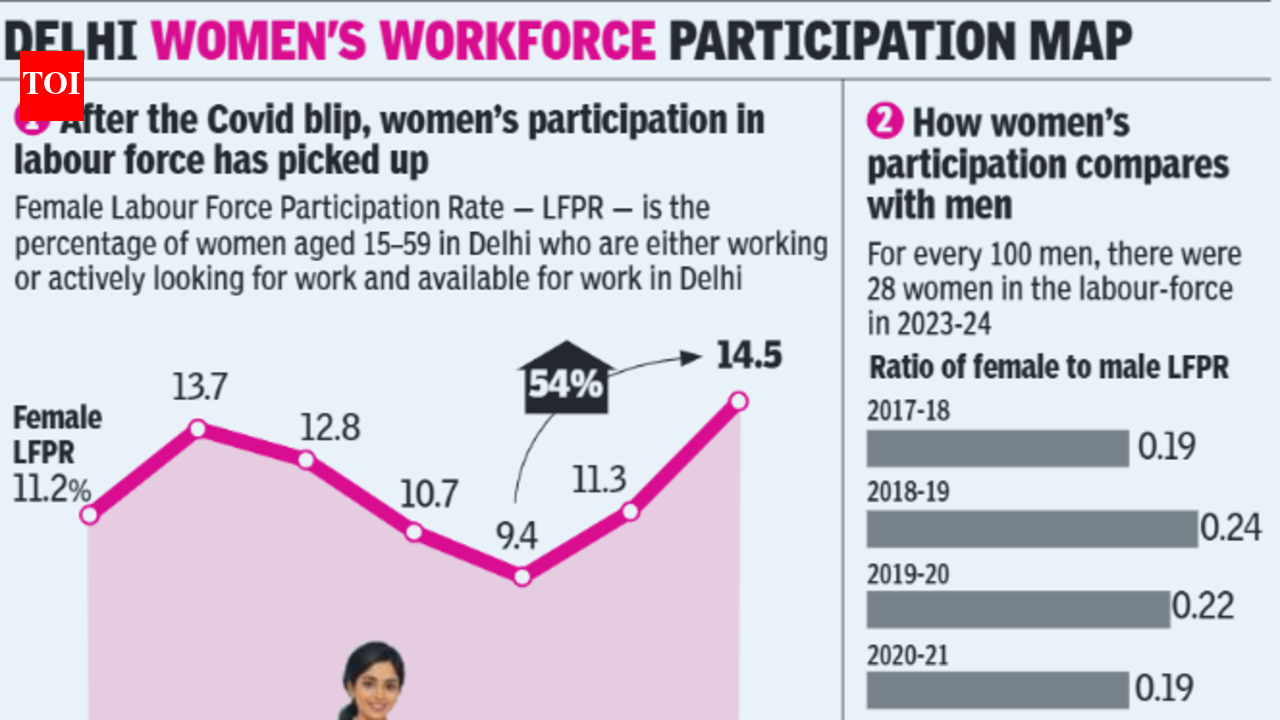
NEW DELHI: The proportion of women in Delhi’s labour force has jumped by 54% in two years, with female labour force participation rate (LFPR) among those aged 15 to 59 years rising from a post-Covid low of 9.4% in 2021-22 to 14.5% in 2023-24 — the highest in seven years.The figures are part of Delhi’s State Indicator Framework Status Report 2025.The city’s LFPR stood at 11.2% in 2017-18 and rose to 13.7% in 2018-19 before beginning to decline. It fell to 12.8% in 2019-20, 10.7% in 2020-21 and 9.4% in 2021-22, the lowest level in the seven-year series. The turnaround began in 2022-23, when the rate rose to 11.3%, followed by a sharp increase to 14.5% in 2023-24.Despite the improvement in women’s participation in the labour market, the relatively low level of female participation shows that a significant gender gap persists in the capital.
The city’s real per capita income growth has also accelerated considerably.
According to the report, Delhi’s real per capita income growth accelerated to just over 7% in 2025-26, from nearly 4.5% in the previous year.The figures show that the capital’s annual growth in Net State Domestic Product (NSDP) per capita at constant prices has fluctuated considerably over the past decade. NSDP is the value of goods and services produced in a state after deducting the loss in value of fixed assets such as buildings, machinery, vehicles and equipment.For example, if Delhi produces goods and services worth Rs 10 lakh crore in a year, its GSDP would be Rs 10 lakh crore. If machinery, buildings, vehicles and other fixed assets used to produce these goods and services lose Rs 1 lakh crore in value through wear and tear or depreciation, this amount is deducted from GSDP and accordingly Delhi’s NSDP would then become Rs 9 lakh crore.Delhi’s real per capita NSDP grew by 9.1% in 2015-16 but slowed steadily to 4.7% in 2016-17, 3.5% in 2017-18, 1.8% in 2018-19 and just 1.1% in 2019-20. The sharpest contraction came in 2020-21, when it fell 12.4%, which reflected the economic disruption caused by Covid-19 pandemic.The economy subsequently staged a strong recovery. Real per capita NSDP growth rose to 5.1% in 2021-22 and 5.4% in 2022-23. Growth accelerated to 7.9% in 2023-24, before moderating to 4.4% in 2024-25 and recovering to just over 7% in 2025-26.The latest figure means Delhi’s real per capita NSDP growth has once again crossed the 7% annual growth benchmark cited in the UN Sustainable Development Goal target.However, the figures also show the difference between growth measured at constant and current prices. At current prices, Delhi’s per capita NSDP grew 7.9% in 2025-26, compared with 7.6% in 2024-25.Growth at constant prices is used to show the increase in economic output after removing the effect of price changes, while current-price growth also reflects changes in prices, including inflation.According to the advance estimate of Delhi govt, Delhi’s per capita income is expected to touch Rs 5.3 lakh in 2025-26, up from Rs 4.9 lakh in 2024-25. Delhi’s per capita income is nearly 2.5 times the all-India per capita income of Rs 2.1 lakh.The 2025-26 figures are an advance estimate and could undergo revisions as more comprehensive economic data becomes available.


