


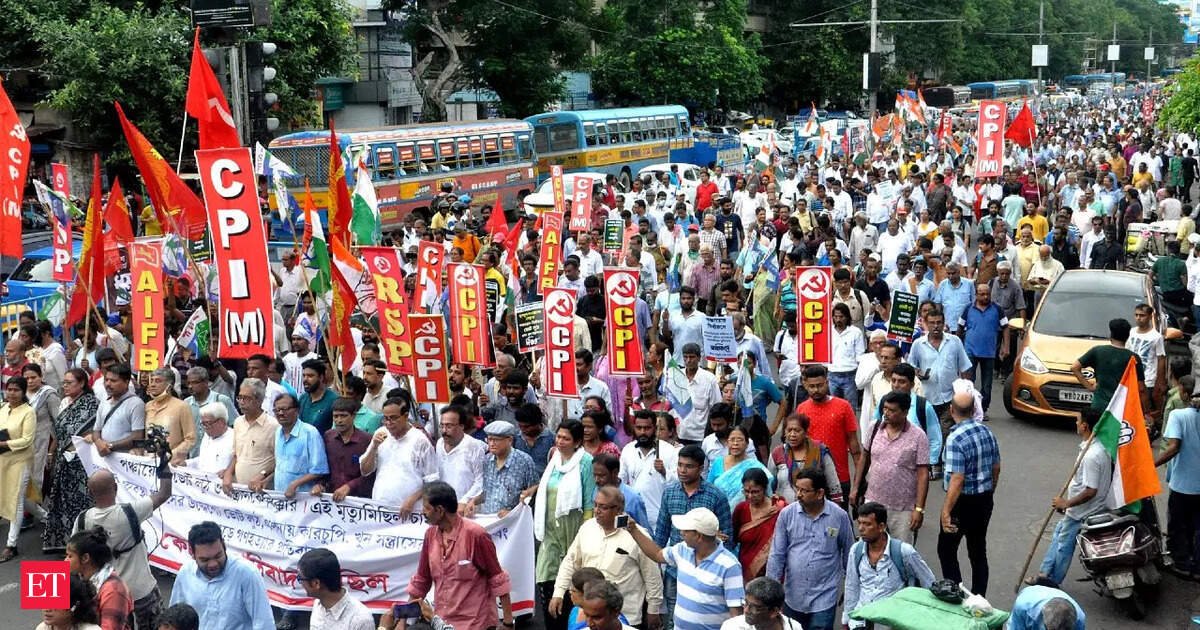
If Bengal politics thrives as much on perception as ideology, then “setting” remains its most durable shorthand, a charge every major political party levels against the other.
The ruling TMC, principal opposition BJP, the CPI(M)-led Left Front, and the Congress invoke it in different tones – either accusation or satire, and often electoral strategy.
In Bengal’s theatrical political culture, humour often accompanies accusation. Terms such as “CPMOOL (CPI(M)-Trinamool)”, “Bijemool (BJP-TMC)” and “Ram-Bam (BJP-Left)” have entered everyday conversation, blurring satire and strategy.
The TMC’s long-standing “Ram-Bam” line suggests Left votes gradually migrated to the BJP after 2019, strengthening the saffron surge.
The CPI(M), in turn, accuses the two principal rivals of benefiting from each other’s existence, while BJP leaders portray TMC and Left forces as tactical collaborators whenever electoral equations demand.
With the state polls barely a few months away, rhetoric has sharpened, shifting focus from governance to allegations of covert alliances, while speeches, digital campaigns and AI-driven memes amplify whispers into mainstream narratives across Bengal’s political landscape.TMC leader Kunal Ghosh dismissed allegations of covert understanding, saying, “Those who cannot challenge us politically keep inventing theories of ‘setting’. The real setting is among defeated forces trying to stay relevant.”
State BJP president Samik Bhattacharya framed it differently.
“People have seen how opposition votes get fragmented in crucial seats and help the ruling party,” he said, arguing that the Left and the Congress have indirectly aided the TMC in several contests.
Senior CPI (M) leader Sujan Chakraborty claimed that the “politics of fear and convenience” between the BJP and TMC benefits both.
“We keep raising governance issues, but the narrative is deliberately diverted,” he said.
Congress veteran Adhir Chowdhury argued that when politics becomes personality-centric, rumours replace ideological debate.
“Past instances have shown that the TMC acts like the BJP’s Trojan horse in the opposition camp and how the BJP is helping the Trinamool Congress in Bengal,” he said.
One of the newest threads in this narrative is the emergence of suspended TMC MLA Humayun Kabir and his proposed Janata Unnayan Party. Kabir’s reported talks with Left circles and possible engagement with minority-focused forces have fuelled speculation that new formations are designed to alter vote equations, reinforcing the “setting” discourse.
TMC leaders have accused emerging parties of indirectly aiding the BJP by dividing anti-TMC votes. Similar allegations have been made against ISF and AIMIM, both of whom reject the charge and insist that they represent independent voices.
For the BJP, the narrative helps consolidate anti-incumbency sentiment while appealing to voters disillusioned with both TMC and the Left.
For TMC, branding smaller formations as “vote-cutters” reinforces minority and secular consolidation, while for the CPI (M) and Congress, the theory helps project both larger rivals as beneficiaries of a managed bipolar contest.
Political analysts note that such accusations work because they require little proof. Every delayed investigation or tactical silence becomes fodder for speculation.
“It is a narrative that thrives on ambiguity based on the nature of the centre-state relationship. People connect dots even when there may be none,” said political analyst Suman Bhattacharya.
The “setting” theory itself is not new and dates back decades, during the 1967 experiment of the first non-Congress government, the United Front alliance between the Congress breakaway Bangla Congress and CPI (M), allegations frequently surfaced that leaders of the Bangla Congress, headed by then chief minister Ajoy Mukherjee, maintained a covert understanding with the Congress high command in Delhi.
Decades later, during the Left Front era, the TMC repeatedly accused the Congress and CPI(M) of tactical proximity, popularising the term “tormuj” (watermelon) to describe state Congress leaders who appeared green outside but red inside, a metaphor suggesting they were publicly opposed to the Left but privately aligned with it.
Veteran observers recall how courtesy meetings between adversaries were interpreted as evidence of secret deals. One such episode, the “fish fry meeting” between Chief Minister Mamata Banerjee and Left leaders after the 2014 Lok Sabha polls, entered political folklore as shorthand for alleged tactical warmth.
The TMC’s abstention during the 2022 vice presidential election, where Jagdeep Dhankhar emerged victorious, was seized upon by opponents as proof of tactical ambiguity, though the party said it was protesting opposition consultation processes.
Similarly, legal and investigative developments often become fodder for narratives of collusion. The pace of central agency probes, such as chit-fund cases or others, is cited by rival camps to support competing theories, while ongoing court proceedings in the ED-I-PAC raids case keep the debate alive.
In Bengal, “setting” has moved from corridor gossip to campaign currency traded by all parties, denied publicly, yet eagerly consumed by voters.


