



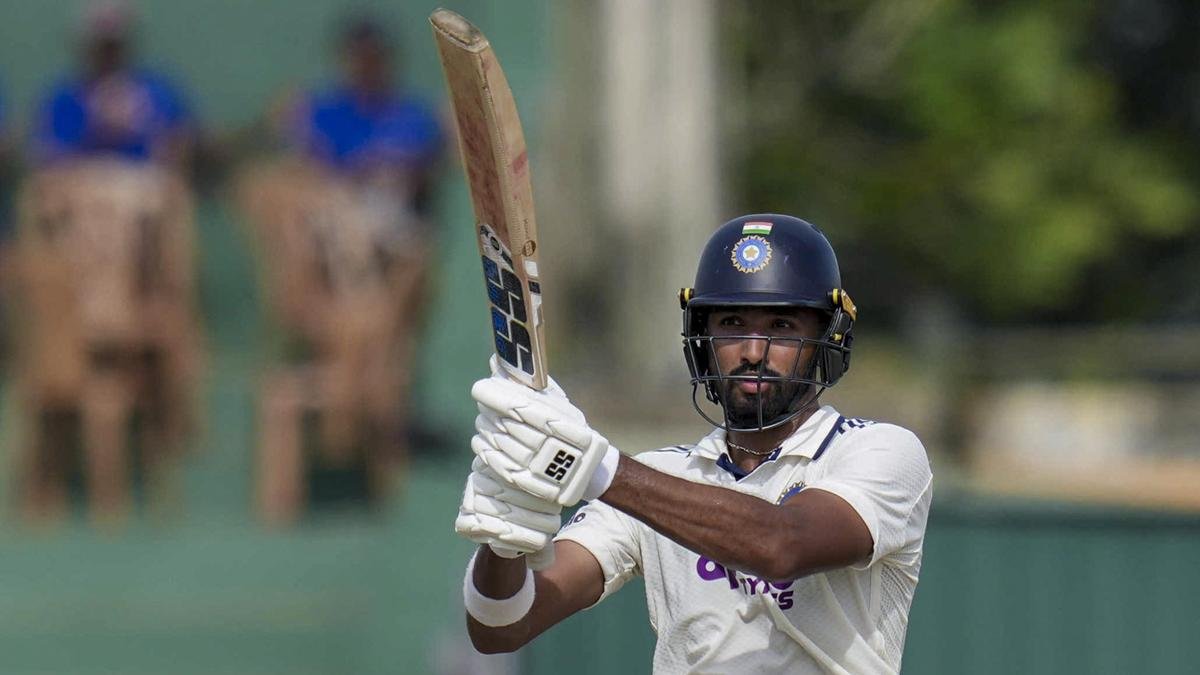
How often does a draw feel like a defeat? And a stalemate assume the hue of a victory? Often enough, Shubman Gill will insist.
Despite their own uneasy recent dalliance with the five-day format, India would have fancied their chances of bearding the Sri Lankan lion in its own den in a two-Test series that is pretty much the norm when the world’s most sought-after side isn’t playing against Australia or England.
India hadn’t lost a series in this country since 2008 and arrived early this month sitting on a five-Test winning streak on Sri Lankan soil. Even though their last visit was in 2017, they had reason to believe the hosts were ripe for the taking.
Significant result
The script seemed to be holding true. Notwithstanding pockets of defiance from their young guns, led by the exceptional Sonal Dinusha, Sri Lanka slumped to a 185-run rout in Galle in the first Test. The result assumed a more significant hue because India were without two-fifths of their first-choice bowling attack — Jasprit Bumrah and Washington Sundar were missing through injuries — but still won a rain-hit encounter with quite a bit to spare.
There was excellent reason, therefore, to aspire for a 2-0 sweep ahead of the second Test at the SSC ground. Sri Lanka, already without Pathum Nissanka and Kusal Mendis, were dealt another unkind cut when Dinesh Chandimal was ruled out of the second Test after hurting his neck while fielding in Galle. But as it turned out, his replacement, Pasindu Sooriyabandara, had a great game at the SSC, desperately unlucky to miss out of centuries in both innings.
Dinusha delights
Dinusha, however, ensured that a similar fate didn’t befall him. Ahead of this series, the 25-year-old left-hander had played just three Tests but had showcased his ability and his temperament, not least in the Caribbean in June-July when he reeled off a sequence of 43, 12 not out, 92 and 28 in the two Tests.
It should have been fair warning well heeded; it will be presumptuous to say that India didn’t pay much attention to the young man, but they didn’t crack the Dinusha puzzle throughout the series, which is one of the main reasons they had to settle for a 1-0 scoreline despite dominating the second Test too for large stretches.
Dinusha batted for a little less than 20 hours in making 420 runs from 722 deliveries, the single point of difference as the Lankans ground out a fabulous draw after being forced to follow on in the second Test.
It wasn’t all doom and gloom from an Indian point of view. Devdutt Padikkal grabbed his chances with both hands in his first Tests in more than 20 months. In the absence of Sai Sudharsan, he took giant strides towards making the No. 3 slot his own with hundreds in the first innings of both games.
The volume of runs was impressive, but so was his presence in the middle. In further signs of his evolution as a dependable, oftentimes aggressive all-format batter, he treated the bowling with just about the respect it deserved, using the offside as his preferred area of scoring and looking equally comfortable against pace and spin.
India will find it very hard to look beyond him for the one-drop position when they play two Tests in New Zealand in November. After all, how can you overlook the credentials of someone as consistent as the Karnataka left-hander was in Sri Lanka?
And then, there was Dhruv Jurel, justifying the faith of the Gautam Gambhir-led think-tank which was sure that the wicketkeeper-batter was the answer to their prayers for a dependable middle-order batter who could play spin with soft hands, deftness of feet and no gremlins of self-doubt.
Jurel showed what he is capable of.
| Photo Credit:
AP
Assured batting
Alongside Sai Sudharsan and Padikkal, Jurel was one of the three batters Gambhir was keen should be a part of the India ‘A’ side that arrived on these shores for a shadow tour towards the end of June. Admittedly, neither Galle nor the SSC was a rank turner like Kolkata had been against South Africa in November, but Jurel didn’t put a foot wrong either in front of the stumps — he had a half-century in the first Test which he topped with his second ton in the next — or behind it when Rishabh Pant sat out much of the Sri Lankan first innings in Colombo with an assortment of blows to his body.
K.L. Rahul was dependable without going big while Pant was, well, Pant — exhilarating, unpredictable, entertaining and compelling. Maybe Gill will be a little disappointed that he didn’t join the list of centurions, but his batting looked in decent order, as did Yashasvi Jaiswal’s even if he found novel ways of courting dismissals.
Then, there was Prasidh Krishna. Ahead of the series, Gill was asked if he had a difficult choice to make between the Karnataka pacer and the uncapped Gurnoor Brar as Mohammed Siraj’s new-ball partner. The skipper barely batted an eyelid when he said that Prasidh was bowling the best with the red ball that he had ever seen him, and the strapping quick didn’t disappoint.
Prasidh bowled his heart out.
| Photo Credit:
ANI
Even on the placid decks on offer, he worked up good pace, extracted appreciable bounce and kept the batters honest. When he pitched the ball up, there was movement which, allied with pace in the region of 140 kmph, made him a tricky proposition.
Up for the challenge
Prasidh was up for any challenge, including doing the dirty job of trying to soften up the batters with his shortish length, and is shaping up into an excellent support act for Bumrah and Siraj. India will need their pacers to fire on all cylinders when they go to New Zealand, so from that perspective, the development of Prasidh is perhaps the single greatest takeaway for the decision-making group from this three-week sojourn to the Emerald Isle.
But there are worrying signs aplenty too, not least when it comes to back-up spin options. Despite starting his Test career with so much promise in New Chandigarh when he took six wickets in the first innings against Afghanistan, and despite his ten-wicket match haul in Galle, Manav Suthar is still very much a work in progress.
In Colombo, his craft had to play second fiddle to the slowness of the SSC strip; there was bounce aplenty, which took bowled and leg before out of the equation, but the left-arm spinner was slow to respond when the Sri Lankan batters resorted to the sweep and the reverse sweep.
It might appear a touch harsh on someone who was only playing in his third Test, but this is an early education for Suthar and he will do well to heed the lessons if he aspires to step into the shoes of Ravindra Jadeja going forward and become the lead bowler around whom the Indian spin attack will revolve in the future.
Debut to forget
While Suthar did show signs of promise, Saransh Jain had a disappointing debut — and there is no way to sugarcoat that. On the radar of those involved in talent-identification and selection matters for a while now, Jain is an experienced hand at 33, with more than 50 first-class appearances under his belt for various outfits.
His first delivery in Test cricket was a no-ball, which can perhaps be put down to nerves, but he bowled six more of them across the two innings, which couldn’t have pleased anyone, least of all new spin bowling coach Sairaj Bahutule. But it wasn’t just the no-balls that were grating. While he did show reasonable control, the threat quotient was barely perceptible.
Saransh wouldn’t have been here if Washington was available but as a fallback alternative, he has a long way to go. In some ways, it points to a slight thinning of resources in the spin cupboard, which ought to worry those in the corridors of power because for so long now, India have got used to having the now-retired R. Ashwin and Jadeja to spin their webs of deception and lure batters to their doom.
After a lull, India have plenty of fast-bowling options to summon despite Mukesh Kumar and Akash Deep and Harshit Rana and Nitish Kumar Reddy spending a lot of time in the infirmary. But for the traditional land of spin to struggle to unearth an incisive off-spinner is a little hard to fathom and harder still to digest.
Jain deserves the benefit of doubt — after all, this was Test No. 1 and maybe he did have the proverbial ordinary one-off game — but for him to set himself up as a semi-long-term option, there must be obvious signs of improvement.
This tour in general, and the second Test particularly, was a steep learning curve for the captain. It’s been a little over 14 months since Gill first led the Test team, in England in Leeds last June. Captaincy looks simple from the outside but entails plenty of decision-making on the fly, even in Test cricket, without second-guessing oneself.
He was handicapped by a rapidly softening ball in Galle and by an SSC surface that had bounce but hardly any pace. Some of the fields he employed were strange, there was a definite occasional slant towards passivity, and the move to almost ignore trying to get Dinusha out on the final day of the series and target the other end was little short of self-defeating.
Mixed run
Gill has had a mixed run as captain — 2-2 in England, 2-0 at home against West Indies, defeat in his only Test against South Africa in Kolkata when he faced a mere three deliveries before contracting a neck injury, a hammering of Afghanistan and now this 1-0 success in Sri Lanka, his first overseas victory as skipper.
The journey has been challenging and exciting, but daunting outings lie in store in the red-ball version before he starts to focus exclusively on the 50-over format ahead of the World Cup in southern Africa in the second half of next year.
India haven’t won a Test in New Zealand since 2009 when Mahendra Singh Dhoni led them to a famous series triumph, and their last visit in 2020 was an unmitigated disaster as they were soundly beaten in both matches.
New Zealand will test the technique and the character of the batting group with its seam-friendly conditions, after which Australia will come calling for five Tests in India. Gill must be on top of his game — as lead batter and as leader — and towards that end, Sri Lanka was a timely, useful wake-up call.


