






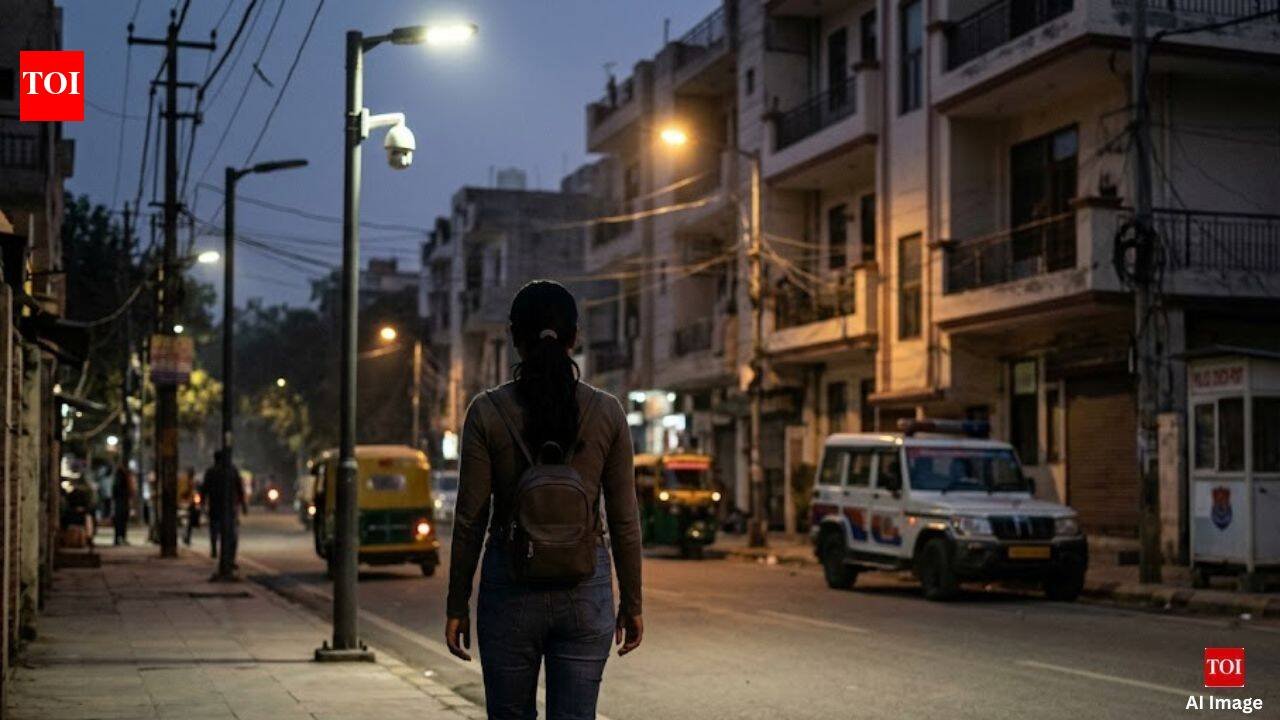
NEW DELHI: A Class X girl returning from coaching with a friend on a scooter being stopped by a group of youths on a public road. A 17-year-old at a Delhi park, separated from her male friend by men ‘posing as policemen’. A 16-year-old stranded in the rain who boarded a bus after its driver and conductor ‘offered to take her towards her destination’.In recent weeks, a series of assault cases involving girls and women in public spaces, transport and other everyday settings has again brought an old response into focus: learn to protect yourself.For many women, the immediate response is not to wait for the next security measure but to change something about themselves: the route, the timing, the people they travel with, or what they carry.But there is another side to that conversation. If women are expected to be more alert, learn self-defence and change the way they travel, what happens to the spaces they are expected to navigate every day?
‘Taught this since childhood’
Delhi reported 13,396 cases of crime against women, including 1,058 cases of rape in 2024. The capital also registered 7,662 crimes against children in 2024. Delhi Police said the city recorded 1,901 rape cases in 2025 as against 2,076 in 2024 and 2,141 in 2023.
Crime stats
For some women, the advice to be more careful after every assault is hardly new.“As a woman in this country, I don’t think we needed any more cases to change the way we travel,” said Siddhi.“We have been taught since childhood how to travel, how to ‘be safe’ and how to protect ourselves, all so that we don’t become the next target of sexual assault,” she said.Her interest in martial arts, however, did not begin because of safety concerns. It came from watching international competitions.That distinction is central to the debate. Learning a combat sport can be a choice. It could be for fitness, competition, confidence or simply interest. Turning it into a safety requirement is a different proposition.Laxmi, who has become more conscious about the timings and routes she takes, said she now keeps her phone accessible and remains more alert in unfamiliar surroundings. But she does not want fear to dictate how she lives.She does not believe women should have to take responsibility for someone else’s decision to harm them.“I would choose a safer environment because we as human beings obviously want the freedom to move around without constantly having to think about protecting ourselves,” she said, describing self-defence as an “added strength” rather than a necessity.For others, training offers precisely that sense of added preparedness.Asmita, who trains in MMA, distinguishes between feeling safer and feeling more prepared. Self-defence can give a person greater control in an unsafe situation, she said, but that does not make the environment itself safer for everyone.Unnati, meanwhile, carries pepper spray even on her hostel-to-college commute. She said she has considered self-defence partly because of her parents and sees it as something that can help in the immediate moment, even while questioning whether it can be a long-term answer.
What martial arts can and cannot prepare you for
The distinction becomes important when martial arts training is brought into the conversation as a response to assault.Avinash Pandey, a coach at Game Changers Martial Arts Academy, trains children in taekwondo, MMA and self-defence. He said regular martial-arts training develops more than the ability to fight.He pointed to discipline, coordination, reflexes, concentration, confidence and the ability to remain controlled under pressure. Training can also improve confidence and help children overcome fear and bullying.Children can begin at around five, provided they can understand and follow instructions, he said.But competitive martial arts and an actual assault are different situations.A formal competition is conducted within rules and under controlled conditions. A real-life assault does not follow either.A real attack can involve surprise, several people, a weapon, a confined space or a situation in which the person being attacked has little time to react. Self-defence training can give someone skills and confidence, but it cannot guarantee that a person will be able to overpower an attacker or escape every situation.Pandey said recent assault cases have led to more enquiries and enrolments. But he also sees a larger problem in the fact that people often turn to self-defence as a reaction to the latest case of assault/harassment/bullying.“The main responsibility lies with the government, people residing there and society to make the area/place safe for everyone to use,” he said. “Self-defence is secondary, making the places safe comes first.”
What self-defence can and cannot do
When the space itself becomes part of the problem
The recent Kalkaji case puts that distinction into sharper focus.A 17-year-old girl was allegedly gang-raped in Aastha Kunj Park near Kalkaji Mandir after three men allegedly posed as policemen, separated her from her male friend and took her to a secluded part of the park.The incident prompted the Delhi Development Authority (DDA) to order a safety audit of parks, with measures including additional lighting and floodlights, CCTV at entry gates, evening vigilance, more security personnel at vulnerable points, controlled access after sunset and identification of dark spots.TOI’s reporting from Aastha Kunj also found multiple access points, poorly lit stretches and gaps in security at the park.The response shifts the question away from what the girl could have done differently and towards what the space itself was offering, or failing to offer, in terms of visibility, surveillance and access to help.The same question appears in other recent cases, although the circumstances are different.In Jamui, the Class X girl was allegedly surrounded by a group of youths while returning from coaching. Police said the incident lasted around 20 minutes, with only parts of it captured in two videos that later surfaced online.The videos helped investigators trace the victims, after which an FIR was registered under the POCSO Act and relevant provisions of the BNS. Three people have been arrested so far, police said.In Samastipur, another video showed a young woman allegedly being surrounded and harassed by a group near an embankment after she and a male acquaintance stopped there to take photographs. Police registered a suo motu FIR and arrested all four accused.In both cases, the incidents unfolded in open public spaces. The question is not simply whether the person being targeted knew how to fight back. It is also whether there were people, surveillance, policing or other safeguards around them that could have interrupted the situation.And when the victim is a child, the limits of putting that responsibility on the individual become even clearer.A three-year-old cannot be expected to recognise an unsafe person, assess an escape route or use a self-defence technique.In one recent Delhi case, a three-year-old nursery student was allegedly sexually assaulted by a school cab driver who had worked at the school for around eight months.Police said the accused allegedly lured the child with chocolates and CCTV footage helped identify him. His phone was also reportedly found to contain videos of him offering chocolates to other children.In another Delhi case, a three-and-a-half-year-old boy was allegedly physically and sexually assaulted at a private playschool in Maujpur. CCTV footage purportedly showed the child being tied to a chair, kicked and held by his ears.Police booked the school director, principal, teacher and caretaker under the POCSO Act and the BNS, while the directorate of education ordered an inquiry.Here, the question of whether a child should know self-defence almost becomes irrelevant. The child is inside a space where adults and institutions are expected to provide supervision and protection.The same applies to the journey to and from those spaces.
When safety depends on the system around you
In the moving-bus case, the 16-year-old Class XI student had not set out looking for an unsafe situation. She had got off at the wrong stop amid heavy rain and darkness and was trying to find a way towards her destination when the driver and conductor of a sleeper bus allegedly offered to take her towards Noida Sector 63. She was later allegedly raped inside the moving bus and abandoned near Kashmere Gate.The Supreme Court on Monday drew a parallel with the 2012 Nirbhaya case and took suo motu cognisance of this issue.It also expressed “anguish and deep concern” over recent rape cases in Delhi-NCR and said such incidents point to a systematic failure of law enforcement and public administrative authorities to ensure basic public safety.The moving-bus case exposed questions that self-defence training cannot answer: who is allowed to operate a passenger vehicle, who is inside it, whether a passenger can summon help and whether surveillance systems actually work when something goes wrong.TOI’s reporting found gaps including defunct CCTV and the absence of stops along the route. The National Human Rights Commission subsequently sought reports from the Delhi and Gautam Buddh Nagar police commissioners on the investigation and measures taken in the case.The setting is different from a park, but the problem is similar. A person can be alert and still be dependent on the people and systems around them.That dependence becomes even more pronounced for children travelling to school.The NCPCR’s guidelines on preventing bullying and cyberbullying, for instance, recommend measures such as staff accompanying students on school buses, training staff to identify bullying, providing children with numbers they can use to seek help and installing CCTV in playgrounds and buses.These are not measures a child can put in place alone.Ishita said she has become increasingly conscious about how and where she travels, sharing her live location with friends even on short rides and constantly paying attention to who is around her.“It’s tiring, to be honest.” She said the habit was not something she consciously decided to adopt but something that happened “after every new case” she read about.She has also started watching self-defence videos that appear on her social media feed, even though she has not formally learnt the techniques.But her reaction to the advice that women should learn self-defence is less about rejecting the training and more about what happens when it becomes the only response.“It’s not wrong advice exactly, learning to defend yourself isn’t a bad thing but when it’s the only advice given after an assault, it shifts the conversation from ‘why did he do this’ to ‘what could she have done differently’,” she said.For her, the answer lies in the surroundings.“Self-defence helps me in one moment, against one person. A safer environment protects me and every other woman all the time,” she said.
What safer spaces actually require
Beyond the latest case
Pandey reiterated that the two things need not compete: martial arts can teach a child discipline, confidence and the ability to respond under pressure, while self-defence can give an individual another tool when something goes wrong.But the responsibility for preventing an assault cannot sit with the person who may be targeted.A safer park does not require every woman entering it to know how to fight. A properly monitored school bus does not require a child to know how to escape an attacker. A school with functioning safeguards does not expect a three-year-old to recognise danger.The students of DU’s Lady Shri Ram College, marching after a police encounter near their back gate, were asking for something that goes beyond another list of precautions: safer routes, reliable last-mile connectivity, visible police presence, functioning lighting and clear reporting mechanisms.In the world’s largest democracy, the freedom to move without constantly calculating risk should not have to be treated as an individual skill, or something women have to train themselves for. If women must learn to fight back, who is making sure they don’t have to?


