


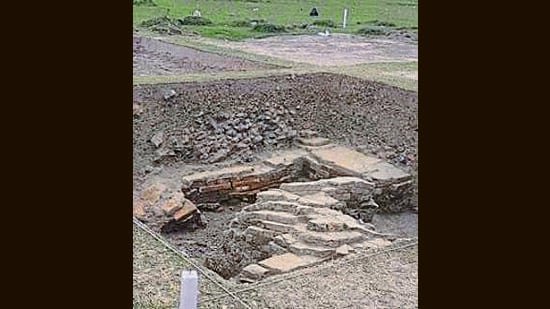
Security arrangements have been strengthened at Balirajgarh excavation site in Madhubani district to ensure uninterrupted excavation work being carried out by the Archaeological Survey of India (ASI) following reports of unwanted intrusion and alleged vandalism, officials said on Monday.

Madhubani SP Yogendra Kumar told Hindustan Times that a dedicated police picket comprising one police officer, two havildars and four constables has been deployed at the excavation site round-the-clock from Monday. ASI officials have also been directed to enforce strict security arrangements at all four entry gates.
The move follows reports that some terracotta artefacts excavated recently had allegedly been disturbed. Kumar rejected allegations of theft, saying miscreants merely attempted to tamper with them. The ASI now sealed important objects, idols and other artefacts in specially designed pouches for safekeeping, he added.
The issue of security and preservation of Balirajgarh also figured prominently during a recent review meeting chaired by district magistrate Anand Sharma. The DM said a boundary wall would be constructed around the excavation area and CCTV cameras installed to further strengthen security arrangements.
The ASI headquarters in New Delhi had granted permission for fresh excavation at Balirajgarh on February 26 this year. The approval, valid for one year, authorised ASI’s Patna Circle to undertake excavation at the site officially listed as “Remains of Ancient Fort of Garh”. The work resumed on March 28 after several years.
Meanwhile, superintending archaeologist of ASI’s Patna Circle, Hariom Sharan, remained unavailable for comment despite repeated attempts over the past two months regarding the reported disturbances at the excavation site. Calls to the department’s landline also went unanswered while emails elicited no response.
Locally known as Raja Bali ka Garh, the site is located in Babubarhi block, about 35 km from Madhubani district headquarters. Balirajgarh is regarded as one of Bihar’s most significant archaeological sites. The site was declared of national importance in 1938 under the Ancient Monuments Preservation Act, 1904.
