



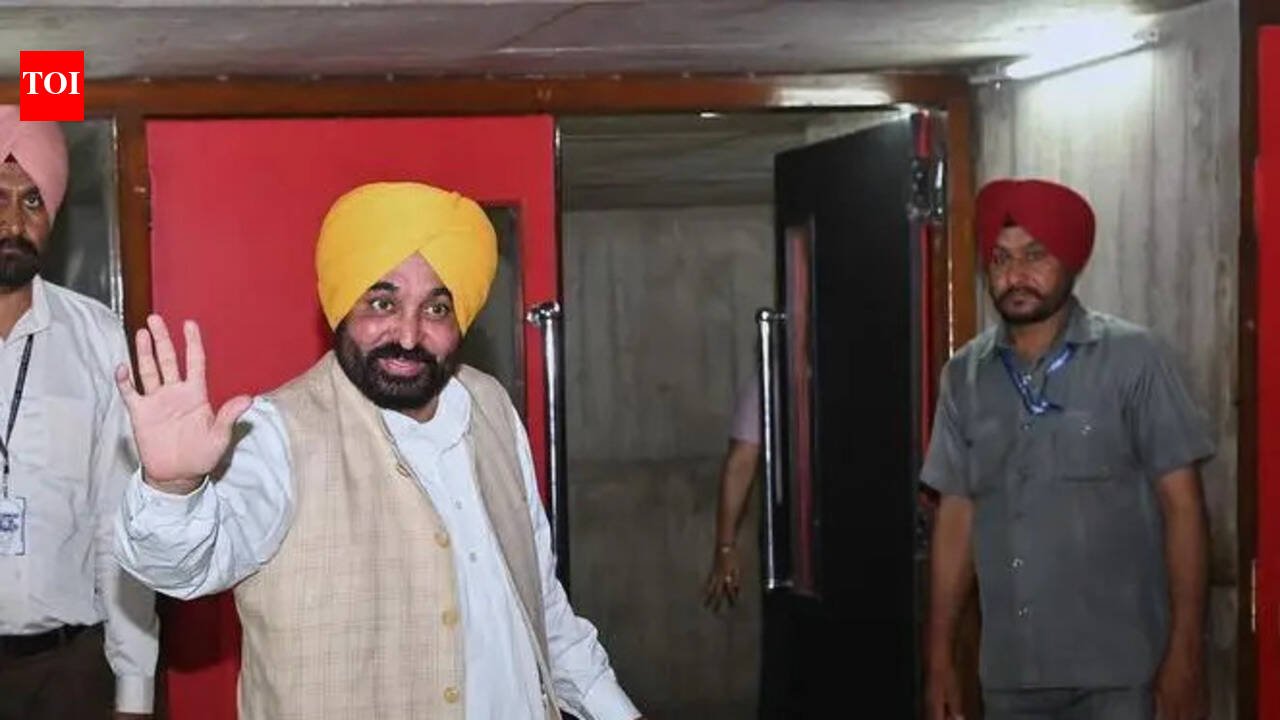
Chandigarh: Punjab CM Bhagwant Mann on Thursday made a case to the NITI Aayog for a special package for revitalisation of border areas, and demanded that Punjab be accorded special category status (SCS) with 90:10 funding under all centrally sponsored schemes. Assuring the Prime Minister of Punjab’s collaborative commitment to the Viksit Bharat 2047 vision, Mann emphasised that only a “secure, safe and thriving” Punjab can guarantee a Viksit Bharat @ 2047. Mann also presented his govt’s achievements in health care, education, anti-drug campaign, entrepreneurship and skill development. The chief minister assured the Prime Minister that Punjab would continue to work shoulder-to-shoulder with the Centre to achieve the vision of Viksit Bharat 2047. “Punjab and its people will collaboratively work with the Govt of India towards making India Viksit Bharat @ 2047. Only a secure, safe and thriving Punjab can guarantee a Viksit Bharat @ 2047,” he said.Presenting Punjab’s development roadmap, Mann said, “I am proud to present our collective vision for a Rangla Punjab that is determined to play a pivotal role in shaping a Viksit Bharat by 2047.” He said that as Punjab’s aspirations align with national priorities, discussions centred on human capital development are both timely and crucial. Pointing to Rs 12,905 crore in losses from the 2025 floods and the impacts of Operation Sindoor, Mann stated that central funding remains grossly inadequate — noting the Vibrant Village-II scheme covers only 107 of Punjab’s over 2,000 border villages. He said that Punjab protects the nation’s borders, yet Centre’s support remains inadequate. He asserted that the state deserves special category status and a dedicated border package.Highlighting Punjab’s role as a frontline defence state sharing a 553-km border with Pakistan, Mann detailed the state’s battle against drone smuggling, terrorism, and economic stagnation. He asserted that the state’s aspirations are aligned with the national goal of Viksit Bharat 2047. He said that densely populated villages and towns located close to the international border have been deprived of the economic growth witnessed by other parts of the country. He noted that decades of uncertainty and risk have resulted in negligible investment in border districts and, in many cases, led to a flight of capital and the closure or relocation of industries.Mann said that Punjab repeatedly urged the Centre to take “urgent measures” to strengthen the international border and address the multiple challenges confronting the state. “To secure our international border with Pakistan, make it future-ready. We have placed a series of urgent demands before the Centre. However, there has been little and unenthusiastic response from the Centre, which is unfortunate and undesirable,” he said.“The genuine demands of the people of Punjab, raised by me during the 10th meeting of the Governing Council and reiterated today, may kindly be accepted,” he said.Mann demanded that Punjab be accorded special category status (SCS) with 90:10 funding under all centrally sponsored schemes on the lines of hill states, North Eastern states and Jammu & Kashmir.Urging the Prime Minister to extend greater support to Punjab, Mann said, “Punjab and its people stand resolute in their commitment to protect the country and its borders from a hostile neighbour even at the cost of their own disadvantage.”Meanwhile, the CM highlighted the Punjab govt’s Mukh Mantri Sehat Yojna as a step towards universal health insurance. He said the scheme is being implemented through an extensive network of nearly 900 govt and empanelled private hospitals across Punjab and Chandigarh.Mann highlighted transformations across the state’s health care, anti-drug, and education sectors. On primary health care, Mann noted the establishment of 990 standardised Aam Aadmi Clinics (414 urban and 576 rural). These facilities utilise IT-enabled real-time reporting systems to provide 107 essential medicines and 47 diagnostic tests entirely free of charge.Turning to the state’s anti-drug initiative, Yudh Nashean Virudh, Mann outlined a comprehensive strategy to combat trafficking and addiction. To support long-term recovery, the state operates 547 out- patient opioid-assisted treatment (OOAT) clinics, 183 de-addiction centres, and 90 rehabilitation centres. Additionally, these recovery services have been extended into 19 jails to guarantee uninterrupted care for incarcerated individuals. MSID:: 131662421 413 |


