






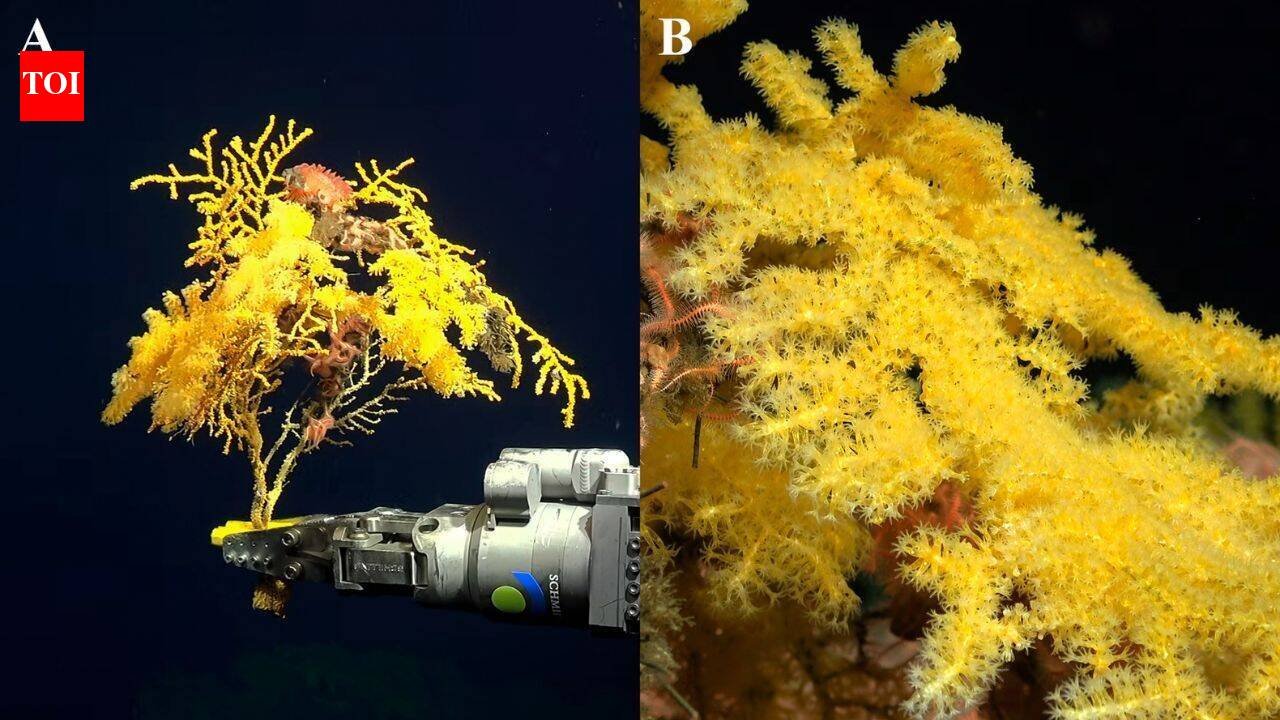
Scientists exploring deep-sea mountains beneath the Pacific Ocean off Costa Rica have discovered a striking ‘golden coral’ so different from known species that researchers created an entirely new family to classify it. The bright yellow, tree-like coral was found between 360 and 529 metres below the surface, growing on rocky outcrops covered with brittle stars. According to a study published in ‘ZooKeys,’ its physical features and genetic makeup made its position in the coral family tree difficult to establish. The researchers examined hundreds of genes to solve the mystery and confirmed that this coral represented a distinct evolutionary lineage. Named ‘Laurinque elenya,’ the species belongs to the newly created family Laurinqueidae. The discovery adds another piece to life in the deep ocean, where remote habitats continue to reveal species that have remained unknown to science.
How did scientists find the unique golden coral deep beneath the Pacific off Costa Rica
The discovery emerged during scientific expeditions to underwater mountains, off Costa Rica in 2019 and 2023. These rocky environments lie far below the ocean surface and can support a variety of marine life. According to the study, researchers used the remotely operated vehicle ‘SuBastian’ to explore the seafloor and collect specimens. The vehicle was deployed during expeditions aboard the research vessels ‘Falkor and Falkor (too).’ The coral was found around ‘Isla del Coco’ and along Costa Rica’s Pacific margin. Its bright yellow branches immediately distinguished it from the surrounding environment. Some colonies grew to more than a metre tall, rising from rocky surfaces densely covered with brittle stars. At that stage, however, the researchers did not know that the striking coral would eventually lead them to create a completely new family.
How genetic evidence showed the golden coral belonged to a brand new family
Identifying the coral’s closest relatives proved more complicated than expected. According to the EurekAlert, scientists first sequenced three genes commonly used to study relationships between corals. Instead of providing a clear result, the genes linked the new coral to different and unrelated families. The researchers then adopted a broader genetic approach, examining hundreds of genes rather than relying on a small number of genetic markers.This analysis showed that the coral represented a separate lineage. It was closely related to the family Eunicellidae, but the researchers found enough differences in its genetics and anatomy to justify placing it in its own family. The study established ‘Laurinqueidae’ as a new family and ‘Laurinque’ as a new genus, with Laurinque elenya becoming the first described species within this newly recognised group. According to the study, genetic evidence and physical characteristics were important in demonstrating that the coral did not belong to an existing family.
Laurinque elenya; A. Colony collection; B. Detail of polyps. Image Credit: ROV SuBastian
The scientific name reflects a remarkable deep-sea landscape
The researchers drew inspiration from the coral’s appearance and surroundings when choosing its name. According to the EurekAlert, Laurinque comes from ‘Laurinquë,’ a Quenya word meaning ‘golden tree.’ The name refers to the species’ vivid yellow colour and branching shape. Meanwhile, the species name ‘elenya’ means stellar or ‘of the stars.’ It refers to the brittle stars that covered the seafloor around the coral colonies. The name therefore captures both the appearance of the coral and the unusual habitat in which it was discovered.
The discovery highlights how much remains unknown within the oceans
The deep ocean remains one of the least explored environments on Earth, despite covering a vast part of the planet. According to the EurekAlert, research around Costa Rica’s seamounts is continuing to document marine life that has not previously been known to science. Such discoveries can improve understanding of the biodiversity found in deep and difficult-to-reach habitats. The newly described coral also adds to knowledge of vulnerable marine ecosystems. Coral gardens create important habitats for other organisms, making the study of these environments valuable for understanding deep-sea life. Deep beneath the Pacific, a golden coral had remained unnoticed until modern exploration revealed that it represented not just a new species, but an entirely new branch of the coral family tree.


