



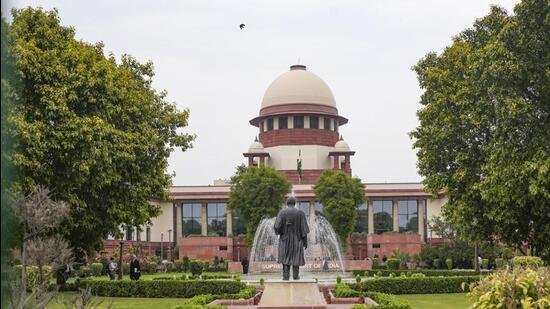
Chief Justice of India (CJI) Surya Kant on Wednesday informed members of the Bar that the Supreme Court has taken suo motu cognisance of a new section in the Class 8 Social Science textbook brought out by the National Council of Educational Research and Training (NCERT) which discusses “corruption in the judiciary”, asserting that he would not permit the institution to be defamed.


“I will not allow anyone on earth to defame the institution. Howsoever high they be, nobody is above the law. Do not worry… I know how to deal with it,” the CJI said in open court after a group of senior advocates urged the court to intervene.
Senior advocate Kapil Sibal mentioned the issue before a bench also comprising justice Joymalya Bagchi, saying the Bar was “deeply disturbed”.
“We are compelled to urgently mention this matter since we, at the Bar, are deeply disturbed. Children in Class 8 are being taught about ‘corruption in judiciary’. It is a part of the NCERT curriculum and their textbook,” Sibal submitted.
The CJI responded that he was already aware of the development. “I am fully aware of it. I can assure you…it definitely concerns the entire institution. All stakeholders, judges in high courts are equally perturbed and have brought it to my notice,” he said.
“I have already passed the order on the administrative side. We are taking the matter suo motu,” he added, indicating that the top court would initiate proceedings on its own motion.
The CJI described the development as “deep-rooted”, adding that it appeared to be “a calculated and conscious step”.
Senior counsel Abhishek Manu Singhvi pointed out that while the chapter dealt with corruption in the judiciary, there was “not a word” about corruption in other sectors such as the bureaucracy or politics.
Responding, Justice Bagchi observed that “constitutional morality, as envisaged in the basic structure, is missing”.
“I can assure you we will take appropriate steps,” the CJI reiterated.
The controversy centres on a newly released Social Science textbook for Class 8 by NCERT, which includes a section on “corruption in the judiciary” as part of a chapter titled “The role of the judiciary in our society”.
The chapter lists “corruption at various levels of the judiciary” and a “massive backlog” of cases as among the challenges faced by the judicial system. It provides approximate figures of pending cases — around 81,000 in the Supreme Court, over 6.2 million in high courts, and nearly 47 million in district courts.
The section states that judges are bound by a code of conduct governing their behaviour both inside and outside court, refers to internal accountability mechanisms, and mentions complaints received through the Centralised Public Grievance Redress and Monitoring System (CPGRAMS). It notes that over 1,600 such complaints were received between 2017 and 2021.
The textbook also explains the constitutional mechanism for removal of judges through impeachment by Parliament after due inquiry, and states that instances of corruption and misconduct can negatively affect public confidence. It emphasises the need for transparency and accountability, and quotes former CJI Bhushan R Gavai on the importance of swift and decisive action to preserve faith in the institution.
The previous edition of the textbook, based on the 2005 National Curriculum Framework, had discussed the structure and role of the judiciary and issues such as delay in disposal of cases, but did not contain a section explicitly dealing with corruption in the judiciary.
NCERT has been revising textbooks in line with the National Education Policy, 2020 and the new National Curriculum Framework for School Education. New books for Classes 1 to 8 have already been rolled out.


