



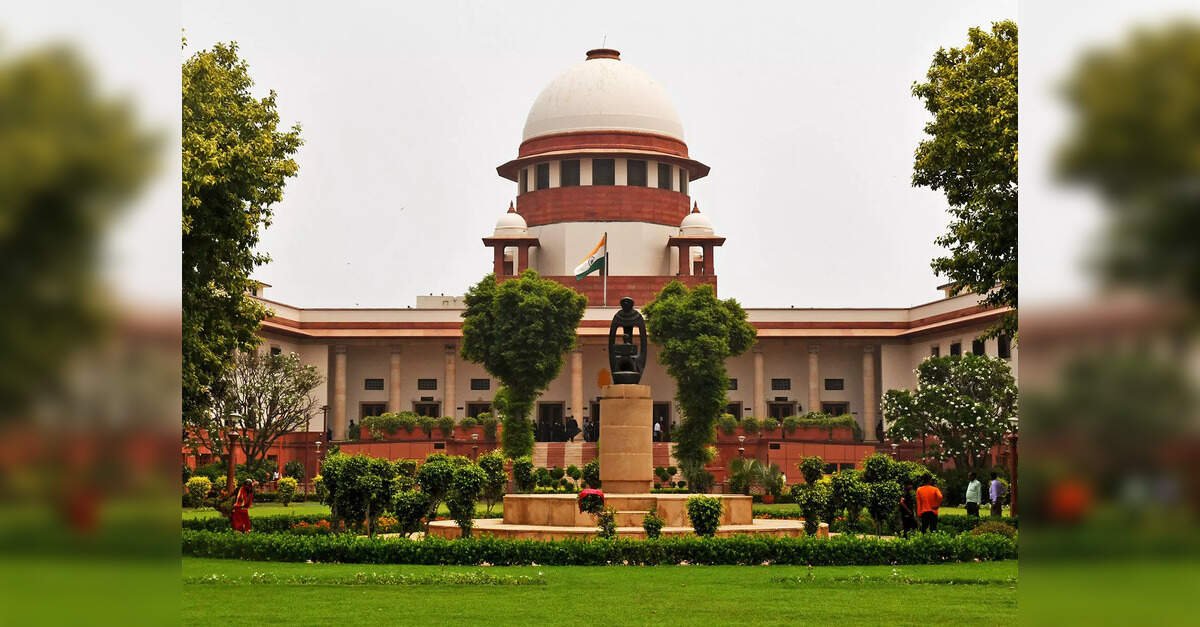
New Delhi, The Supreme Court has referred to a larger three-judge bench an important legal question whether the moratorium provisions of the Insolvency and Bankruptcy Code (IBC) staying all recovery proceedings against a firm undergoing insolvency proceedings will also lead to the halting of cheque bounce cases against the company and its directors.
Under the IBC, once the insolvency proceedings are invoked against a defaulting firm, all the recovery cases against it get stayed in a bid to save the assets of the firm with an aim to either revive it or liquidate to ensure repayment of dues to the creditors.
A bench comprising Justices J B Pardiwala and K V Viswanathan, in a judgment pronounced on Wednesday, also referred to the larger bench the question of whether an IBC moratorium should stop the entire cheque bounce trial or only the recovery of the compensation.
It also referred to the larger bench the second question whether Section 138 of the Negotiable Instruments (NI) Act, under which cheque bounce cases are prosecuted and the objective underlying the enactment indicate that “it is quasicriminal in nature with a tilt towards the criminal side?”
Justice Pardiwala, writing a 151-page judgment, said, “We are of the opinion that, for a comprehensive consideration and an authoritative pronouncement after taking into account all aspects, including those dealt with hereinabove, the matter needs to be placed before Hon’ble the Chief Justice of India to constitute an appropriate three-Judge Bench.”
“Whether the provisions of Section 138 of the NI Act and the objective underlying the enactment thereof indicate that it is quasi-criminal in nature with a tilt towards the criminal side,” reads the first question referred to the larger bench.
“Whether the moratorium provisions under Part III of the IBC should be made applicable on the entire proceedings under Section 138 of the NI Act or only to the compensatory aspect thereof?” reads the second question.
The bench asked the apex court registry to place the cases before the Chief Justice of India for appropriate orders.
The case titled ‘Dineshchand Surana vs UCO Bank’ centred on whether a person undergoing personal insolvency under the IBC can use the statutory moratorium to halt criminal trials under Section 138 of the NI Act.
Until now, the legal field has relied on the 2021 judgment which famously described cheque bounce proceedings as a “civil sheep in a criminal wolf’s clothing”, suggesting that since the primary goal is money recovery, such cases should be stayed during insolvency.
However, Justice Pardiwala expressed reservations about viewing Section 138 as a purely civil remedy.
The bench suggested that this aspect should be stayed by the IBC moratorium to prevent the depletion of the debtor’s assets, ensuring all creditors are treated fairly under the insolvency process.
Justice Pardiwala said that while Section 138 arises from a civil debt, the legislature intentionally gave it “criminal color” to ensure trust in commercial transactions.
“If the protection of moratorium is granted to persons accused of cheque dishonour, it would tantamount to allowing evasion of criminal liability,” the court said.
The bench, which framed three issues for its adjudication, first dealt with the question whether the proceedings under Section 138 of the NI Act are initiated with the object of recovering the money from the debtor.
Answering the question, it said, “The answer to this question must be an emphatic ‘No’. We are of the considered view that the discussion on the predominantly criminal nature and objective of Section 138 of the NI Act was not brought to the attention of the three-Judge Bench of this Court in P. Mohanraj (supra).
“We have held that though proceedings under Section 138 of the NI Act are quasi-criminal, yet the predominant nature of such proceedings is criminal.”
The second issue was whether the proceedings under Section 138 of the NI Act are protected during the moratorium period provided under the IBC.
Answering this question, it said, “We have also dealt with the compensatory aspect of Section 138 proceedings and have taken the view that the same is in the nature of a civil remedy that would result in the depletion of the assets of the individual debtor if not stayed.”
“Therefore, we are of the view that the moratorium provisions under Part III of the IBC must be made applicable in respect of recovery of compensation in Section 138 proceedings.”
It said that consequently, the operation of moratorium depends upon the stage of the Section 138 proceeding.
The verdict also answered the third question whether the proceedings under Section 138 of the NI Act against the individual directors and other persons vicariously liable under Section 141 of the NI Act for the actions of the corporate debtor would benefit from the moratorium provisions of the IBC in cases of personal insolvency or bankruptcy.
Replying to this, the verdict said, “In our considered opinion, moratorium under Sections 96 and 101 of the IBC respectively is applicable on the director(s) who are saddled with the liability to discharge the compensatory obligation of the company by virtue of the use of the words ‘any debt’ therein.”


