






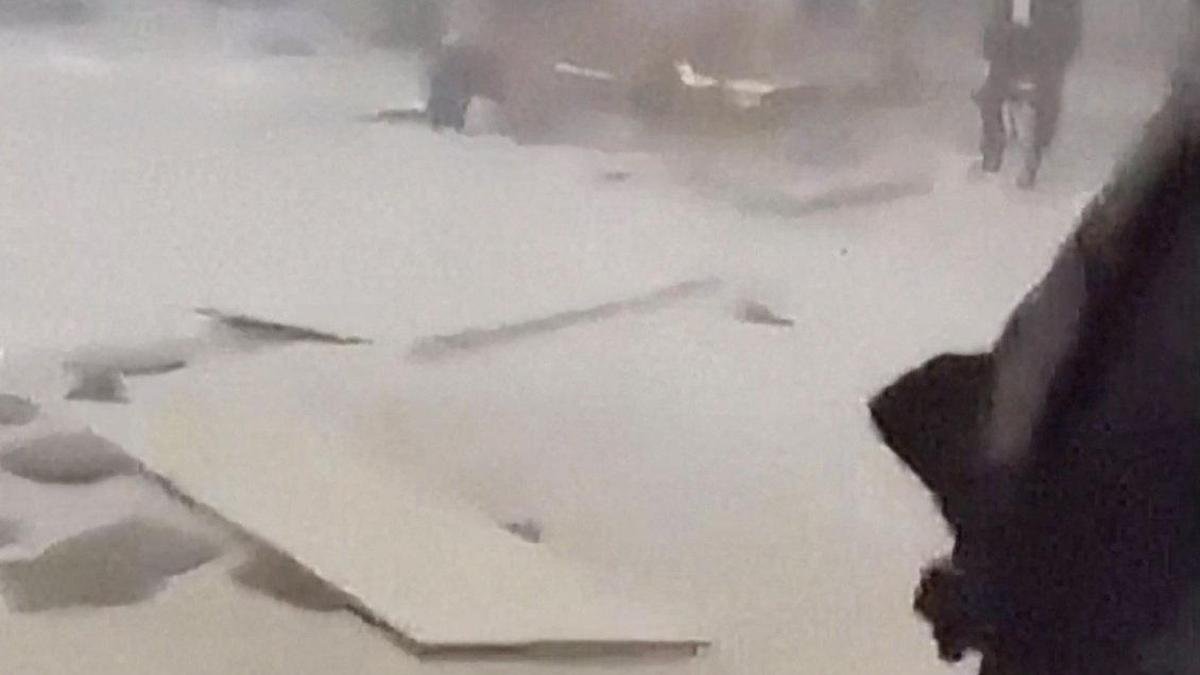
A Saudi-led coalition fighting Iran-backed Houthi rebels in Yemen said a projectile struck a passenger terminal at the international airport in Riyadh on Sunday (October 11, 2026), less than a day after a missile struck it and killed 12 people. Saudi civil aviation authority said that the latest attack caused injuries.
Yemen’s Houthis claimed responsibility for the attack. The group said that it has launched several attacks on Riyadh airport since Saturday (October 12, 2026).
There were no immediate details about the latest strike, which hit the same complex housing terminals 3 and 4 for domestic flights.
The sharp escalation in the new front in the Iran war threatens to draw in greater U.S. military involvement, as President Donald Trump has said he is weighing joining the fight against the rebels.
The strike came shortly after the Houthis said the airport under their control in the Yemeni capital of Sanaa had been struck again. They blamed the Saudis but provided no details.
Saturday’s missile attack on the Riyadh international airport was the deadliest in a Gulf Arab nation since the Iran war began. Over 300 people were wounded, some of them critically.
The strike on Sunday (October 11, 2026) occurred as King Khalid International Airport remained closed and authorities moved schools in the capital online.
At stake, again, are global supplies and prices of oil as well as commercial shipping through a crucial alternative waterway to the Iran-threatened Strait of Hormuz — along with civilians and aviation throughout the region.
Trump says he is weighing joining strikes against rebels
Mr. Trump on Saturday (October 10, 2026) said he was considering whether to join Saudi strikes against the rebels. He later said he planned to speak with Saudi Crown Prince Mohammed bin Salman.
U.S. intervention could prompt the Houthis to halt shipping through the Bab el-Mandeb Strait at the southern end of the Red Sea off Yemen and further restrict the flow of oil out of the Persian Gulf.
Saudi Arabia is running low on missile interceptors and has asked France, Britain, Pakistan and Egypt to deploy air defence support to the region, regional officials told The Associated Press last month, with one noting that the US has seen its own stock dwindle during the war with Iran.
Meanwhile, deeper U.S. involvement in an unpopular regional war could further threaten Trump’s Republican party in upcoming midterm elections. Both Trump and Iran insist the American election calendar has no effect on their decisions on how to end the seven-month-old conflict.
Houthis have targeted Saudi airports, military and oil facilities
As the Riyadh airport remained closed until at least 9 pm Sunday, according to Flightradar24, fighting continued in Yemen.
Earlier on Sunday (October 11, 2026), the Houthi-run health ministry said a child was killed and six people wounded in a suspected Saudi airstrike on a house in Sanaa. The ministry also said 91 Yemenis have been killed by the Saudi-led coalition in five weeks, 60 per cent of them women and children.
There was no immediate comment from Saudi authorities on the claims.
And there remained no claim of responsibility for the Saturday attack on Riyadh airport, though the Houthis at times have kept silent when an attack brought widespread international condemnation.
But the rebels have acknowledged targeting Saudi airports and oil installations in recent days, and on Sunday they again warned: “all airlines, experts, employees, workers and travellers against using Saudi airports and airspace, as they are vulnerable to attack and have become a theatre of operations for our forces.”
Brig. Gen. Yahya Saree, the group’s military spokesperson, wrote on X that airports in the holy cities of Mecca and Medina were exempt.
The dead in the airport attack included several nationalities
The missile on Saturday (October 10, 2026) struck an airport complex housing terminals 3 and 4 for domestic flights, a regional official said, speaking on condition of anonymity because they weren’t authorised to speak to the media.
A Saudi statement said the dead included four Saudi citizens, two Bangladeshi nationals, a Palestinian, a US citizen, an Egyptian, a Jordanian, a Syrian and a Sudanese.
The Egyptian woman was a flight attendant identified as Azza Ramzy, who worked for Saudi airline Flynas, according to Egyptian state-run TV.
The Syrian woman was a widowed mother of four who had been living in Saudi Arabia for five years, a relative told The Associated Press. The Syrian Embassy identified her as Buthaina Ahmad Oweida. Her niece, Nisreen Oweida, said she had left during Syria’s civil war. She was living in Mecca and had been returning from a visit to her sister in Riyadh when she was killed.
The Houthis claimed attacks earlier in the week on King Khalid International Airport that killed three Saudis, including a pilot, and a Sudanese national. The airport has no military facilities.
Published – October 11, 2026 09:07 pm IST


