


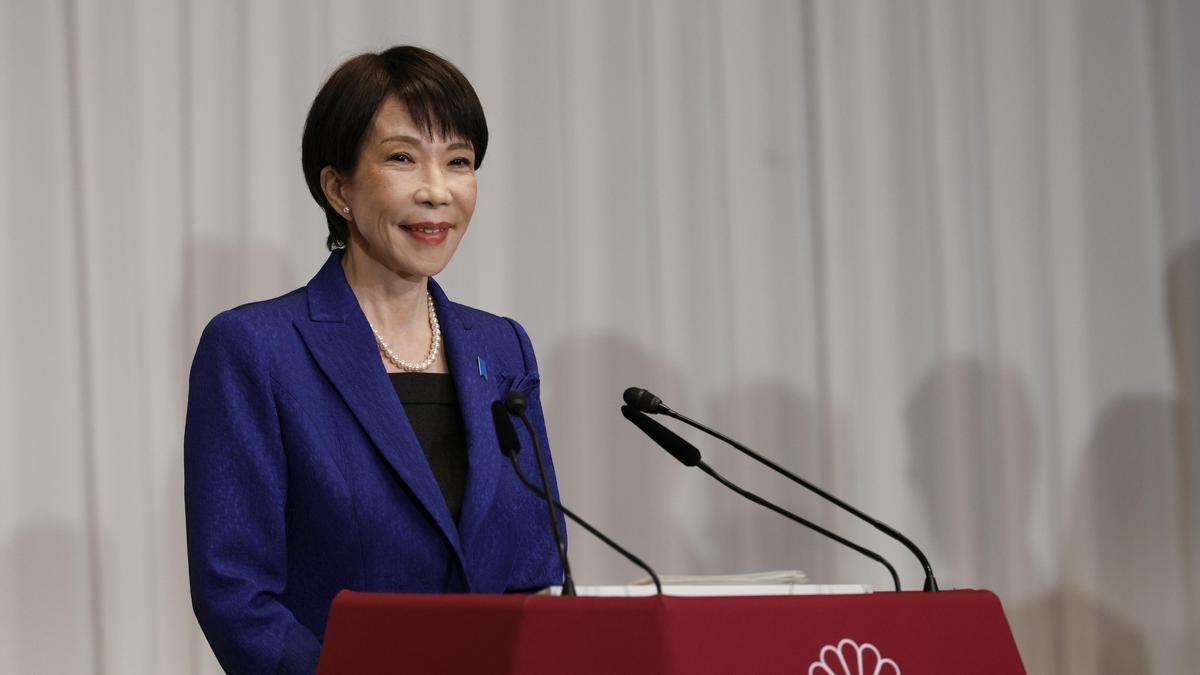
Japan’s Prime Minister Sanae Takaichi, leader of the ruling Liberal Democratic Party (LDP), speaks during her press conference on February 9, 2026 in Tokyo.
| Photo Credit: AP
Japanese Prime Minister Sanae Takaichi’s landslide victory in snap polls she had called for, are seen as a vote for a strong security policy in Japan, could mean more tensions with China and hold out hope for closer India ties in the Indo-Pacific, say experts.
In particular, the Liberal Democratic Party’s (LDP’s) record performance winning two-thirds of the Japanese House of Representatives will accrue to Ms. Takaichi personally, given the LDP’s poor performance in the past. Ms. Takaichi, who first came to power after an in-party election in October 2025, was preceded by Shigeru Ishiba, Fumio Kishida, and Yoshihide Suga, all of whom served as PM for 2-3 years.
“The win is entirely due to PM Takaichi’s personal popularity,” said former Ambassador to Japan Deepa Gopalan Wadhwa, comparing the “drubbing the LDP had got” in the 2024 elections to the latest polls, where the LDP won 316 of 465 seats. “As a protégé of former PM Shinzo Abe, she can be expected to carry on his legacy, and that means focus on the Indo-Pacific and valuing close ties with India,” Ms. Wadhwa told The Hindu.
In particular, Ms. Takaichi’s personal style in international engagements won her many voters, Tomohiko Taniguchi, professor at Japan’s Keio University and an advisor to former Japanese PM Shinzo Abe said.
“The way she smiled with Donald Trump, the way she embraced the Italian Prime Minister, and the way she sat down at the drum set with the president of South Korea—all this set her dramatically apart from her three immediate predecessors: Suga, Kishida, and, worse still, Ishiba, none of whom learned how to connect with ordinary people,” he added, pointing to PM Takaichi’s “viral” social media content.
The Japanese PM will now be watched most closely for whether she sets out mend fences with China, or step up the country’s security policies to counter its maritime neighbour with whom tensions have been high since November, when Ms. Takaichi’s comments on Taiwan set off a series of economic sanctions by China.
“[PM Takaichi] can certainly increase the defence budget—something China may not welcome. Yet the relationship between Xi and Takaichi could well improve, simply because Xi tends to show due respect to leaders who have proven themselves strong and resilient,” Professor Taniguchi said. Beijing will also watch closely to see if Ms. Takaichi, with her massive mandate, makes moves toward a less pacifist, more securitised Constitution, although she would only be able to make changes if the LDP wins similarly in the upper house, where elections are not due until 2028.
Ms. Takaichi, who was congratulated by Prime Minister Narendra Modi for the win on Sunday (February 8, 2026), said in a post that she looks forward to working on bilateral ties and to “cooperate in realizing a Free and Open Indo-Pacific (FOIP)”. However, New Delhi will hope for her to push specifically for holding the Quad summit in India, which has not been held since 2024, with the US as well. Ms. Takaichi is expected to travel to Washington in March, ahead of a visit to Beijing by U.S. President Donald Trump in April.
“PM Takaichi knows that her friend and mentor, ABE Shinzo, respected both Mr. Modi and Mr. Singh, and how much strategic importance he placed on India and the QUAD,” said Mr. Taniguchi. “She has indicated that she intends to give renewed momentum to FOIP, the QUAD, and Japan’s relations with India”, he added, in comments to The Hindu.
Published – February 10, 2026 10:34 pm IST


