



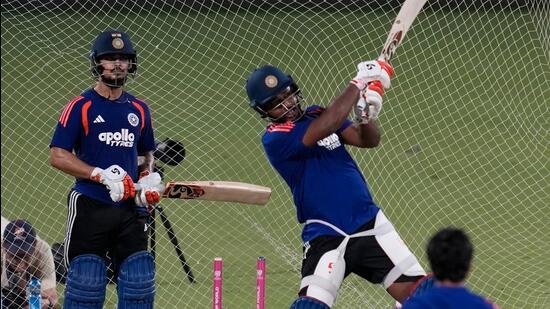
Chennai: So attuned is the mind to watching Abhishek Sharma opening the batting that it was taken for granted that India’s practice session too would be no different. It was though. In the backdrop of Tilak Varma and Ishan Kishan starting in adjacent nets, Abhishek cut a stark picture wheeling left-arm dollies that were promptly dispatched to the yellow grand stands of the Chepauk stadium.
Outside, Sanju Samson started taking throwdowns before he was joined by Suryakumar Yadav. Is that India’s top-four for Thursday? Or just a quirk of Tuesday’s training plans? With Rinku Singh having to rush home as his father is seriously ill and a doubt against Zimbabwe, all three top-order batters could well play.
Abhishek did bat, but much after the other top-order batters had clocked in. Which is still quite a deviation from the usual routine. It could be deliberate given Abhishek’s form has slipped into an abyss. On his exploits used to hinge India’s powerplay momentum, till Kishan joined and made India look unstoppable in the New Zealand series just before the World Cup. That script has gone for a toss now after scores of 0,0,0 and 15 from Abhishek, and India can’t be faulted for starting to blink at the question whether the opening batting needs a reset.
The mindset still is that the slip in form is not entirely Abhishek’s fault. “I think Abhi’s preparation coming into the World Cup with the food poisoning that he had at one stage has obviously hampered his progress in terms of where we want him to be at this phase,” India assistant coach Ryan ten Doeschate said after the loss to South Africa.
“You want him up and running and sort of confident in his swing and confident in his game plan, and when you score three zeros that is going to start weighing on you. I saw some really good signs on Friday night in the nets. But he looks a little bit short and our job as the coaching staff is to pull that right.”
For a side built on batting depth, there are other subtle but significant questions to be addressed. Can the top order recalibrate from caution to clarity? Against South Africa, India’s innings stalled at crucial junctures, momentum leaking through overs that promised more. In T20 cricket, hesitation can be as damaging as aggression that misfires. More concerning was how lack of pace has been easily used against the Indian top-order. Like in the last game where Kishan got out to Aiden Markram and Abhishek to a slower delivery from Marco Jansen.
On Tuesday, Kishan started against pace before switching to the nets with spinners operating. Charging down to bowlers, Kishan’s intent couldn’t have been clearer. Not just Kishan, Varma’s extended batting session too was indicative of single-mindedness to correct a few wrongs. His highest score so far is 25, his strike rate a lowly 118. The belief with which he anchored chases in last year’s Asia Cup has taken a beating due to a string of low scores this time. But who knows if this is where Varma’s curve will find a new trajectory. For if India aim to continue giving Kishan and Abhishek that freedom to hit and get out, Varma needs to up his game immediately.
The middle overs will offer their own examination. Zimbabwe bowlers, though less heralded, are disciplined enough to apply the squeeze if they take early wickets. India must resist the temptation to play the situation, rather dictate it. Scoreboard pressure, even against a lower-ranked side, can distort judgement. This is where Surya, Varma and Shivam Dube (Rinku didn’t attend Tuesday’s practice) come into the picture. Hardik Pandya as well, who was seen honing his lengths before carting net bowlers for straight sixes towards the end of the training session.
The bowling unit, particularly the spinners, will be scrutinised. The game against South Africa exposed fissures—lengths misjudged, variations anticipated. Zimbabwe’s batting line-up may not boast the same firepower, but this is precisely the scenario in which rhythm can be rediscovered.
No one knows that more than Varun Chakravarthy who gave away 47 runs against South Africa. This is his home though. And on a track that has a history of being two-paced, Chakravarthy has the perfect ally to stage a turnaround. The pitch wore a fresh look, prompting coach Gautam Gambhir to do a closer inspection as his team went about the fielding drills. The practice pitches are not always the best indicator of how the match pitch could behave but the ease with which Varma and Dube were lining up big hits indicated that the track may not be that slow after all.
Which means India need to get their strategy and selection on point.


