



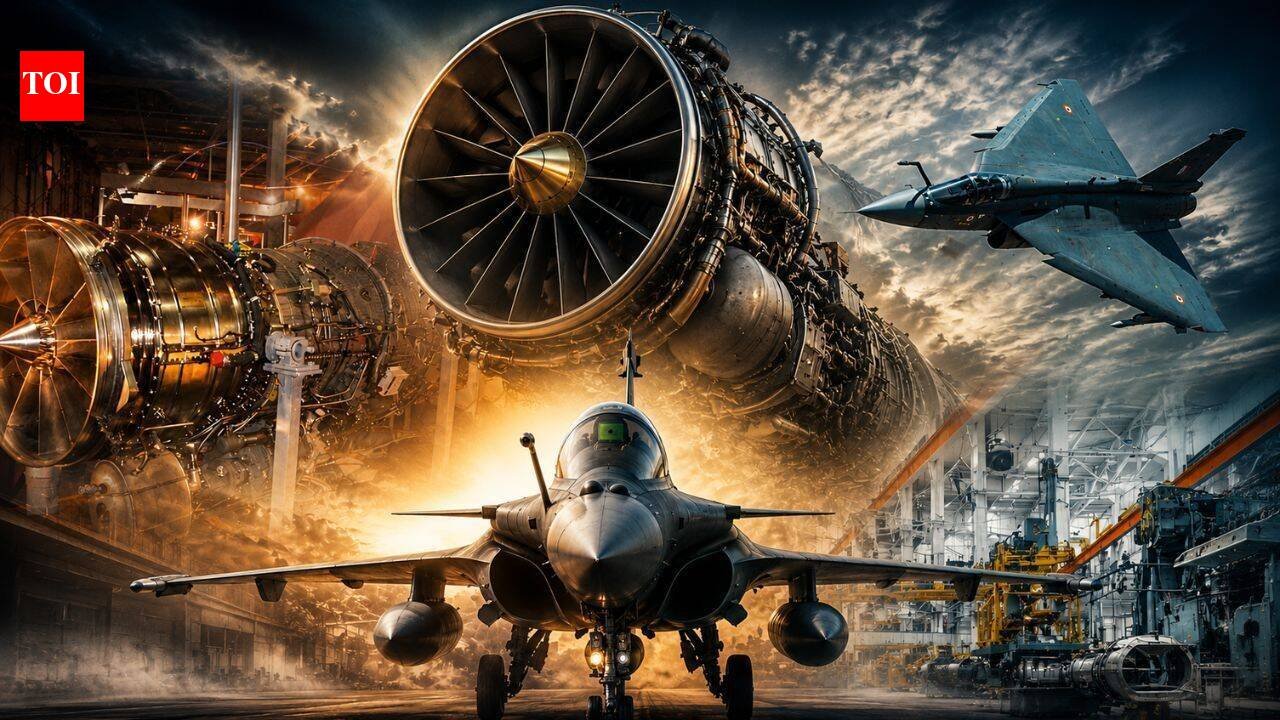
For most civilians, when one hears about fighter jets, the most appealing aspects hinge on four elements. Speed. Stealth. Roar. Agility. However, that’s not all. The heart of a jet is its engine. But alas, engines sound boring! And even if one works up the nerve to delve deeper, there are high chances of ending up flustered. Nevertheless, if we really stop to think about what powers these flying machines, engines would be equally, or even more, mesmerising. Engines step up the speed, strengthen the stealth, refine the roar, and accentuate the agility. In geopolitics, engines carry heavier cargo than thrust alone. Who builds them often matters more than who buys them. That reality has now put India at a crossroads.Think about it: If India can launch 104 satellites in a single mission, why can’t it make world-class jet engines? That’s not an idle question, it has great strategic urgency. Should India shake off reliance on foreign suppliers? Partner up and co-develop? Or pursue full ‘aatmanirbharta’ (self-reliance) at any cost? Bharat currently stands at a crossroads when it comes to producing jet engines, confronted with a few demanding questions. Should it shed its dependence on foreign suppliers? Should we co-develop with global partners? Or is “atmanirbharta” the only way forward?These are not a question India can sit on much longer. UK’s Rolls-Royce has submitted what it describes as its final offer to jointly design and manufacture a new 120 kilonewton (kN)-plus fighter engine for India’s Advanced Medium Combat Aircraft (AMCA). France’s Safran has officially submitted its financial proposal to co-develop India’s next-generation fighter jet engine. The offer from both companies come at a time when New Delhi’s negotiations with American engine-maker General Electric (GE) have hit a rough patch.
Dilemma of choosing the best
Rolls-Royce has stated that if a contract is signed by the end of 2026, the engine core could begin testing by 2030, achieve its first flight by 2034 and enter series production by 2036. In its “final offer”, the UK firm has proposed a comprehensive partnership that would create a full-spectrum propulsion ecosystem in India, from design and development to manufacturing, maintenance, repair and overhaul, and future upgrades, alongside 100 per cent technology and intellectual property transfer that stays with India.Calling it a “final offer” appears no casual choice as it signalled that Rolls-Royce was not prepared to wait indefinitely. France’s Safran, meanwhile, has built its case on a foundation of familiarity. The French company is already embedded in India’s aerospace landscape through the Rafale fighter jet programme, and the Indian Air Force (IAF) operates a fleet powered by Safran’s M88 engine. Their AMCA proposal draws on that M88 goodwill and promises 100 per cent technology transfer with no export restrictions. The French pitch is essentially one of trust built through proximity, an ally who already knows what the Indian defence establishment prefers. There is, however, a detail that colours the comparison. Safran significantly updated its pitch only in late 2025 by incorporating elements it had not initially offered, doing so only after the competitive pressure from Rolls-Royce had become visible.
How the engines work
Why the urgency
The urgency for India, to quickly choose between the two, has grown because of a problem New Delhi neither anticipated nor can afford to ignore.After ordering 83 Tejas Mk1A fighters in 2021 and another 97 in 2025, the Indian Air Force has yet to receive a single aircraft from the first batch. While the delays are attributed to engine deliveries from American engine manufacturer General Electric (GE), integration of systems within the aircraft is also contributing to the hold-up.Hindustan Aeronautics Limited (HAL), which is India’s public sector aerospace and defence company, has already rolled out several Mk1A airframes, but they remain grounded for want of engines. India has built the aircraft, but cannot power it.
Tough negotiations with GE
Moreover, India’s negotiations with America’s GE for F414 engines to power the AMCA reportedly hit a stalemate after the American company, in an unusual move, raised the estimated price per engine from around Rs 80–90 crore to over Rs 200 crore.This shocking price rise by GE may also be driven by the fact that the Aeronautical Development Agency (ADA), which is leading the AMCA programme, requires 15 F414 engines for five flying prototypes (trial aircraft), with each aircraft powered by two engines and one additional spare engine allocated for every prototype.
GE’s F414 engine
With the AMCA’s airframe design already frozen around the F414 engine, India’s alternatives for powering its new stealth fighter are limited, giving GE considerable negotiating leverage.Despite how the deal with American giant GE has unfolded, and with competing offers from Rolls-Royce and Safran now on the table, the choice is anything but black and white. It is, instead, a delicate balancing act. The decision involves India’s long-term strategic interests, making certain aspects absolutely non-negotiable.
The technical nitty-gritty
For India, the absolute breakthrough would be access to the technologies that determine whether a country can one day design its own engines from scratch. Broadly, those technologies fall into four areas. The first is advanced metallurgy, or the ability to manufacture turbine blades and develop the high-temperature metal alloys that power modern jet engines, rather than merely importing ready-made metal blocks whose composition remains a closely guarded secret. The second is specialised heat-resistant coatings that protect those components from melting. The third is the engineering know-how used to design the engine’s compressor, combustor and turbine. The fourth is the engine’s digital control system, which governs everything from fuel flow to thrust. Only after mastering all four can a country truly claim design sovereignty.“On the technology side, four aspects are non-negotiable: hot-section metallurgy — single-crystal blade casting, directional solidification, and the alloy chemistry itself, not black-box billets; thermal barrier and bond-coat chemistry together with the application processes; the core aerothermal design codes for compressor, combustor, and turbine, with their underlying physics and not merely validated outputs; and the FADEC control architecture with source code and the authority to modify it,” Air vice marshal Vikas Dwivedi (Retd.) told TOI, adding that “a control system you cannot re-tune is a leash”.
Making the engine’s toughest part
However, technology transfer alone would not guarantee strategic autonomy. India would also need ownership of intellectual property created during the partnership, broad access to existing technologies, and, crucially, the right to modify, upgrade and export future variants without requiring fresh approvals. More importantly, it would need design authority, giving it the ability to independently certify, improve and develop derivative engines rather than remaining dependent on the original manufacturer.“We must eliminate every “golden screw” — the single foreign-controlled component that quietly holds the whole programme hostage,” AVM Dwivedi, who is an aerospace engineer with 35+ years of experience in aviation maintenance, engineering and flight test engineering and certification, told TOI.
Shielding parts from extreme temperatures
The quest for an Indian engine
India’s strive to be “atmanirbhar” in engines is not a story of 2026. In 1986, the government had tasked DRDO’s Gas Turbine Research Establishment (GTRE) with building the indigenous Kaveri engine to power the then-nascent Tejas light combat aircraft. What followed was four decades of heartbreak. Despite nine prototype engines, over 3,200 hours of testing, and a budget overrun of 642 per cent, the Kaveri produced only 70.4 kilonewtons (kN) of wet thrust against a required 81 kilonewtons. By 2008, the engine was formally delinked from the Tejas programme. Though India had built a reasonably competitive fighter airframe but could not build the engine to power it.The failure, though, was not one of intellect or ambition but of an ecosystem. The absence of a robust supply chain and meaningful private sector participation meant the programme largely worked in isolation.“Kaveri’s failures were not failures of intellect — GTRE’s engineers were world-class. They were failures of ecosystem, sequencing, and patience. Five shortcomings stand out. First, the materials base did not exist — we attempted a modern turbine without indigenous single-crystal superalloys or coatings, so the hot section was perpetually constrained. Second, we lacked a flying testbed for far too long,” AVM Dwivedi told TOI. “Third, the programme worked in relative isolation, without a deep industrial supply chain or private-sector capacity behind it. Fourth, funding was episodic and requirements shifted — which is fatal for a decade-long materials endeavour. Fifth, the certification pathway was never built, so even good work could not be qualified at the pace required,” he further said.
The Kaveri Journey
A consolation prize
The Kaveri, however, has since been repurposed for unmanned aerial vehicles, including the Ghatak stealth drone programme. In February 2026, defence minister Rajnath Singh witnessed a successful full afterburner test of an updated Kaveri configuration, with GTRE now advancing toward flight trials of an afterburning variant, potentially scaling to 80 to 85 kilonewtons (kN) with a new afterburner module under development. Progress, yes! But progress measured against a four-decade-old target is a complicated kind of victory.
Rajnath Singh visited GTRE in Bengaluru on February 16, 2026, reviewed indigenous jet engine projects, and witnessed the Kaveri engine’s successful full afterburner test.
The AMCA ambition
India’s answer to its engine deficit is the AMCA, among the most ambitious defence undertakings the country has ever embarked upon. Developed under the Atmanirbhar Bharat initiative, the AMCA is designed to be India’s first indigenous fifth-generation stealth fighter, bristling with advanced stealth characteristics, internal weapons bays, sensor fusion, supercruise capability and next-generation avionics.The AMCA Mk1 will fly on the GE F414 engine, the same American powerplant selected for the Tejas Mk2. But the more powerful Mk2 variant, requiring an engine in the 110 to 130 kilonewton thrust class, cannot rely on that arrangement indefinitely.
Tejas Mk1A
For that, India needs either to build its own engine or partner with someone who will genuinely share the keys, not merely rent them out on a long-term lease. That question of who gets to hold the keys has ignited a contest between two of Europe’s aviation giants.“The AMCA partnership needs to be structurally positioned. It should be a clean-sheet co-development with Safran/Rolls Royce, not a solo effort. The materials base now genuinely exists—MIDHANI’s CEMILAC-certified superalloys and DMRL’s single-crystal work are real, not aspirational. NAEM (National Aero Engine Mission) provides the sustained Rs. 61,000-crore funding envelope that Kaveri never had,” AVM Dwivedi told TOI.“Private primes, TASL, L&T, Bharat Forge, bring serial-production capacity. And the flying-testbed gap is being closed through the Su-30MKI conversions. The lesson Kaveri teaches is that an engine is an ecosystem, not an artefact. We need to carefully build and sustain the ecosystem,” he further added.
How far is India from aero ecosystem
The AMCA engine programme is about far more than powering a single stealth fighter. If successful, it could lay the foundation for an indigenous aero-engine ecosystem capable of supporting future fighter jets, unmanned combat aerial vehicles (UCAVs), trainers and even sixth-generation combat aircraft. The programme would not only develop an engine but also create the industrial backbone needed to sustain one, from advanced superalloy production and thermal coating technologies to specialised testing facilities, certification infrastructure and a skilled workforce. “The engine is the hardest, most closely guarded technology in all of aerospace, which is precisely why mastering it unlocks everything downstream. A well-architected engine core is scalable by design. A dry variant powers UCAVs and loitering platforms; a higher-thrust derivative powers heavier fighters; a de-rated version can serve trainers and business-class applications,” Dwivedi said.
Digital brain that runs the engine
“The same core philosophy India masters now becomes the seed for an entire family of powerplants. More importantly, the ecosystem the programme builds —the superalloy foundries, the coating lines, the test rigs, the certification consortium, and above all the trained engineers — is entirely reusable across every future platform,” he added.The significance of the AMCA engine programme extends well beyond powering a single fighter aircraft. If successful, it could lay the foundation for an indigenous aero-engine ecosystem capable of supporting future fighters, drones and, eventually, sixth-generation combat aircraft. Future fighter engines will also need to be smarter, more efficient and capable of handling the extreme heat generated by advanced weapons.While those platforms remain years away, the technologies, manufacturing capabilities and testing infrastructure developed through the AMCA programme will determine how prepared India is to make that leap when the time comes.
Science and tools to design the engine
“Sixth-generation engines push the bar higher still. They can change their own airflow in flight to switch between speed and efficiency, and they must carry away enormous heat to feed laser and microwave weapons. India cannot jump straight to that frontier. The design skills, the mature materials, and the testing infrastructure built through the AMCA engine programme are the foundation everything else stands on,” Dwivedi said.For all the attention on engines, technology transfer and intellectual property, the real measure of success may lie elsewhere. Producing an engine in India would undoubtedly be a milestone, but genuine self-reliance will only be achieved when the country no longer depends on foreign partners to design, test, certify or upgrade future engines. In other words, the objective is not merely to manufacture an engine, but to build the knowledge, institutions and skilled workforce capable of creating the next generation of powerplants independently.“There is no ambiguity in my mind. Building an engine in India is necessary but utterly insufficient. The artefact is not the asset — the capability is the asset,” Dwivedi said.“History will judge this programme a success only if, twenty years on, India can conceive, design, test, certify, and upgrade a new engine without foreign hand-holding. If we have merely produced AMCA engines under licence but still cannot independently certify a derivative or raise the turbine inlet temperature by a hundred degrees on our own, then we will have built hardware while remaining strategically dependent — and the next programme will once again begin with a foreign partner,” he further said, adding: “Build the engine, yes — but build the engine-builders”.


