






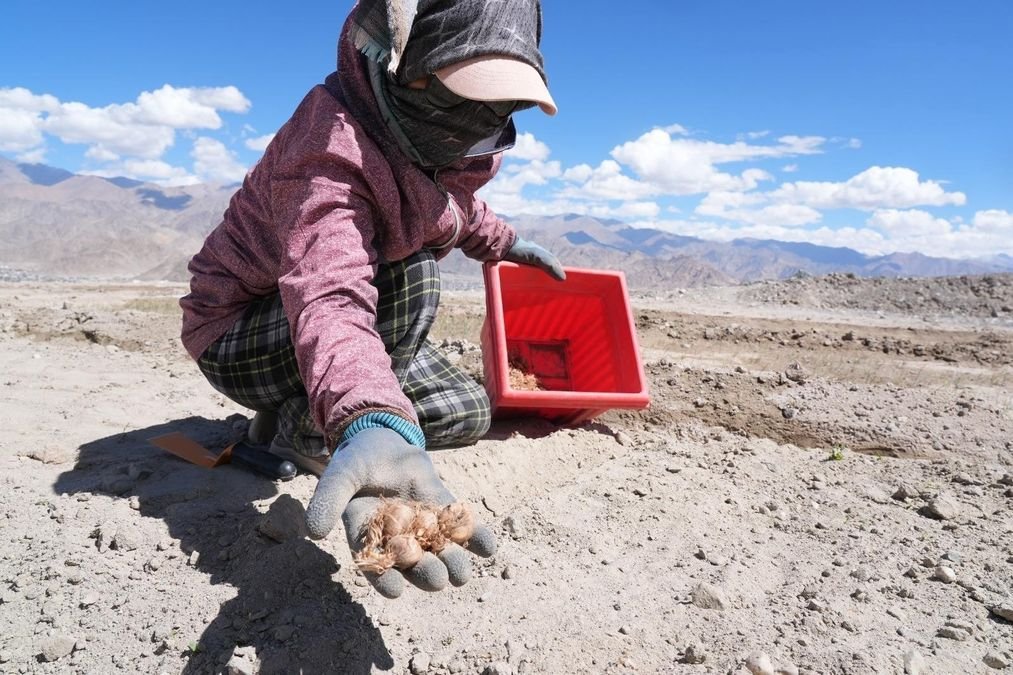
Leh, Oct 3: After Kashmir, where saffron cultivation has been a centuries-old agricultural tradition, Ladakh is now set to embark on its own saffron journey, with nearly 90,000 premium Iranian saffron corms planted on recently restored barren land in Leh.
The first-of-its-kind pilot project marks a major step in Ladakh’s efforts to diversify agriculture and explore high-value crops suited to its unique high-altitude climate.
Nearly 800 kg of saffron corms have been planted across around 4,000 square metres at Command Area Gate No. 27 in Spituk Pharka, Leh. The land, which remained barren until about three months ago, has been restored and rejuvenated under Project Him Sarovar.
The initiative has been undertaken under the guidance of Lieutenant Governor Vinai Kumar Saxena, following the administration’s experiments with high-value floriculture crops such as Lilium and Gladiolus.
Agriculture experts have selected premium Iranian corms measuring 8–10 cm in circumference, at least 2.5–3 cm in diameter and weighing 10 grams or more. Officials expect the pilot plantation to yield a good quantity of saffron and, more importantly, provide an assessment of whether the crop can adapt to Ladakh’s cold-desert conditions.
The development assumes significance for Kashmir, the traditional saffron hub of India. Pampore is widely known as Kashmir’s saffron bowl, with the region accounting for the overwhelming share of India’s saffron production. The crop is also cultivated in areas including Budgam and Kishtwar.
Unlike Kashmir’s established saffron belt, however, Ladakh’s cultivation is presently at the experimental stage. The administration will use the pilot to assess the crop’s climatic suitability, productivity and economic viability before considering any wider expansion.
Saxena said the initiative has the potential to create another high-value agricultural avenue for the people of Ladakh.
“Our endeavour is to transform degraded and barren land into productive assets and create new opportunities for our farmers. The introduction of saffron is another important experiment in crop diversification, which can open a new avenue for enhancing farmers’ incomes through a premium-value crop,” he said.
The saffron plantation is part of a larger effort to restore nearly 800 acres of land in Leh. Excess water from the recently restored Igoo–Phey irrigation canal is being channelled towards the barren land to improve soil moisture and make it suitable for cultivation.
Four water ponds developed under Project Him Sarovar are also located near the plantation site, with a combined storage capacity of around 24 million litres.
The Ladakh administration is now looking at saffron as another potential high-value crop after its experiments with Lilium and Gladiolus. If the pilot proves successful, the initiative could open a new chapter in agricultural diversification in the cold desert, while testing whether a crop traditionally associated with Kashmir can establish itself in the high-altitude landscape of Ladakh.


