


Last Updated:
SC to review 2018 Sabarimala verdict from April 7-22: What is legal history? Why is it clubbed with Parsi, Muslim women’s rights cases? What does it mean ahead of Kerala polls?
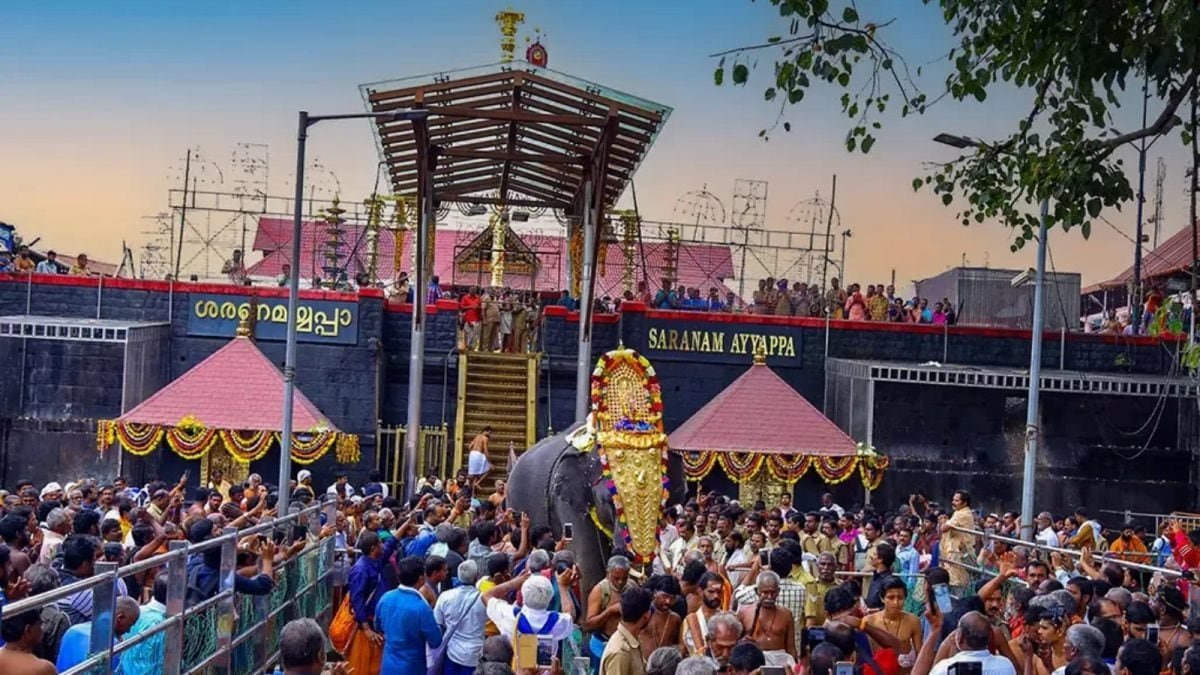
Sabarimala 2018 verdict review: The nine-judge Supreme Court bench will hear the petitions from April 7 to 22. (Image: keralatourism.org)
The Supreme Court is set to hear 67 petitions, which seek review of its September 2018 verdict allowing women of all age groups to enter the famous Sabarimala temple in Kerala, from April 7 to 22.
While the nine-judge Constitution Bench will hear petitions seeking a review of the verdict from April 7-9, those against it will be heard from April 14-16.
The restriction on women entering the Sabarimala Sree Dharma Sastha Temple in Kerala is one of India’s most complex legal and religious debates, centering on the tension between ancient tradition and modern constitutional rights.
What is the case? What is the legal history? What do the political parties say? What is common between Sabarimala, Parsis and Muslims? What does it mean ahead of polls? Explained
The Lord Ayyappa temple
The temple is dedicated to Lord Ayyappa, who is worshipped in the form of a Naishtika Brahmachari (a perennial celibate).
According to legend, a demoness named Mahishi, after being defeated by Ayyappa, turned into a beautiful woman and proposed to him. He promised to marry her only when “kanni-swamis” (first-time pilgrims) stopped visiting the shrine. Since they visit every year, she waits at a nearby temple, and women of menstruating age traditionally stay away to respect the deity’s celibacy and her sacrifice.
Pilgrims observe a rigorous 41-day Vratham (austerity), including abstinence from worldly pleasures. Proponents of the ban argue this is physically and ritually difficult for women in their menstruating years.

The legal history of the temple
In its 1991 ruling, the Kerala High Court legally barred women aged 10–50 from entering, stating the restriction was in accordance with “time immemorial” usage.
In a 2006 PIL, the Indian Young Lawyers Association filed a petition in the Supreme Court, arguing the ban violated the Right to Equality (Article 14) and discriminated against women based on biological factors.
In a landmark verdict, on September 28, 2018, a 5-judge bench ruled 4:1 that the exclusion was unconstitutional. The majority held that devotion cannot be subject to gender discrimination.
Justice Indu Malhotra, the lone woman on the bench, famously dissented, arguing that “notions of rationality cannot be invoked in matters of religion” and courts should not interfere in deep-seated religious beliefs.
The protests after the 2018 verdict
The 2018 verdict sparked massive protests across Kerala by groups like the Sabarimala Karma Samithi, who viewed the ruling as an attack on faith.
On January 2, 2019, two women—Bindu Ammini and Kanakadurga—successfully entered the shrine under police protection. This led to the temple being temporarily closed for “purification rituals”.
Over 3 million women formed a 620-km human chain (Vanitha Mathil) across Kerala to support gender equality and the court’s verdict.
About the review
The Supreme Court referred review petitions to a larger nine-judge bench in 2019. The Supreme Court has expanded the scope of the case from a single temple entry issue to a broader examination of Constitutional Morality versus Religious Freedom.
The aim is to look at several key questions:
- Can the court determine what is “essential” to a religion? Critics argue that religious denominations should have the autonomy to decide their own rituals under Article 26.
- Does a woman’s individual right to worship (Article 25) override the collective right of a religious denomination to maintain its traditions (Article 26)?.
- To what extent can secular courts interfere in matters of deep-seated faith and tradition?.
- Can someone who does not belong to a specific religious group (like the original petitioners) challenge that group’s internal practices via a Public Interest Litigation (PIL)?.

Why has the court clubbed it with cases related to Muslim and Parsi women?
The court has clubbed this case with other similar issues, including Muslim women’s entry into mosques and the rights of Parsi women who marry outside their faith.
The Sabarimala case was clubbed with the Parsi and Muslim women’s cases in November 2019 because the Supreme Court identified “larger issues” of religious freedom and gender discrimination that were common to all of them.
The Court noted that all these cases involve a conflict between the right to equality (Article 14) and the right to religious freedom (Articles 25 and 26). A central point of debate in all three is the “essentiality test”—determining whether a specific practice (like barring women from mosques or fire temples) is an “essential” part of that religion and thus protected from judicial interference.
The Court sought to establish a uniform definition of “constitutional morality” that would apply across all faiths, rather than deciding on a case-by-case basis for each religion.
The majority bench, led by then-CJI Ranjan Gogoi, argued that the restrictions on women in Sabarimala were not unique and mirrored practices in other religions, such as the right of Muslim women to enter mosques and dargahs; the right of Parsi women married to non-Parsis to enter the “holy fireplace” of an Agyari (Fire Temple). The practice of female genital mutilation (FGM) in the Dawoodi Bohra community.
By clubbing these, the Supreme Court aimed to settle the broader legal principles governing how far the judiciary can intervene in religious customs across different faiths.
What it means for political parties ahead of Kerala polls
The ruling Left Democratic Front (LDF) government, led by Chief Minister Pinarayi Vijayan, has significantly softened its stance since 2018 to avoid alienating devotees ahead of the 2026 Assembly Elections.
While the government officially supports the 2018 verdict allowing women entry, it has shifted from “active facilitation” (using police force to escort women) to a policy of “administrative neutrality”.
The CPI(M) leadership now describes the 2018-2019 controversy as a “closed chapter,” focusing instead on protecting “devotee sentiment” while waiting for the final Supreme Court ruling. To regain ground lost during the 2019-21 protests, the CPM has recently attempted to appeal to devotees, such as organising a “Global Ayyappa Sangamam”. The party’s current “cryptic” stance—stating that “change is the only constant”—suggests a strategic evolution to avoid alienating religious voters before the polls.
Despite pressure from the Opposition (UDF and BJP) to withdraw its 2018 affidavit supporting women’s entry, the government clarified in late 2025 that it has no plans to rethink or withdraw its legal position unless specifically asked by the court.
The United Democratic Front (UDF) has pledged that if they come to power, they will file a new affidavit in the Supreme Court specifically to protect the temple’s traditional customs.
The hearing coincides with other Sabarimala-related scandals, including allegations of gold misappropriation and theft from the shrine, which the opposition is using to accuse the government of mismanagement and corruption.
With Agency Inputs
February 16, 2026, 12:31 IST
Read More


