



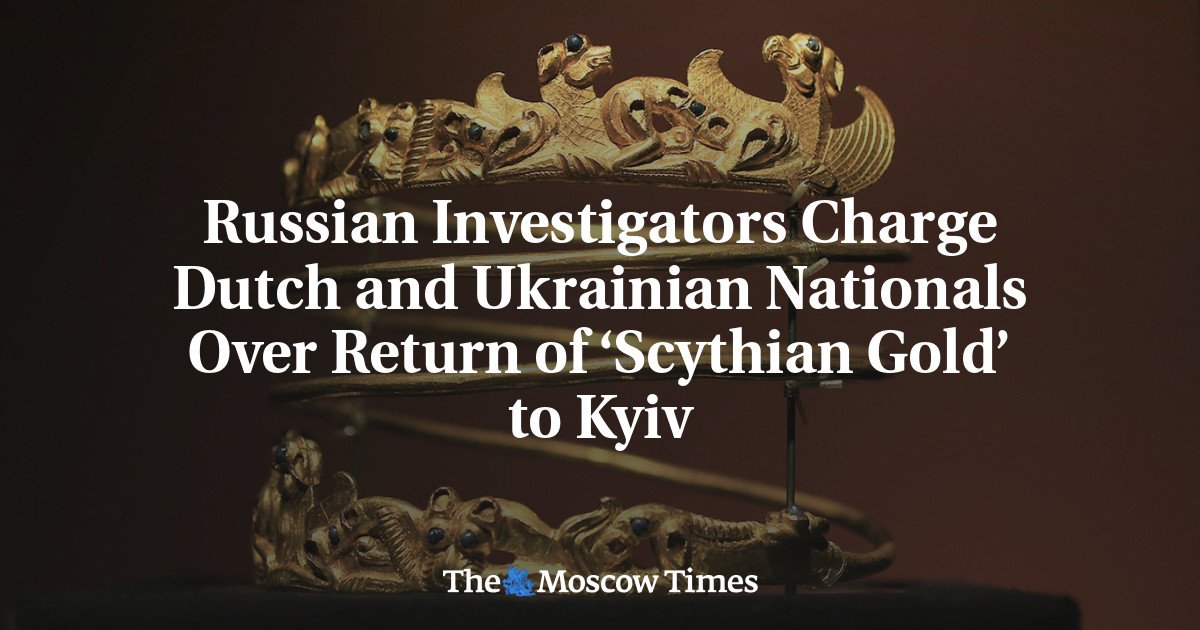
Russian law enforcement authorities on Tuesday announced criminal charges against Dutch and Ukrainian nationals over the return of Crimean gold artifacts to Ukraine.
After a decade-long legal battle, a collection of Scythian artifacts that had been on loan to Amsterdam’s Allard Pierson Museum since 2013 was returned to Ukraine in 2023 following a ruling by the Supreme Court of the Netherlands.
The Investigative Committee, Russia’s top investigative body, argued that the 565 museum items had become Russian property after Moscow’s 2014 annexation of Crimea and should therefore have been transferred to Russia once the exhibition ended.
“Officials from the Netherlands, Ukraine and the Allard Pierson Museum thus stole these museum items,” the Investigative Committee said in a statement, without specifying who was facing charges.
Investigators said they launched a criminal probe into the alleged theft of items of “special historical, artistic and cultural value” and the failure to return cultural property to Russia.
The Moscow Times contacted the Allard Pierson Museum for comment.
The Investigative Committee said Russian law allows the prosecution of foreign nationals for actions taken abroad if the alleged crime is directed against Russian interests.
Committee spokeswoman Svetlana Petrenko said law enforcement authorities would seek to “identify the persons involved” in what Moscow described as the plundering of Russian cultural heritage.
The artifacts, often referred to as “Scythian gold,” date back to the second century B.C., when Crimea lay at the crossroads of ancient trade routes dominated by the Scythians.
Russian authorities estimate the insurance value of the 565 items at 117 million rubles ($1.5 million), though investigators said some pieces were effectively priceless because they have no equivalents in other cultures.
A Message from The Moscow Times:
Dear readers,
We are facing unprecedented challenges. Russia’s Prosecutor General’s Office has designated The Moscow Times as an “undesirable” organization, criminalizing our work and putting our staff at risk of prosecution. This follows our earlier unjust labeling as a “foreign agent.”
These actions are direct attempts to silence independent journalism in Russia. The authorities claim our work “discredits the decisions of the Russian leadership.” We see things differently: we strive to provide accurate, unbiased reporting on Russia.
We, the journalists of The Moscow Times, refuse to be silenced. But to continue our work, we need your help.
Your support, no matter how small, makes a world of difference. If you can, please support us monthly starting from just $2. It’s quick to set up, and every contribution makes a significant impact.
By supporting The Moscow Times, you’re defending open, independent journalism in the face of repression. Thank you for standing with us.
Continue
Not ready to support today?
Remind me later.
×
Remind me next month
Thank you! Your reminder is set.


