






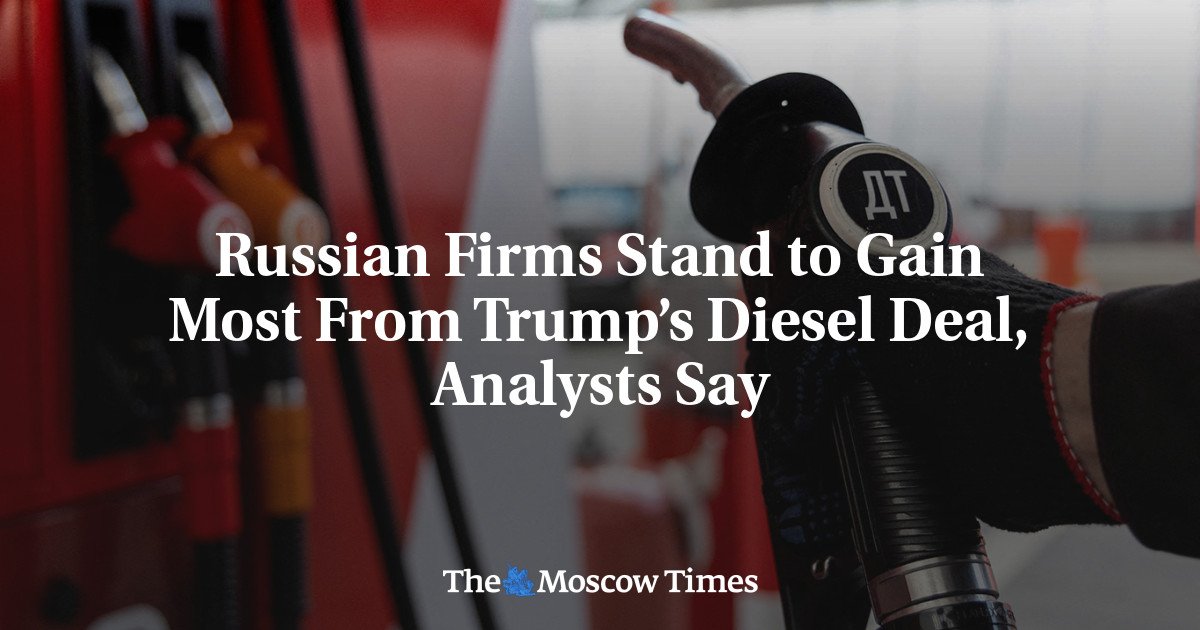
U.S. President Donald Trump’s diesel deal with Moscow could do more for Russian oil companies than for the American consumers he wants to help, analysts say.
While Russian firms stand to benefit from looser export restrictions, the promised shipments may do little to bring down U.S. fuel prices.
The agreement has drawn scathing criticism from Ukraine and its European allies, as well as scrutiny from lawmakers at home. But does it make economic sense?
What does Trump want?
Trump announced that Russia would “immediately” supply 300,000 tons of diesel to the U.S. and global markets, followed by another 500,000 metric tons in November and 1 million metric tons thereafter.
The deal comes as U.S. diesel prices have risen to $6.179 per gallon, up nearly 70% year-on-year, amid the turmoil that has gripped the global oil market since the start of the Iran war in late February.
Reduced refinery output has sharply cut global diesel exports, which totaled about 172.2 million metric tons in the first nine months of 2026, down 10% from the same period last year.
Higher prices are hurting Americans, including the truckers and farmers who are part of Trump’s traditional support base. With just a month to go before the midterm congressional elections, 73% said they disapprove of his handling of the cost of living, according to poll aggregator Silver Bulletin.
Additional Russian supplies are not intended to directly ease a U.S. diesel shortage because the country already produces roughly a quarter more diesel than it consumes. But U.S. fuel prices are shaped by global markets. The more other countries are willing to pay for diesel, the more domestic consumers must pay in turn.
REUTERS / Mike Blake
More Russian diesel on the global market could therefore help lower American prices by narrowing the gap between supply and demand, regardless of whether it is shipped directly to the U.S.
Encouraging Russia and Middle Eastern producers to increase fuel supplies is the most straightforward way for Washington to bring prices down.
That’s because U.S. refineries are already operating at close to full capacity, while restricting exports to force domestic fuel prices lower could create other problems, including storage constraints.
Can Russia help?
Like the U.S., Russia is a net exporter of diesel, meaning it produces more than it consumes and sells the surplus abroad.
That has not changed despite Ukraine’s drone campaign against Russian refineries in recent months. While the attacks have caused sporadic gasoline shortages, Russia’s pre-war diesel output was more than double domestic demand, compared with a surplus of just 15-20% for gasoline.
Russia has therefore continued to export diesel, though in smaller volumes. Shipments totaled about 427,000 metric tons in September, compared with roughly 3 million metric tons a month before Ukraine intensified its strikes, Reuters reported.
These figures only cover shipments to the limited number of countries, mostly in Central Asia, exempted from restrictions Russia imposed in July to keep its domestic market supplied.
Other estimates are higher. Kpler put September shipments at 584,000 metric tons.
Energy analyst and former Gazprom Neft executive Sergei Vakulenko, citing shipping data, said Russia exported at least 1.6 million metric tons of diesel by sea between July and September, despite a broad export ban that exempted supplies to Mongolia and Central Asia.
REUTERS / Anastasia Barashkova
Vakulenko, now based in Germany with the Carnegie Russia Eurasia Center, said Russian authorities had made little effort to stop these “grey” shipments because the country lacked the storage capacity to hold the surplus.
This means that Russia could supply the 500,000 metric tons Trump requested for November without causing domestic shortages simply by legalizing existing grey exports, he said.
Moscow partially lifted its diesel export ban from Oct. 10 following the agreement with Trump.
Supplying 1 million metric tons of diesel a month during the winter is also realistic, especially as domestic demand falls after the autumn harvest season, Vakulenko added.
U.S.-based energy analyst Tatiana Mitrova also said the volumes Trump requested from Russia “would have gone to the global market anyway without any additional effort.”
So what’s the catch?
The volumes Trump announced may be realistic, but they could be too small to bring prices down significantly.
For example, 500,000 metric tons of Russian diesel equals roughly 4% of monthly U.S. consumption or 0.4% of monthly global consumption. It would cover about 13% of the estimated monthly global diesel shortfall of 4 million metric tons.
Russian supplies could have a greater impact if exports returned to levels seen before Ukraine intensified its attacks. But Kyiv has yet to agree to halt its strikes, and Moscow would need to repair its damaged refineries and restore lost capacity.
“The volumes under discussion are too small, all else being equal, to noticeably affect global prices, especially before the midterm elections,” Vakulenko said.
REUTERS / Fred Greaves
Without an effective energy truce, the diesel deal will largely amount to “appearances rather than a real increase in Russian diesel supplies to the global market,” he said.
The deal could provide “temporary relief to a global market facing a significant diesel deficit,” but Russia’s constrained refinery capacity limits how much additional supply it can deliver, analytics firm Kpler said in a note.
Shipping Russian oil products through the Baltic and Black seas poses another challenge, as Ukrainian drone attacks also disrupt those routes, Kpler added.
Moscow-based analyst Kirill Rodionov said Russian companies stand to reap the most benefits from the deal, as it would allow them to officially export more diesel at higher prices.
Those exports would do little to lower U.S. fuel prices, but would allow the Trump administration to claim at least a partial foreign policy success, he said.
A Message from The Moscow Times:
Dear readers,
We are facing unprecedented challenges. Russia’s Prosecutor General’s Office has designated The Moscow Times as an “undesirable” organization, criminalizing our work and putting our staff at risk of prosecution. This follows our earlier unjust labeling as a “foreign agent.”
These actions are direct attempts to silence independent journalism in Russia. The authorities claim our work “discredits the decisions of the Russian leadership.” We see things differently: we strive to provide accurate, unbiased reporting on Russia.
We, the journalists of The Moscow Times, refuse to be silenced. But to continue our work, we need your help.
Your support, no matter how small, makes a world of difference. If you can, please support us monthly starting from just $2. It’s quick to set up, and every contribution makes a significant impact.
By supporting The Moscow Times, you’re defending open, independent journalism in the face of repression. Thank you for standing with us.
Continue
Not ready to support today?
Remind me later.
×
Remind me next month
Thank you! Your reminder is set.


