



The Russia-Ukraine war, which began with Russia’s invasion four years ago, on February 24, 2022, has continued despite thousands of casualties and numerous rounds of peace negotiations. A joint report by the World Bank, European Union (EU), United Nations, and Ukraine, published on February 23, estimates the cost of post-war construction in Ukraine to be around $558 billion over the next decade, nearly three times the country’s estimated GDP in 2025.
The war has taken a toll on both countries. Russia, one of the world’s largest economies, has been battered by sanctions imposed by the EU and the U.S. As shown in the chart below, its economy grew by less than 1% last year and is estimated to grow by another 1% in 2026.
The economic condition of Ukraine, one of the poorest European nations even before the war, has worsened in recent years. The country is reeling under mounting government debt, rising reliance on aid, and heavy damage to infrastructure. Its GDP growth contracted by almost 30% in 2022. Its economy, which grew by just 2% last year, is estimated to recover to 4.5% in 2026.
Data show that people in both Russia and Ukraine have been feeling the pinch of the conflict.
Consumer price inflation in both countries surged to a six-year high at the outset of the war in 2022. It has remained persistently elevated in the years since. For instance, in Russia, inflation surged to 14% in 2022, moderated to 5% in 2023, but subsequently increased to 9% in the last year.
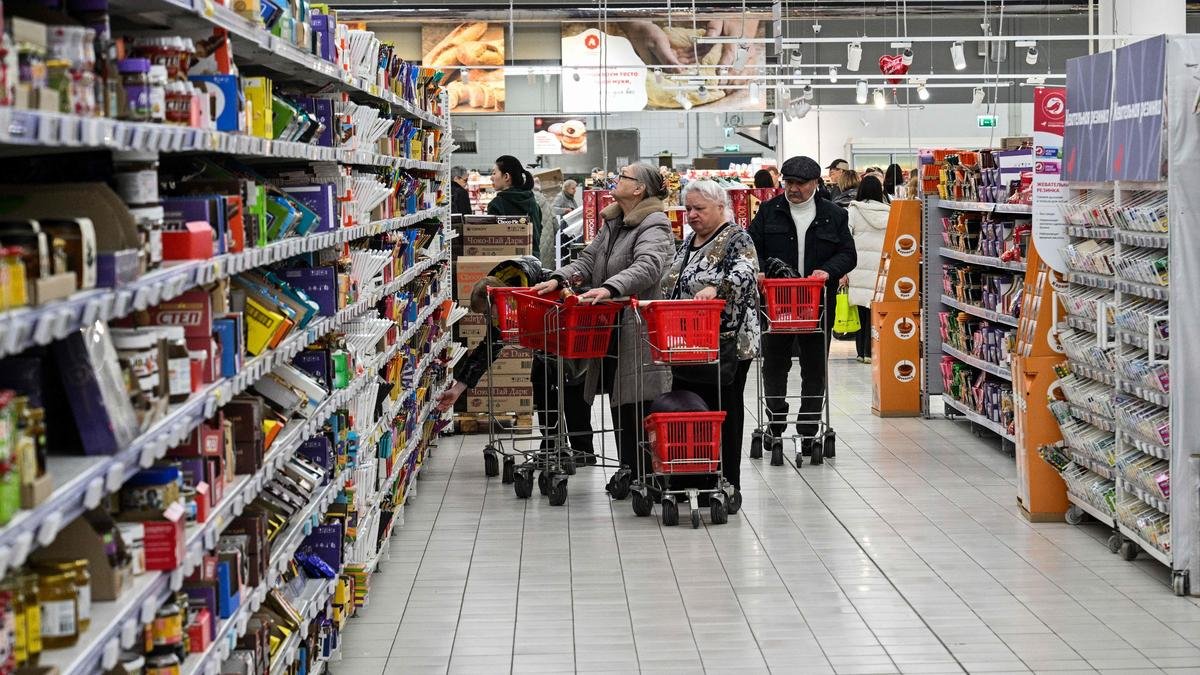
The cost of essential items such as basic food products has risen substantially in both countries. In Russia, a kilogramme of bread increased by 13% this month compared to a year ago and increased by over 50% compared to five years ago, according to the Food and Agriculture Organization’s Food Price Index.
Similarly, the price of a kilogramme of rice increased by 40% this month, compared to 2022. The chart below shows the retail prices of select food items in Russia and Ukraine.
In Ukraine, the cost of basic food products such as wheat and maize has increased by 15% compared to four years ago. The price of wheat flour increased from 12,633 Ukrainian Hryvnia (UAH)/tonne in February 2022 to 14,700 UAH/tonne in 2026.
High levels of defence spending also resulted in decreased allocation for social spending, education, and healthcare in both countries. In Ukraine, defence spending consistently accounted for more than half of the country’s spending since 2022. In contrast, expenditure on education, health care, and social protection declined by more than half when compared to 2021.
Defence spending surged to over 20% of the country’s GDP in 2022 and was estimated to reach 26% by 2025. The sharp increase has widened the budget deficit, and the country’s gross government debt accounted for over 109% of the country’s GDP in 2025.
In Russia, defence spending accounted for almost 30% of the total expenditure. The country’s social spending did not decrease drastically like Ukraine’s.
However, a research paper published by SIPRI notes that Russia’s military spending is not always classified under ‘national defence’, but is sometimes recorded under other categories, such as social support. This makes it difficult to find out its exact non-defence expenditure.
The war has come at a severe human cost. Last month, the Centre for Strategic and International Studies estimated that 1.2 million people were killed, wounded, and missing in Russia between February 2022 and December 2025. The corresponding figure for Ukraine was 5 lakh-6 lakh.
The data for the charts were sourced from the International Monetary Fund, Food and Agriculture Organization’s Food Price Index, World Bank, OECD Economic Survey, and Stockholm International Peace Research Institute
Published – February 26, 2026 08:00 am IST


