



Russia has repeatedly offered to remove Iran’s highly enriched uranium (HEU) since the United States and Israel first launched hostilities with the Islamic Republic last summer.
On Friday, as the clock counted down on a fragile ceasefire between the U.S. and Iran, Kremlin spokesman Dmitry Peskov said that Russia’s offer was “not currently on the negotiating table.” Peskov stressed that although Moscow was still open to the idea, Washington had “no interest” in its proposal.
An Iranian Foreign Ministry spokesman said Monday that Tehran had not discussed transferring its uranium in previous talks with Washington, despite U.S. President Donald Trump saying Friday that the United States would work with Iran to recover its “nuclear dust” and bring it back to the U.S.
Still, some experts say that Russia’s offer could offer a workable compromise in what has become a sticking point in ending the U.S.-Israeli war with Iran, citing Moscow’s technical capacity, high level of Iranian trust and long history of nuclear cooperation with Tehran.
What is the proposal?
The International Atomic Energy Agency (IAEA) currently believes that Iran had around 440 kilograms of uranium enriched to 60% when the U.S. and Israel launched their June 2025 attacks. That is far above the enrichment levels needed for power generation (3-5%) or most other civilian purposes (up to 20%).
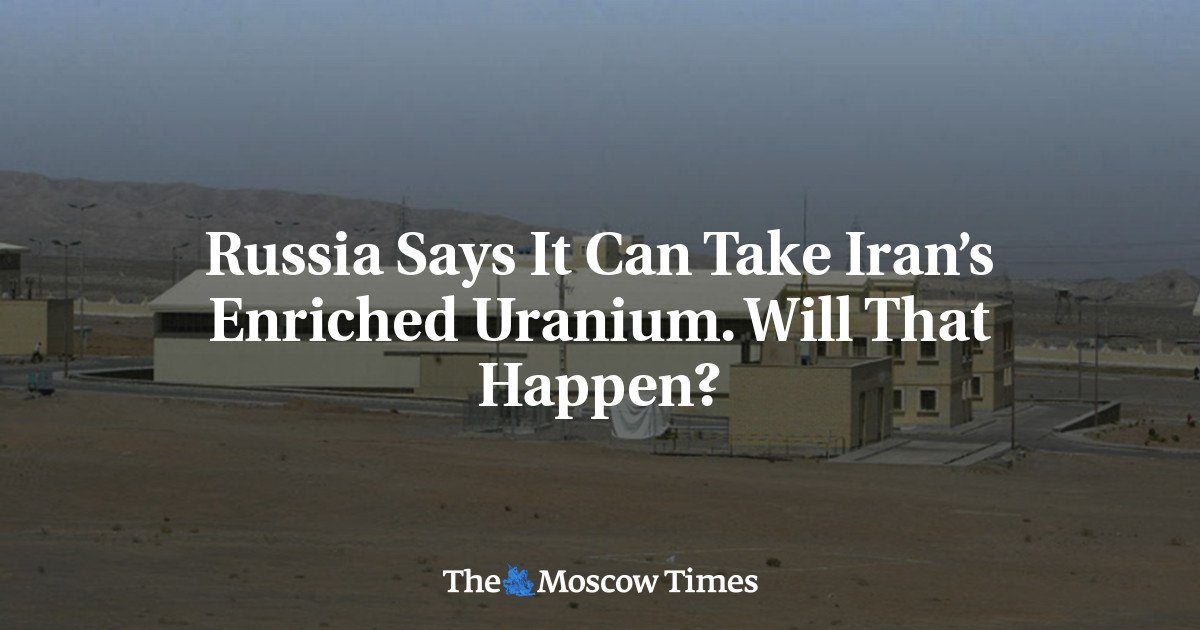
This uranium is believed to be located in the underground tunnels at the Isfahan complex and the Natanz enrichment site, both of which were damaged in Israeli and U.S. strikes last June.
Alexei Likhachev, the head of Russia’s state nuclear corporation Rosatom, said Saturday that the company was ready to assist, describing Russia as the “only country with positive experience cooperating with Iran.”
The proposal would see Russia transport and store Iran’s stockpile of enriched uranium, something that Dmitry Gorchakov, a nuclear adviser at the environmental NGO Bellona, told The Moscow Times is well within Moscow’s capabilities.
While transporting nuclear material under wartime conditions would be a challenge, Gorchakov said it would be feasible, noting that everyone involved would be familiar with deconfliction methods.
“If this deal happens, the IAEA will be involved, absolutely,” he said. “It is in everyone’s interest, even Iran, Russia, and, of course, the United States, to invite the IAEA.”
Gorchakov added that the quantity of uranium itself would not pose a major logistical challenge, provided it remained in usable condition.
What if the uranium has been damaged?
The state of Iran’s HEU is unclear. International observers have been unable to visit some of the country’s sites for 10 months, and damage from last year’s U.S.-Israeli strikes could complicate any removal effort.
Transporting Iran’s uranium would likely involve a significant cleanup effort as a result.
“It probably would be the most complex uranium removal operation in history,” Andrew Weber, a senior fellow at the Council on Strategic Risks and a former Pentagon official involved in past removal operations, told The Wall Street Journal.
“There are a lot of uncertainties because of the U.S. attacks in June, the logistical requirements, security risks and foreign policy tensions,” he continued.
Gorchakov said it would be a “difficult task” to collect the material, as well as to determine how much had been destroyed in the strikes.
However, the problem is not insurmountable and could be handled with IAEA and other third-country help, Gorchakov said.
“The main question is how to collect it and be sure about the specific amount of destroyed material, and that’s it,” he said. “What to do with it next is not very important, but they can find solutions.”
Why Russia?
Although U.S. officials have ruled out sending Iran’s uranium to Russia, Gorchakov called the proposal a “win-win, depending on the negotiations between Iran and the United States.”
That is because Iran can trust Russia more than it trusts Washington, he said.
Russia also has experience in transporting HEU, he said, referring to the cooperation between Washington and Moscow to transport 500 tons of Soviet HEU to the U.S. to be downgraded to fuel for American reactors.
Iran and Russia have a long history of nuclear cooperation. In the 1990s, Russia signed a deal to complete Iran’s Bushehr-1 reactor, a project started by Germany in the 1970s. That plant was connected to Iran’s power grid in 2011 and staffed by more than 700 Russian specialists until their withdrawal during the current war.
While European countries, the U.S. and even China are technically capable of transporting and downgrading Iran’s uranium, Russia is the best choice for Tehran, Gorchakov said.
But ultimately, this all rests on Trump.
“I don’t see any reason for [the Trump administration] not to do it. It’s just a question of what they really want from Iran, what Trump wants, what the goal of this war was. I have many more questions about this than for this possible deal,” he said.
“Now they are discussing something like [the 2015 JCPOA nuclear deal], but Trump cancelled the deal in 2018. So what is his goal now? I don’t know. I have many more questions for Trump than for Putin,” he said.
A Message from The Moscow Times:
Dear readers,
We are facing unprecedented challenges. Russia’s Prosecutor General’s Office has designated The Moscow Times as an “undesirable” organization, criminalizing our work and putting our staff at risk of prosecution. This follows our earlier unjust labeling as a “foreign agent.”
These actions are direct attempts to silence independent journalism in Russia. The authorities claim our work “discredits the decisions of the Russian leadership.” We see things differently: we strive to provide accurate, unbiased reporting on Russia.
We, the journalists of The Moscow Times, refuse to be silenced. But to continue our work, we need your help.
Your support, no matter how small, makes a world of difference. If you can, please support us monthly starting from just $2. It’s quick to set up, and every contribution makes a significant impact.
By supporting The Moscow Times, you’re defending open, independent journalism in the face of repression. Thank you for standing with us.
Continue
Not ready to support today?
Remind me later.
×
Remind me next month
Thank you! Your reminder is set.


