



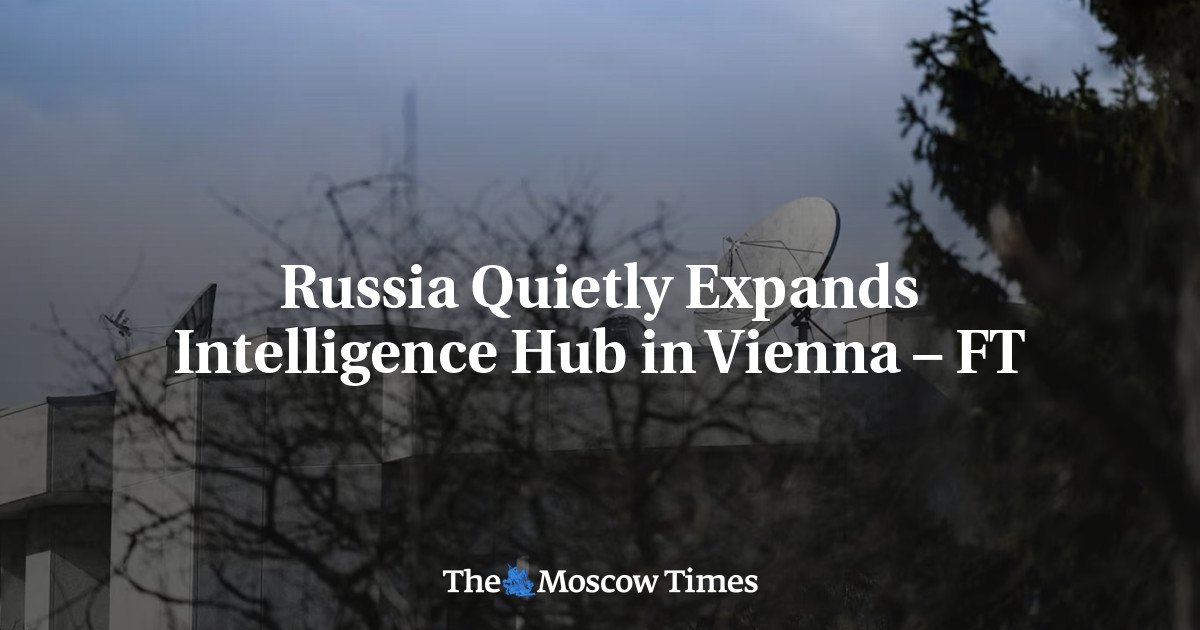
Russia has quietly stepped up its intelligence operations in Vienna, taking advantage of legal loopholes and Austria’s neutrality to expand what Western officials describe as one of its largest covert signals intelligence platforms in the West, the Financial Times reported.
While European countries have expelled hundreds of Russian diplomats since Moscow’s invasion of Ukraine, around 500 Russian diplomats remain in Austria, with roughly a third believed by authorities to be engaged in intelligence work, the report said.
Numerous satellite dishes have appeared on rooftops of Russian-owned buildings in Vienna, including non-diplomatic sites, over the past two years, the newspaper reported.
“It’s one of our main concerns about Russian activity here. We know they have been targeting NATO government and military communications with what they’ve got,” an anonymous senior European diplomat based in Vienna told the FT. “Vienna has really taken on a lot of importance for them … it’s their hub in Europe.”
A key site is a large Russian compound on the Danube, jokingly called “Russencity,” whose location offers advantageous access to satellite communications, according to Vienna-based researchers cited by the FT.
While satellite dishes are standard for diplomatic communications, a Western intelligence official cited by the FT said Russian installations in Vienna are used more actively to monitor signals from multiple satellites.
In one instance, a large rooftop dish was observed changing orientation around the time of the Munich Security Conference in February before returning to its previous position after the event ended, the report said.
Austria hosts several international organizations including the United Nations, OSCE, IAEA and OPEC, making Vienna a high-value intelligence target.
“The technical capabilities and adaptable alignment of the Russian Federation’s SIGINT stations [in Vienna] pose a significant security risk in counter-espionage,” Austria’s domestic intelligence service has warned.
But although Austrian law limits prosecution of espionage to cases involving national interests, an Austrian official told the FT that Vienna shares information about suspected Russian activities with its European partners.
Read this story in Russian at The Moscow Times’ Russian service.


