



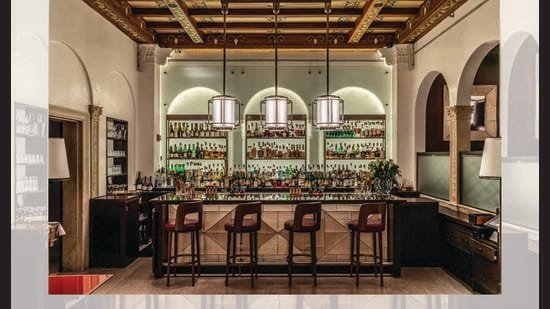
In the West (and especially in America) a restaurant reservation can be the social equivalent of a gold brick. To be able to get a table at a top restaurant is a mark of status. People will wait weeks or months for a reservation. Some restaurants will operate a dual reservation system: Preferred customers (the rich or the famous) will be given a secret number to call when they need a booking. Ordinary punters will use the general number and will only be offered tables at awkward times on weekdays, when business is slower.
For instance, when the New York restaurant, Daniel, had three Michelin stars, no tables for after 6.30pm were available on the normal reservation line. (Daniel has since been knocked down to one star and is no longer as desirable a destination.) In its heyday, Ma Maison in Los Angeles would brag that its phone number was unlisted, so to even try to book a table, you had to be part of some secret circle.
The principle still holds but the technology has changed. People now book tables on the internet, so top restaurants hold back some tables while putting the rest on the net. The tables they hold back go to select customers or (increasingly) to concierges at luxury hotels. That is how a concierge can usually get you into a restaurant with two days’ notice even though the website says there are no tables available for the next three months.
Inevitably, when technology changes, so do some of the rules of the game. Top restaurants will offer reservations for say, the next three weeks on the net. Every single table will be booked within an hour or even less. Some of these bookings will be made by scalpers who will then resell the reservations at a premium; the restaurant version of buying movie tickets in black. Some websites will even operate a grey market for dinner.
We used to regard the reservations culture as an entirely Western phenomenon. Some years ago, when Kapil Chopra and I started Eazydiner, a restaurant reservation service, industry veterans asked us the obvious question: Who would be interested in a reservation site when most Indians just turn up at a restaurant and expect to find a table? And in fact, in those days, there were only two significant restaurants in Delhi where you had difficulty finding a table: Bukhara and Indian Accent. The rest always had room.
We would respond that while this might be true, we were confident that things would change as time went on. Frankly, we were more hopeful than we were confident. But when I look at the restaurant scene today, I am astonished by how time has vindicated our position. In almost every major city in India you cannot expect to just turn up at a top restaurant and find a table. If you have not booked, you will probably be turned away. And getting a booking can be incredibly difficult.
The trend began with Indian restaurants abroad. In London, it’s hard to get into Gymkhana despite its size. In Bangkok, Gaggan is the city’s most expensive restaurant and still remains the hardest to book. In New York, it’s even crazier. Semma and Bungalow are almost impossible to book. Tables are sold out within minutes of becoming available on the net. The New York Times once did an entire story on how hard it is to score a table at Semma. Bungalow keeps some tables for walk-ins, and people queue up for hours hoping to get in. (Vikas Khanna often goes out of the restaurant to talk to the people who are queuing up and to offer them free snacks.)
The reservation trend has finally spread to India. The two hardest restaurant reservations in India are Papa’s in Mumbai and Naru in Bengaluru. Both are smallish restaurants, so even if you are well connected, it does not help. They cannot conjure up seats out of nowhere if they are full. Unless you plan weeks in advance, you won’t get in. If, like me, you are never sure when you will next be in Mumbai or Bengaluru, you can abandon all hope of eating at Papa’s or Naru. (I have only got into Naru once, and have never been to Papa’s since it opened to the public.)
It’s much the same with other top Mumbai restaurants at dinner time. You can’t hope to just walk into Masque, The Table, Kasper’s, Izumi, Americano or even to Bastian, where the food will win no awards, but which probably makes more money than all the other top restaurants put together.
In Delhi, Bukhara and Indian Accent are still at the top, but they have been joined by several others. Nisaba is very hard to get into and even very new restaurants such as the South Indian Nadoo will not be able to seat walk-ins at dinner.
The trend has reached the quieter cities. You won’t get into Avartana in Chennai unless you book, and Sienna in Kolkata is such a rage that tables are hard to come by.
What accounts for this turnaround? The short answer is that the dining scene in India is changing much faster than we sometimes realise. Hotel restaurants are no longer at the cutting edge and are rarely seen as immensely desirable places to go to. There are exceptions – Bukhara and Avartana for instance – but the general rule holds.
We used to say, in the old days, that Indians only go out to eat two cuisines: Chinese and North Indian. Both cuisines are still very popular but apart from the obvious exceptions (Bukhara again) old-style Punjabi restaurant food no longer remains at the top. People are more adventurous when it comes to food: The modern Indian cuisine of Nisaba is one example. So are the South Indian flavours of Avartana and Nadoo.
As for Chinese, it seems to have lost its cachet at the top, in keeping with global trends.There are many successful Chinese restaurants and some even have very good food (Delhi’s China Kitchen for example), but they are not the kinds of places you have to book weeks in advance. They usually have room for walk-ins.
So, what makes a restaurant hard to get into? My guess is that to reach that level you have to offer something that nobody else (or very few restaurants, at any rate) can provide. Nobody even attempts to cook ramen with the precision and attention to detail that characterises Naru. There is no restaurant in India that offers the same experience as Johnson Ebenezer’s Farmlore in Bengaluru. Varun Totlani at Masque is a singular talent. The Italian food at Americano combines traditional authentic Italian dishes with the dazzling originality that the chef Alex Sanchez brings to Italian flavours.
And yes, chefs are more important than ever. More and more owners are recognising this. Nisaba was a success from the day it opened because of Manish Mehrotra’s reputation. The husband and wife team behind Masque, Aditya and Aditi Dugar, told me that they were clear that it had to be a chef-driven restaurant right from the start. At Hunger Inc, the partners are content to remain backroom boys and to let chef Hussain Shahzad be the face of O Pedro, Veronica’s, The Bombay Canteen and Papa’s.
Are we going to get to the stage they are at in America, where the top restaurants keep tables reserved for celebrities and high rollers? I don’t think so. The best thing about the new generation of restaurants is that they have turned their backs on the VIP culture of five-star hotels. They let the food speak for itself.
From HT Brunch, June 27, 2026
Follow us on www.instagram.com/htbrunch


